


The book, titled *Y a-t-il des leçons de l'histoire?* in French, was released internationally in 2025. This nearly 100-page work contains reflections from philosopher Edgar Morin, distilled from over a century of living through the era's many ups and downs. In Vietnam, the local edition, titled *Lich su lieu co day ta dieu gi? Mot suy tuong ve hien tai va tuong lai nhan loai* (Does History Teach Us Anything? A Reflection on Humanity's Present and Future), was translated by Nguyen Sinh Vien and published by Ha Noi Publishing House in collaboration with Omega+ in march.
The work is structured into 16 main sections, each corresponding to a lesson, and three supplementary chapters. Each lesson begins with the author's perspective, followed by arguments, interspersed with stories of notable events and figures as evidence. For some content, the thinker states he drew insights from lectures given by his university professors.
Through his complex thought approach—one of Edgar Morin's renowned theories—he illustrates that humanity's progress is neither linear nor deterministic. Instead, it harbors many paradoxes; things that seem impossible can occur, such as destroyers also being civilization builders, or myths influencing history.
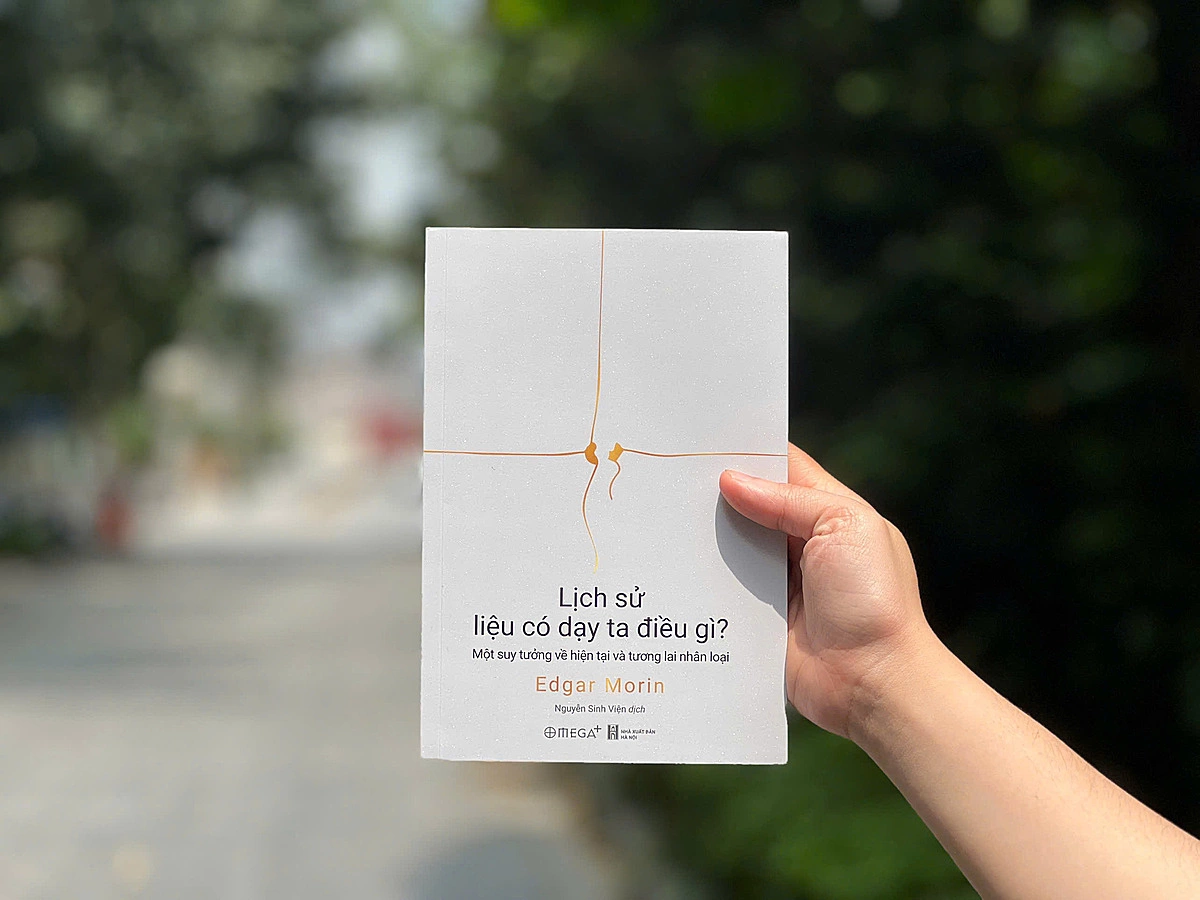 |
The white thread on the book cover symbolizes the continuous but non-linear flow of history. Knots represent paradoxes and events that can alter humanity's future. According to the publisher, the minimalist cover design emphasizes the book's contemplative spirit: "History is not a closed truth, but an ever-open question." *Photo: Omega+* |
In the introduction, Edgar Morin describes the book as the result of many years spent pondering what history can teach humanity. According to the local publisher's introduction, the work is "the contemplative voice of an intellect who has lived fully through the century, where each lesson is not just a reflection on the past, but a profound reminder of how humans understand and act in today's uncertain world."
On Amazon and Goodreads, the French edition received ratings of 4,5/5 and 3,6/5 stars, respectively. A Goodreads account from France noted that the author's perspective helped them connect various historical events across different cultures, praising the accessible writing style. However, some word usage in the book is considered outdated, though deemed appropriate for the author's generation. Some readers also found the lessons interesting but too concise, lacking full development. This reader suggested the work felt more like a collection of notes than a thorough research project.
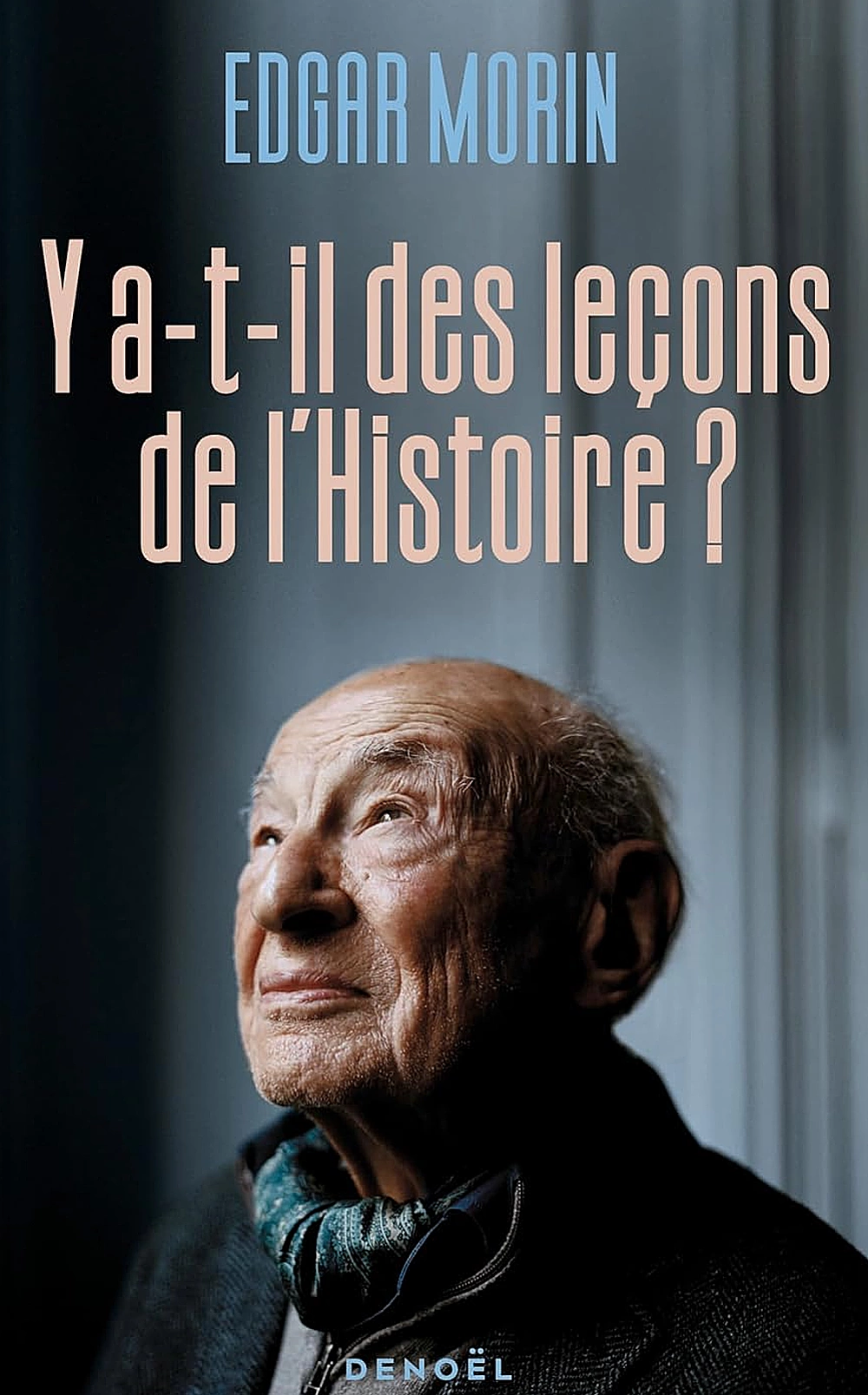 |
The French edition of *Does History Teach Us Anything?* A portrait of philosopher Edgar Morin is printed on the cover. *Photo: Denoel* |
Edgar Morin, born in France in 1921, grew up in a Jewish family. His birth name was Edgar Nahoum, and he is known as an eminent French philosopher and sociologist. During the German occupation of France, he joined the resistance, adopting the nom de guerre Morin, which he has used ever since.
Starting in 1949, he embarked on his research career, contributing numerous academic works to the world across diverse fields such as media, politics, anthropology, and ecology. Edgar Morin is also renowned for his complex thought theory—an interdisciplinary approach that offers a multi-dimensional, interconnected, and non-reductive view of the world. According to Goodreads, he has published about 60 books, though they are not widely known in the US due to limited English translations. His books are popular in French-speaking countries, Europe, and Latin America.


