According to Sina, the advancement of technology offers users the opportunity to create videos based on their imagination and aesthetic preferences. Since the beginning of the year, many have released short films adapted from Jin Yong's wuxia novels, with some videos receiving positive feedback for their visual effects.
On Weibo on 3/8, the keyword phrase "AI creates my ideal The Return of the Condor Heroes" became a trending topic. Thousands of viewers noted that a key strength of AI films is their ability to render majestic mountain landscapes, vivid condor imagery, and grand battle scenes that align with the imaginative world of martial arts in Jin Yong's stories.
A one-minute film created by Faye Glide garnered praise for its romantic and beautiful aesthetics. Wuxia fans wrote, "The video isn't perfect yet, but I'm eagerly awaiting a complete AI-generated 'The Return of the Condor Heroes'. The wave of technology is unstoppable; a new era of filmmaking is on the horizon."
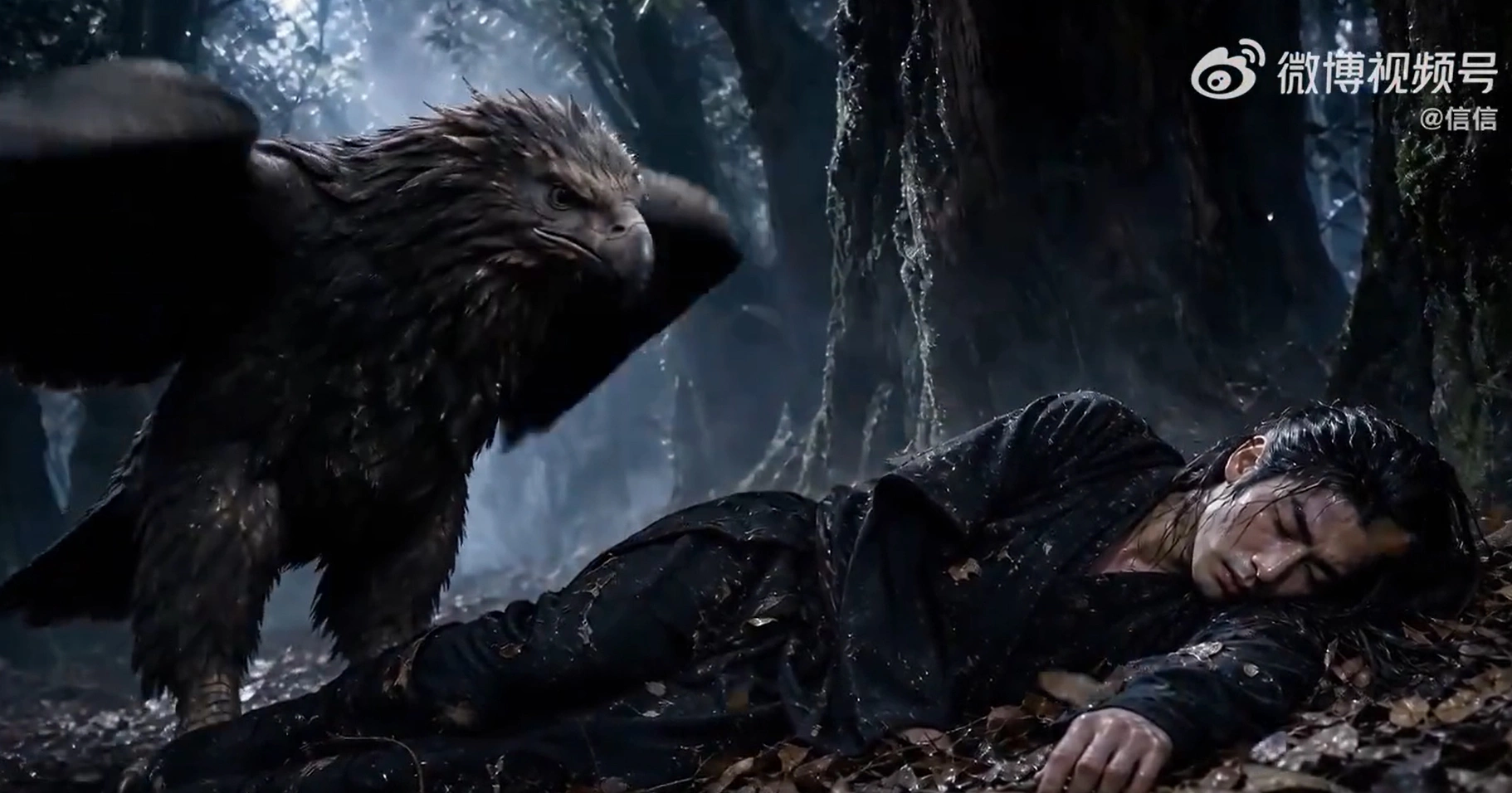 |
The Condor and Yang Guo, as imagined by readers of Jin Yong's stories. Photo: Weibo |
However, the expressions and charisma of characters Xiaolongnu and Yang Guo were criticized as monotonous. The AI version of Xiaolongnu "failed to capture the cold, ethereal demeanor embodied by Li Ruotong's portrayal."
Jin Yong's novel, "The Return of the Condor Heroes", has been adapted into films more than 10 times. Television versions from the 1980s and 1990s were immensely popular, leaving a lasting impression on generations of viewers in several Asian countries. The story revolves around the intricate love affair between Xiaolongnu and the hero Yang Guo. In the novel, Jin Yong portrays the female protagonist as pure, cold, and ethereal, a result of her secluded life in an ancient tomb.
Beyond Jin Yong's wuxia world, many viewers also anticipate Chinese mythological stories appearing on the big screen with AI-generated versions. In June, Utopai, an American AI company, announced a partnership with China's Huace Media to create an AI-animated film, "Journey to the West: 500 Years Lost". The film explores Sun Wukong's confinement at the foot of a mountain, explaining his humility and willingness to protect Tang Sanzang on the journey to retrieve scriptures.
According to Xinhua, in July, major Chinese television stations such as Dongfang TV and Zhejiang TV for the first time aired AI films like "Legend of the White Snake" and "Peach Blossom Pond", marking a turning point for AI-generated films from mobile screens to television broadcasts.
Li Xiao, an associate professor of Film Studies at the Beijing Film Academy, described this as a brave experiment by traditional media in their development, boosting the popularity of AI content. According to him, at its core, the purpose of these broadcast films is to tell stories in a new format, thereby transmitting traditional culture.
By Nhu Anh