Last week, "Hop Long" secured the gold award at an artificial intelligence content creation competition. The film received a cash prize of 1 million yuan (nearly 3,9 billion VND) and an equivalent 1 million yuan in funding for future productions.
Douyin, a video platform, launched the competition in June, attracting over 170,000 entries. "Hop Long" was created by 2XLabs, a small team experienced in traditional film production.
According to Sohu, 2XLabs spent one and a half months developing their entry, from concept to completion. The script alone took over one month. Generative AI created the visuals in one week, and post-production also took one week.
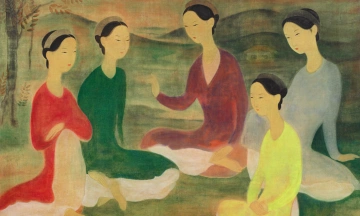
Inspired by the ancient painting "Fu Chun Shan Ju Tu", the film tells the story of a young girl who finds a fish that has become a spirit. The fish reveals a woman resembling the girl lives across a river, trapped because a bridge collapsed and a monster prevents its reconstruction. The girl and villagers then seek to defeat the monster to reunite the bridge and connect the two shores.
WallStreet (China) reported that for the opening scene, the director aimed to evoke a sense of detachment from the modern world through the image of a fisherman. The team used AI to test hundreds of visual options, including dawn, dusk, and twilight scenes. This process, which traditionally demands elaborate coordination of setting, lighting, and scheduling, was condensed into the AI image generation phase.
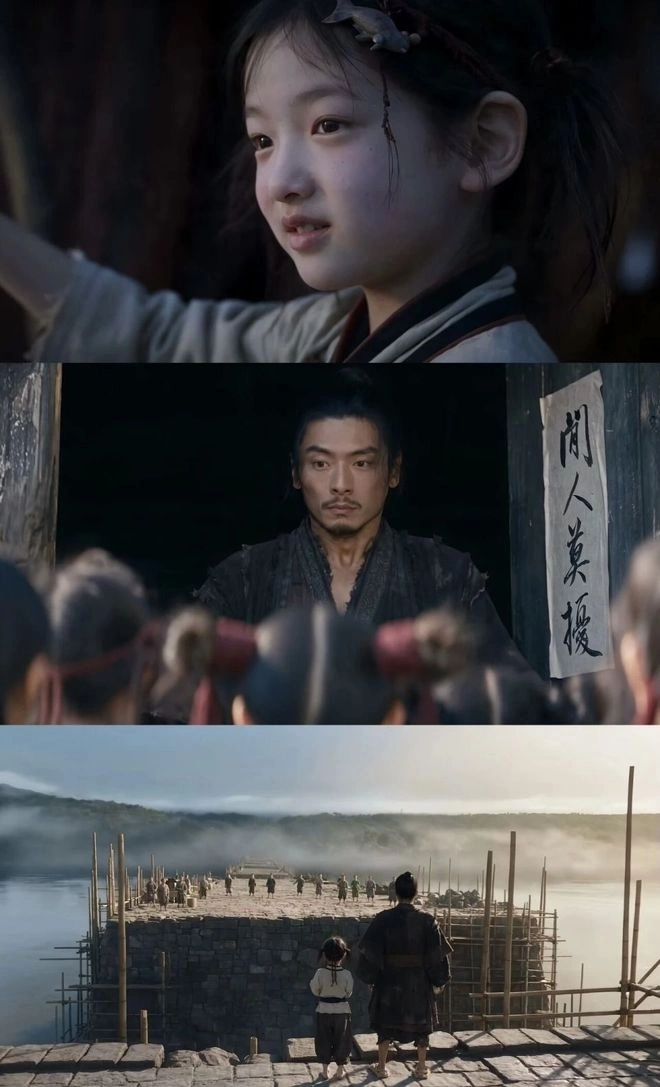 |
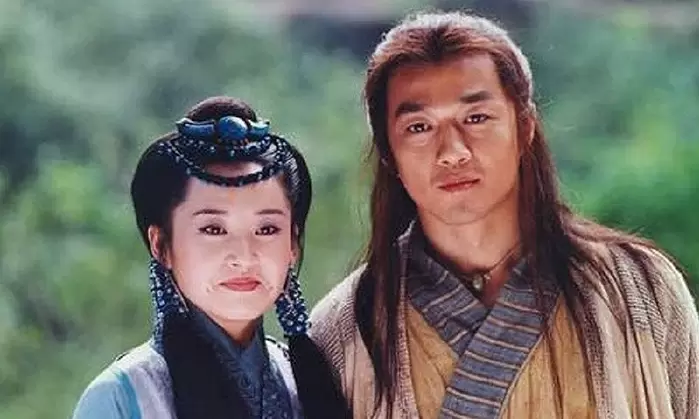
Characters in "Hop Long". Photo: Weibo |
HK01 noted that "Hop Long's" artistic style and visual effects rival those of fantasy films. Characters and animals are vividly portrayed, with settings combining ink wash painting and realism, rich in ancient Chinese character.
The production timeline—one month for the script versus one week for image creation—highlights a new characteristic in current film production: AI significantly shortens the time for "image realization" but does not reduce the essential human cognitive time. While AI lowers production barriers, it does not diminish the need for strong storytelling. Those with compelling stories will find faster recognition through this new technology.
Douyin's video production competition is part of its "AI Creative Wave" initiative, launched in September 2025, to encourage artificial intelligence content. Over the past year, over 1,6 million people have participated, with videos garnering over 140 billion views.
Chinese companies are actively competing to develop AI-generated television series and films. Earlier this year, Ton Trung Hoai, CEO of Tencent Video, predicted 2026 would be a pivotal year for the explosion of AI feature films. Cung Vu, CEO of Iqiyi, stated that the market would see a hit AI feature film by this autumn at the latest.
On 27/9, Bona Film released the trailer for "Sanxingdui: Past and Future", announcing its release on 23/10. This marks the first AI film to receive a nationwide theatrical release license in China. All characters in the film are entirely AI-generated. The film revolves around the Sanxingdui archaeological site, originating from the ancient Shu civilization, which flourished in the Sichuan Basin and Chengdu Plain around 3,000 BCE.
The story of "Sanxingdui" spans space and time. Modern archaeologists discover that characters carved on ancient bronze artifacts are binary code not belonging to that era. Three millennia later, the world faces a crisis as super AI sweeps the globe, leaving humanity reliant on algorithms. An archaeologist then discovers the key to resolving this crisis lies in 7 characters found on the bronze artifacts at Sanxingdui.
Nhu Anh