* This article contains spoilers.
The film, directed by Korean-Japanese filmmaker Lee Sang Il, adapts Shuichi Yoshida's 2018 novel. Set in the 1960s kabuki theater world, it follows two actors striving for the "living national treasure" title, an honor for masters of traditional arts.
Satoko Okudera's screenplay focuses on onnagata, male actors specializing in female roles in kabuki, a tradition dating back to the 17th century when women were banned from the stage. After witnessing his yakuza boss father's death in Nagasaki, Kikuo (Ryo Yoshizawa) moves to Osaka. He apprentices under Hanjiro (Ken Watanabe), a renowned kabuki actor. Kikuo grows up alongside Shunsuke (Ryusei Yokohama), Hanjiro's biological son. They are both stage partners and professional rivals.
Though both aim to become Japan's number one kabuki artist, their starting points differ. Shunsuke, born into a theatrical family, is seen as an heir. Kikuo, an outsider with a complex past, enters the profession through effort and innate talent. In the kabuki world, lineage often dictates a career path, so Kikuo's emergence disrupts the established order. His talent quickly gains recognition from his teacher, causing Shunsuke, who was expected to continue the family tradition, to face a crisis.
Their lives resemble two constantly reversing spirals. At times, Kikuo surpasses Shunsuke through sheer ability, only for Shunsuke to regain his position with support. The director highlights a paradox in kabuki: despite talent, artists struggle to overcome the barrier of family tradition.
A key theme is the loneliness of artists pursuing greatness. In an interview with Japan Times, director Lee explained that the "living national treasure" title in the film can signify a person's ability to perceive what others cannot. Yet, achieving such a level demands a high price. Artists spend decades striving for glory, but the further they advance, the more isolated they become. Kikuo once stated his readiness to sacrifice everything to become a kabuki master, comparing it to "a pact with the devil" that cost him his family, mentor, confidants, and loved ones. When his daughter questions how many people he sacrificed for his position, the query echoes as an accusation. In the film's final scene, as Kikuo performs the "Sagimusume" (The Heron Maiden) play, behind the brilliance and applause lies a long silence of solitude.
The director omits much of the internal monologue from the novel, instead using kabuki plays to reflect psychological developments. The "Sekinoto" (Barrier Gate) play opens the story, foreshadowing Kikuo's rise. "Renjishi" (The Two Lions) mirrors the relationship between a strict father and his highly anticipated son. "Ninin Fuji Musume" (Two Wisteria Maidens) marks Kikuo and Shunsuke's first joint stage appearance, silently competing.
The "Ninin Dojoji" (Two Maidens at Dojoji Temple) play underscores their complex relationship. In the play, the maiden's suppressed love, transforming into rage, becomes a metaphor for their interwoven bond and rivalry. When the play appears a second time, after both have experienced many upheavals, their emotions shift from competition to understanding.
"Sonezaki Shinju" (The Love Suicides at Sonezaki) is the film's most crucial performance. The love O-Hatsu has for Tokubei in the play reflects Kikuo's dedication to kabuki. The lovers' death symbolizes the protagonist's complete devotion to art. In a later performance, when Shunsuke takes on the role while gravely ill, the work becomes his tragic farewell to the stage.
The film concludes with "Sagimusume" (The Heron Maiden), considered the pinnacle of onnagata art. As Kikuo performs after receiving the national treasure title, paper snowflakes fall onto the stage, recalling the scene he pursued for over half a century. But in the moment his dream is realized, he stands alone.
The cast's performances are a major highlight. Ryo Yoshizawa, as Kikuo, portrays an ambitious character willing to exploit those around him for his passion. Yoshizawa opts for a restrained acting style, with a subtle facial expression that creates a sense of detachment. According to Vogue Hong Kong, the actor spent over one year training in singing and dancing. This effort is evident in the "Sagimusume" segment, where Kikuo completes the entire performance.
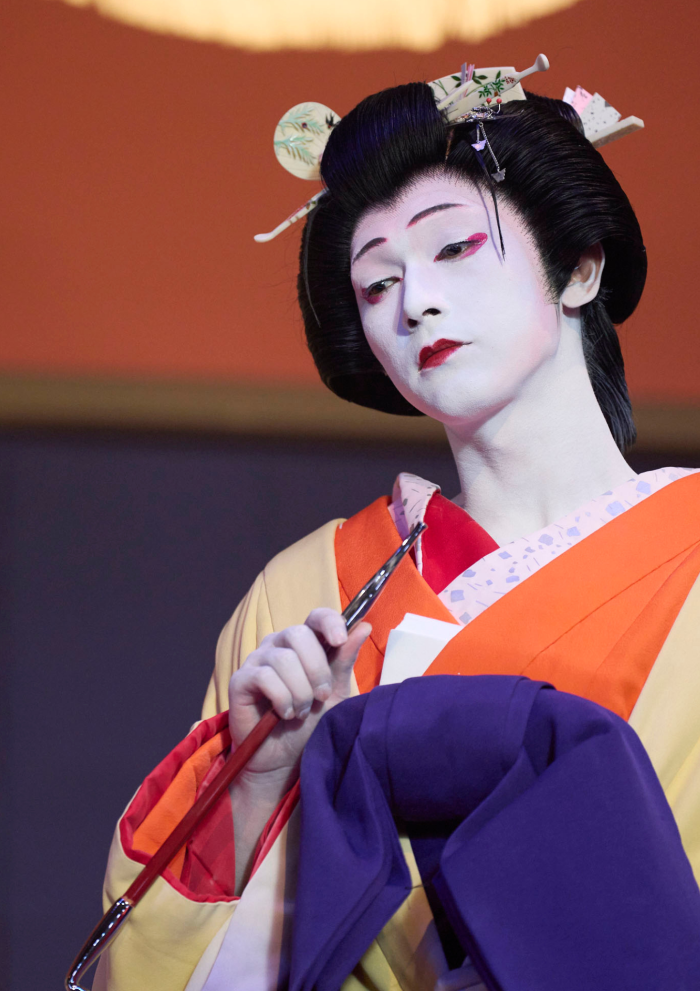 |
Actor Yoshizawa Ryo in "Kokuho". Photo: GKIDS |
On Japan Times, director Lee stated he invited the actor to participate around 2019-2020, before the project secured funding. According to the director, Yoshizawa's demeanor aligns with the Kikuo in the novel: a calm exterior with an unpredictable inner world.
Ryusei Yokohama presents a contrasting image to Kikuo. He conveys the pressure of an heir, carrying both pride and insecurity when encountering a rival. Actor Ken Watanabe contributes depth to the story as the teacher. His character faces a choice between bloodline and talent upon realizing his adopted son possesses greater potential than his biological son.
With a runtime of nearly three hours, "Kokuho" impresses with its aesthetically rich staging. The crew interweaves close-ups of actors' faces and bodies with wide shots of the stage, highlighting each performance movement. Cinematographer Sofian El Fani uses a vibrant color palette to enhance Yohei Taneda's art direction and Kumiko Ogawa's costumes. Each kabuki play features on-screen titles in Japanese, with English translations and plot summaries, helping international audiences access stories often centered on love, hatred, and tragedy.
According to Screen Daily, despite its melodramatic tone and dramatic plot points, the film offers a compelling insight into kabuki art. "As the film concludes with Kikuo's performance, many viewers – including those new to this art form – may grasp some of the beauty and depth of Japanese culture," the publication wrote. Los Angeles Times noted the film's distinction in weaving backstage drama with a coming-of-age narrative. The director offers a perspective on the dark side of fame, avoiding romanticizing the path to stardom. However, in the second half, the film sometimes overemphasizes dramatic climaxes, making the pacing heavy and repeating some tragic elements. These intense events accelerate the film's rhythm, diminishing the subtlety of its earlier construction.
Cat Tien