On 3/2, the Prime Minister signed a decision recognizing the stone Buddha altar at Huong Trai Pagoda, also known as the lotus stone pedestal, as one of 30 new national treasures. Dating back to 1370, this significant artifact is preserved at Huong Trai Pagoda in Duong Hoa, Hanoi, a site established in the mid-14th century.
The Cultural Heritage Department considers this altar a "rare artifact," deeply connected to the history of Dai Viet Buddhism during the Tran dynasty. It stands as the largest among seven Buddha altars with absolute dating from the latter half of the 14th century found in Vietnamese pagodas. For example, the Buddha altar at Dai Bi Pagoda (1374) is 129 cm high, with a surface length of 266 cm, a base length of 261 cm, and surface and base widths of 118 cm and 134 cm, respectively. The Buddha altar at Ngoc Dinh Pagoda (1375) is 136 cm high, 276 cm long, and 135 cm wide. In contrast, the Buddha altar at Huong Trai Pagoda is 112 cm high, with a pedestal surface length of 368 cm, a base length of 398 cm, a pedestal surface width of 132 cm, and a base width of 159 cm. Its unique form, intricate carving techniques, and decorative patterns set it apart.
The altar features a multi-tiered structure, assembled from stone slabs arranged in a zigzag pattern and linked by dovetail joints, creating a stable and majestic form. Its surface is rough, slightly concave in a kite shape, with four corners gently rising. This design breaks from rigid squareness, lending a soft quality that distinguishes it from other altars made of stone, wood, terracotta, or bronze from various Vietnamese historical dynasties. While largely intact, a lotus petal on the right corner of the pedestal is broken, some stone slabs show horizontal cracks, and the bottom base is partly obscured due to past renovations that raised the Upper Sanctuary’s foundation.
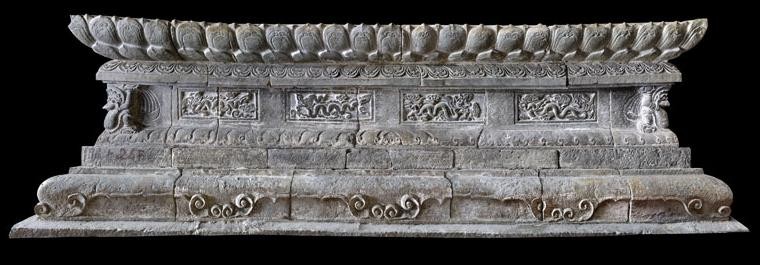 |
Front view of the national treasure. Photo: *Cultural Heritage Department* |
Elaborate decorative patterns adorn three vertical surfaces of the altar, featuring motifs like double lotus petals, dragons within rectangular frames, chrysanthemums, swirling vines, and water waves. Three layers of "plump, robust, and stable" double petals encircle the three faces, forming a blooming lotus. Artisans carved soft lines along the edges, extending from the base to the pointed tips, curving into double spirals centered with a stylized flower.
A prominent feature is the carving of the mythical bird Garuda at the four corners of the altar's body. Depicted as a strong yet soft boy, Garuda embodies extraordinary power. The figure is shown seated, with a human head, round bulging eyes, and the character "Vuong" (King) subtly carved on the forehead, signifying the deity's supreme authority. Garuda has a thick, short beak, a lion-like nose, a swollen belly, and muscular calves and arms. Its two raised hands, with tightly gripping fingers, support the lotus pedestal. Its legs are spread to the sides, pressing downwards as if bearing a heavy load. Rings adorn its wrists and ankles, and its wings are carved in low relief, pressed against the altar's two sides.
The altar's reverse side is plain, largely covered with inscriptions, some of which are faded and illegible. These inscriptions record the names of individuals who donated money and land to the pagoda in Dai Tri 3 (1360) and specify the altar's construction date as Dai Dinh 2 (1370).
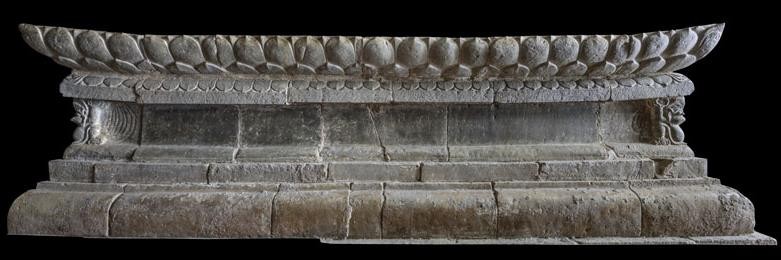 |
Rear view of the stone Buddha altar at Huong Trai Pagoda. Photo: *Hanoi Department of Culture and Sports* |
Researchers note that the patterns on late 14th-century stone Buddha altars, including the one at Huong Trai Pagoda, are not as intricate or fluid as those from the Ly dynasty. Instead, they exhibit "round, plump, simple, and airy forms refined to the highest degree." These extensive patterns on the three surfaces effectively reduce the overall heavy appearance of the altar.
The inscriptions also provide crucial historical and cultural information, supplementing both official and unofficial histories. This data is particularly valuable for understanding the administrative structure, official ranks, place names, family lineages, land tenure systems, and the development of Buddhism during the Tran dynasty.
The Cultural Heritage Department emphasizes the altar's role as an invaluable historical marker, offering insights into stylistic transitions across various dynasties. It serves as a continuous constant, enduring alongside the Huong Trai Pagoda since the mid-14th century.
Phuong Linh