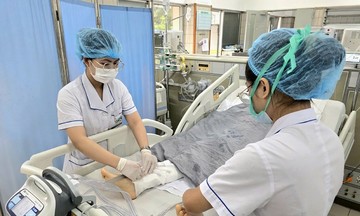
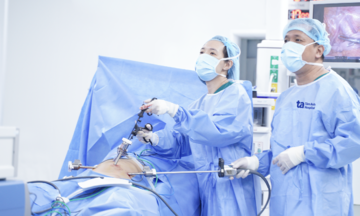
On 21/2, Associate Professor Doctor Pham Ngoc Thach, Deputy Director of Nhi Dong 2 Hospital, reported that the patient was admitted due to intermittent lower abdominal pain that had lasted for over two months. The girl had been almost unable to urinate for two days, experiencing abdominal distension and constipation. Doctors performed emergency catheterization, noting approximately 1,5 liters of urine retained in her bladder—a volume rarely seen in children.
The patient showed signs of puberty, such as breast development, but had never menstruated. A physical examination of her external genitalia revealed an imperforate hymen, which was swollen and had an unusual bluish-purple color. An ultrasound confirmed dilated vagina and uterus due to accumulated menstrual blood, forming a mass that compressed the bladder and ureters. This condition had caused her left kidney to begin dilating, indicating an impact on her urinary system.
Doctors performed surgery to incise the hymen, releasing the accumulated menstrual blood. Following the intervention, pressure on the bladder and kidneys rapidly decreased. The patient’s abdominal pain resolved, urination returned to normal, and her kidney was no longer compressed. Twenty-three days after the surgery, the girl experienced her first menstruation.
 |
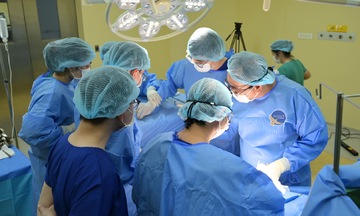
Doctors in the operating room at Nhi Dong 2 Hospital. Photo: Quynh Tran
According to Doctor Thach, imperforate hymen is the most common congenital defect among abnormalities causing vaginal obstruction, yet it is often overlooked. Menstrual blood is produced regularly but cannot exit, becoming trapped within the body and gradually increasing over time. Children are often only brought for examination when complications arise, such as abdominal pain, urinary retention, or constipation, as these symptoms are frequently mistaken for digestive issues or urinary tract infections. Normally, the hymen has one or several small openings to allow menstrual blood to exit during puberty.
Each year, Nhi Dong 2 Hospital records nearly 10 similar cases. Most are detected during puberty, and the majority already present with complications. If diagnosed late, this condition can lead to kidney damage, infection, and fallopian tube inflammation due to menstrual blood accumulation, increasing the risk of affecting future fertility.
Doctors advise parents to pay more attention to their adolescent daughters, as children often feel shy, embarrassed, and tend to hide symptoms. Early medical attention is crucial if parents observe signs such as puberty without menstruation by 14-15 years old, recurrent and cyclically increasing lower abdominal pain, urinary retention or difficult urination, prolonged constipation of unknown cause, or the appearance of an abnormal bulging in the external genitalia.
Le Phuong