Many individuals only discover they have had a myocardial infarction when the first angina attack occurs. However, Traditional Eastern Medicine experts suggest that certain facial features can help identify this risk early.
According to the traditional belief that "appearance reflects inner health", external changes are closely linked to internal organ health. Doctor Hoang Thien Thuy, a Traditional Eastern Medicine practitioner, explains that by using "vong chan" (observing facial expression and shape), doctors can assess the stability of a person's circulatory system and cardiovascular function.
Clinically, however, doctors do not rely solely on facial diagnosis to conclude illness. They combine it with inquiries about symptoms such as chest tightness, palpitations, sharp chest pain, and shortness of breath, along with blood pressure, blood lipid, and blood sugar readings.
Here are three facial characteristics that warn of cardiovascular disease risk:
A diagonal crease on the earlobe, known as "ranh vanh tai" in Traditional Eastern Medicine and "Frank's sign" in Western medicine, indicates a potential heart health issue.
Doctor Hoang Thien Thuy states that modern medical studies show individuals with an earlobe crease have a significantly higher incidence of ischemic heart disease and stroke compared to those without this sign.
A deep vertical crease between the eyebrows, referred to as "huyen cham van" (hanging needle mark), suggests chronic stress or poor qi and blood circulation to the heart.
The area between the eyebrows is called An Duong. In optimal health, An Duong is smooth, flat, and wrinkle-free. When a deep vertical crease appears in this region, resembling a suspended needle, it signals that the body is experiencing chronic stress or has inadequate qi and blood flow to the heart.
Horizontal creases at the nasal root, known as "son can hoanh van", indicate significant pressure on the cardiovascular system.
The area between the inner corners of the eyes, where the bridge of the nose begins to rise, is called Son Can. If this Son Can region is sunken or displays small horizontal wrinkles, it is a sign of "son can hoanh van", warning that the cardiovascular system is under considerable strain.
Modern medicine's dangerous myocardial infarction shares similarities with "tam thong" (heart pain) or "hung be" (chest tightness, obstruction) described in ancient Traditional Eastern Medicine texts.
For prevention and supportive treatment, Traditional Eastern Medicine often uses herbs like cuu cam thao thang, dan sam, tam that, and hong hoa to activate blood, resolve stasis, and promote blood circulation. However, a specialist doctor must examine and prescribe the correct dosage; people should never self-medicate.
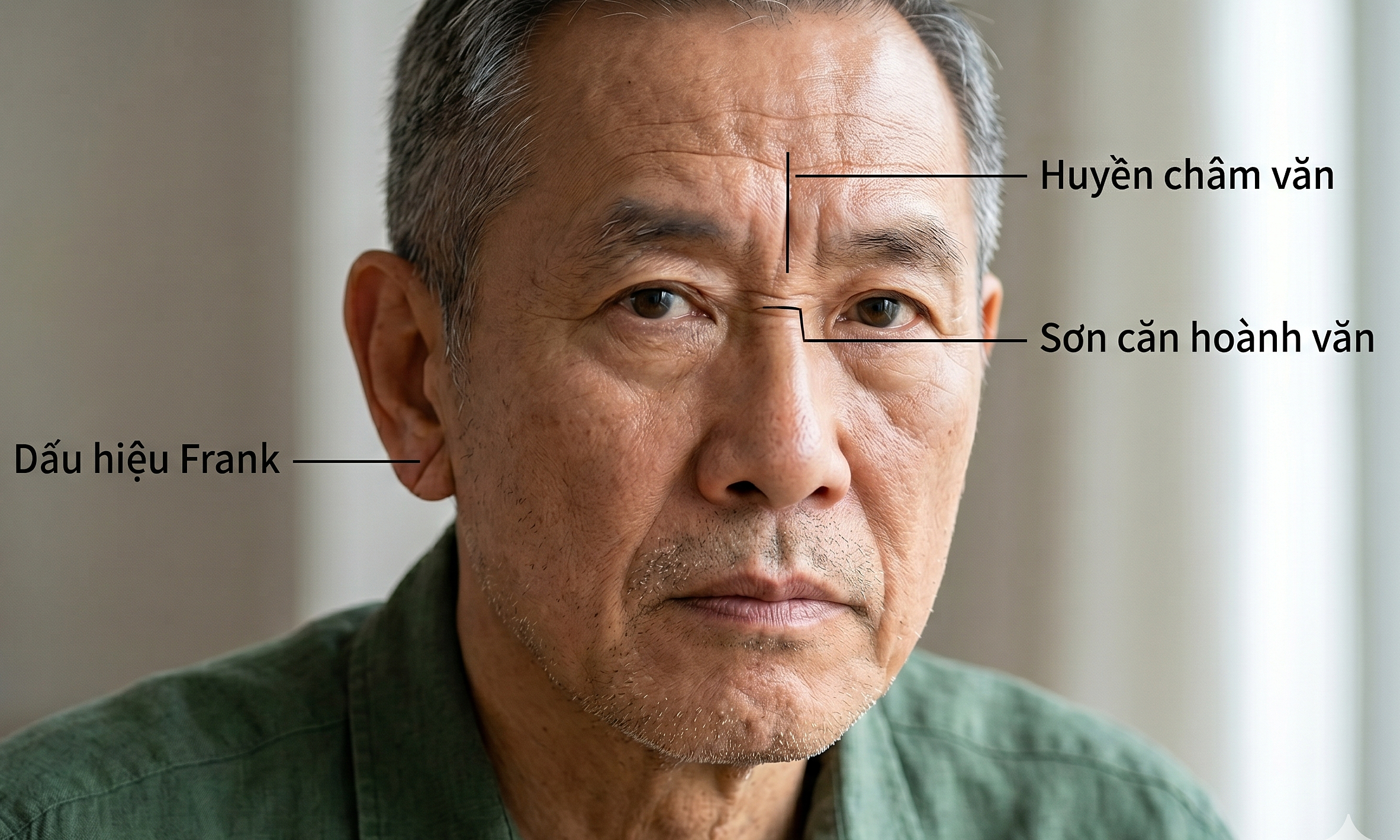 |
Three facial signs warning of cardiovascular disease risk are a diagonal crease on the earlobe, a vertical crease between the eyebrows, and a horizontal crease at the nasal root. *AI-generated image* |
Additionally, individuals can proactively protect their daily cardiovascular health with two simple methods:
- Massage two "heart protection" acupoints:
Shen Men acupoint: This point belongs to the Heart Meridian. When the palm is facing upwards, the acupoint is located on the inner edge of the wrist, directly above the wrist crease, on the side of the little finger.
Noi Quan acupoint: This point belongs to the Pericardium Meridian. The acupoint is on the front of the wrist, measuring up the arm about three cun (equivalent to the width of three closed fingers) from the wrist crease, located between two tendons.
- The heart-nourishing formula "Sinh Mach Am": This is a classic herbal remedy that helps tonify qi and nourish the heart.
Formula: nhan sam 10 g, mach mon dong 6 g, ngu vi tu 4 g.
Preparation: Place all ingredients into 600-1000 ml of water, bring to a boil, then reduce heat and simmer for 15-20 minutes. Let it cool before drinking.
Suggested modifications: Individuals prone to "internal heat" can substitute nhan sam with American ginseng. To enhance the "qi tonic" effect, add hoang ky; to boost the "blood-activating" effect, add dan sam.
Note: Do not drink this formula if you have a common cold or a weak spleen and stomach. Individuals with "three highs" (high blood pressure, high blood lipids, high blood sugar) and pregnant women must consult a Traditional Eastern Medicine doctor before use.
Finally, Doctor Thuy emphasizes that maintaining a healthy lifestyle, limiting late nights, avoiding overly oily and heavily spiced foods, and consistently exercising are the "golden keys" to preserving a healthy heart.
My Y (According to UDN)