Stroke is a leading cause of death in Vietnam for both men and women. Men, who often face more life pressures and frequently consume alcohol and tobacco, have a higher incidence rate than women.
Doctor Dao Viet Phuong, deputy director of the Stroke Center at Bach Mai Hospital, stated, "Stroke can instantly lead to disability or death for many." He advises a quick 30-second check using short questions when someone exhibits unusual signs.
Specifically, ask their name to check speech. Request the patient raise both arms and lift their legs to assess for weakness or paralysis. Ask them to smile and observe for a drooping mouth. Crucially, inquire about the symptom onset time, as this determines eligibility for thrombolytic medication or thrombectomy.
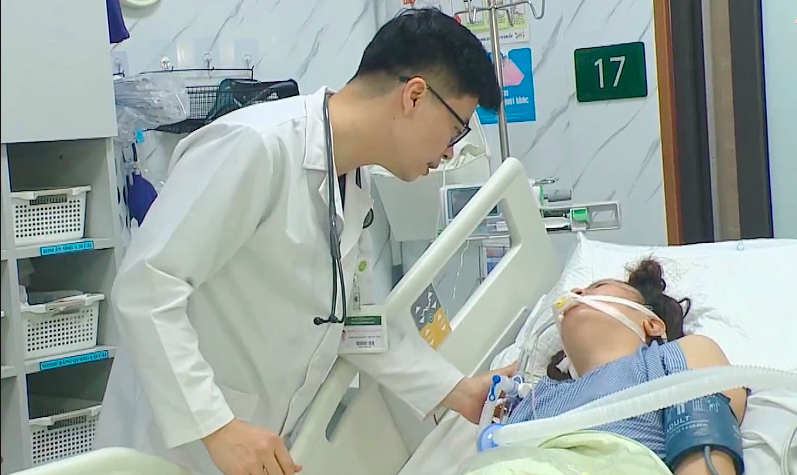 |
A patient receiving treatment at the Stroke Center, Bach Mai Hospital. Photo: Nguyen Chinh |
Doctor Phuong noted that the F.A.S.T rule (facial drooping, arm weakness, speech difficulty, time to call emergency services) is widely recognized for stroke checks. However, some cases present as "F.A.S.T negative"—appearing normal externally, yet the brain is actually in distress.
Some signs warrant special attention, such as blurred vision or loss of sight in one eye. Many mistake this for an eye condition, only to discover a stroke when the "golden hour" for treatment has passed. Patients may also experience severe dizziness, a loss of balance, and unsteady walking, distinct from common dizziness. A "thunderclap headache," a sudden and intense pain, is a critical warning sign.
In emergencies, many resort to unproven methods, inadvertently worsening the situation. Doctors advise against finger pricking, giving lemon juice or anything by mouth, or administering medication without authorization when someone shows stroke signs. Stroke patients are prone to choking, and giving them anything orally can lead to acute respiratory failure.
Furthermore, do not waste time measuring blood pressure or waiting for it to stabilize. Brain cells suffer damage every minute; do not delay. Call emergency services (115) to transport the patient to the hospital as quickly as possible.
Stroke prevention begins with small changes: reducing alcohol consumption, quitting smoking, controlling blood pressure, and adhering to prescribed treatment.
Le Nga