The appearance of fine lines around the eyes and reduced skin firmness at age 25 are early signs of the aging process, primarily linked to a decline in collagen and elastin in the skin. However, your condition represents only mild aging, where the underlying support structure has not yet significantly loosened.
Intervening with a skin lift at this stage can help slow down the aging process, maintain skin firmness, and limit the formation of static, deep wrinkles in the future. It is crucial, however, to choose a method appropriate for your current degree of aging.
Currently, two popular non-invasive skin lifting technologies are HIFU and Sofwave. Both operate on the principle of using ultrasound waves to stimulate collagen production. Each method impacts different depths and is suitable for different skin conditions.
HIFU (high-intensity focused ultrasound) technology creates thermal points in deep layers, such as the superficial musculoaponeurotic system (SMAS). This method is often indicated for obvious sagging skin, thick subcutaneous fat, jowls, double chin, and for lifting and reshaping facial contours.
For individuals under 25 whose skin does not show clear signs of loosening, HIFU intervention may not be truly necessary. However, after age 25, as skin loses collagen each year and aging gradually becomes more apparent, using HIFU technology also serves as a preventative measure against sagging skin, helping to maintain stable skin firmness.
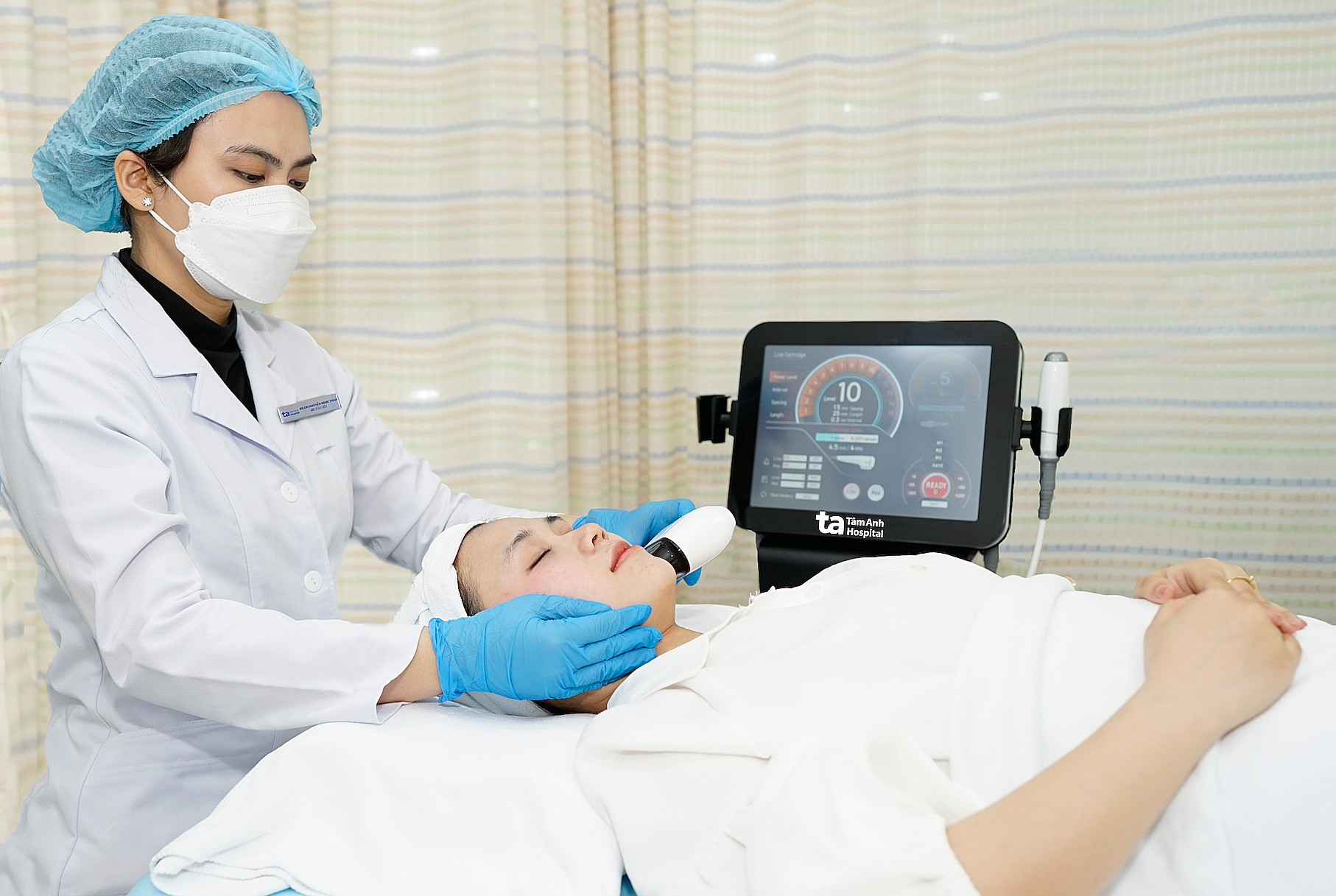 |
Doctor Tran uses HIFU focused ultrasound to improve aging, sagging skin. Illustration: Tam Anh General Hospital
In contrast, Sofwave uses parallel ultrasound beams, primarily affecting the dermis—where collagen is concentrated. The energy is evenly distributed, stimulating the production of new collagen and hyaluronic acid without causing deep damage. This method is suitable for mild aging conditions such as reduced skin firmness, fine wrinkles, increasing elasticity, and naturally smoothing the skin surface.
In your case, Sofwave is often prioritized due to its mild, minimally invasive intervention, requiring almost no downtime. After treatment, the skin may be slightly red but quickly returns to normal. Results typically become apparent after 2-3 months as new collagen and hyaluronic acid are formed.
Before undergoing a skin lift, consult a dermatologist or cosmetic dermatologist for an accurate skin assessment and to develop a suitable treatment plan, ensuring long-term effectiveness and safety. Regularly use sunscreen, maintain hydration, supplement with antioxidants like vitamin C, L-cystine, and Glutathione, and apply retinol products at appropriate concentrations to support skin regeneration and extend treatment efficacy.
Dr. Nguyen Ngoc Tran
Specialist in Dermatology - Cosmetic Dermatology
Tam Anh General Hospital TP HCM
| Readers can submit questions about dermatological conditions and skincare here for a doctor's response. |