Eng English
China 中国人

Eng English
China 中国人
  • News
  • World
  • Business
  • Entertainment
  • Sports
  • Law
  • Education
  • Health
  • Lifestyle
  • Travel
  • Science
  • Digital
  • Automobiles
  • Trở lại Thể thao
  • Health
Saturday, 16/5/2026 | 12:03 GMT+7

9-year-old suffers stroke, brain blood vessel rupture

A 9-year-old girl fell into a coma after sudden disorientation and left-sided paralysis, diagnosed with a severe hemorrhagic stroke caused by a ruptured cerebral arteriovenous malformation.

On 16/5, Dr. Nguyen Huu But, a first-degree specialist in the Department of Surgical Anesthesia and Resuscitation at S.I.S Can Tho International General Hospital, stated that the child patient arrived in a deep coma with constricted pupils. A cranial CT scan showed severe brain hemorrhage, with blood spilling into the cerebral ventricles and causing acute brain compression. Cerebral angiography images also revealed a cerebral arteriovenous malformation (AVM), an abnormal connection of blood vessels that had ruptured, leading to massive bleeding.

Facing a life-threatening situation, the hospital activated a multidisciplinary consultation, agreeing on DSA endovascular intervention to embolize the vascular malformation. This procedure aimed to urgently stop the bleeding and prevent further hemorrhage before surgery.
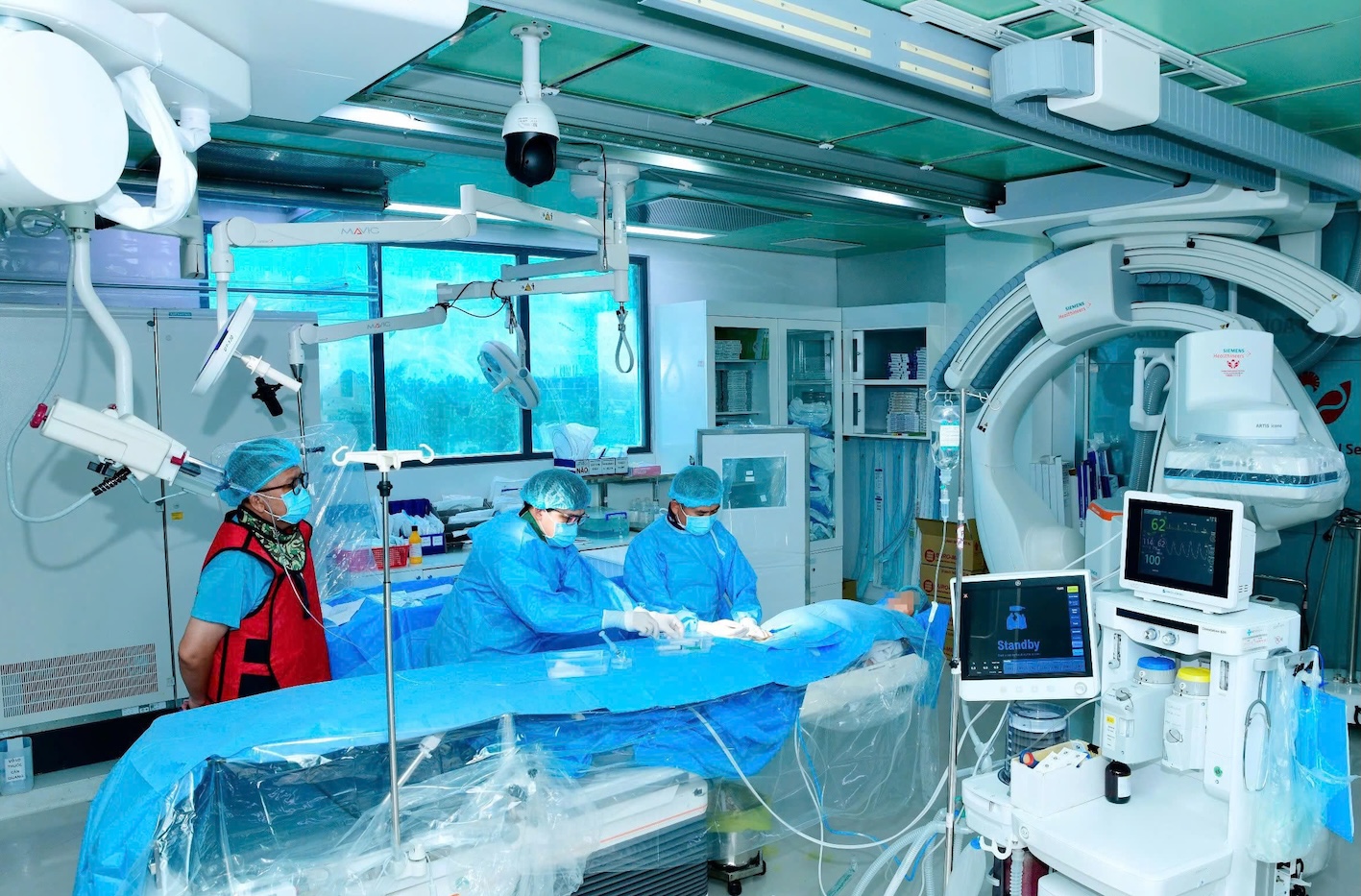
Doctors perform DSA endovascular intervention to embolize the brain vascular malformation for the child patient. Photo: Hospital provided

Dr. Nguyen Luu Giang, head of the DSA unit and a second-degree specialist, noted that this was a challenging case due to the patient's young age, complex brain vascular lesion, and high mortality risk. After controlling the bleeding source, the team faced the next challenge: removing the hematoma to reduce brain compression, limit damage, and mitigate the risk of sequelae.

According to Dr. Nguyen Quang Hung, head of the Neurosurgery Unit and a first-degree specialist, the team utilized 3D hematoma localization technology, a neuro-navigation system, and minimally invasive microsurgery. These advanced techniques allowed for precise access to the lesion, minimizing impact on healthy brain tissue.
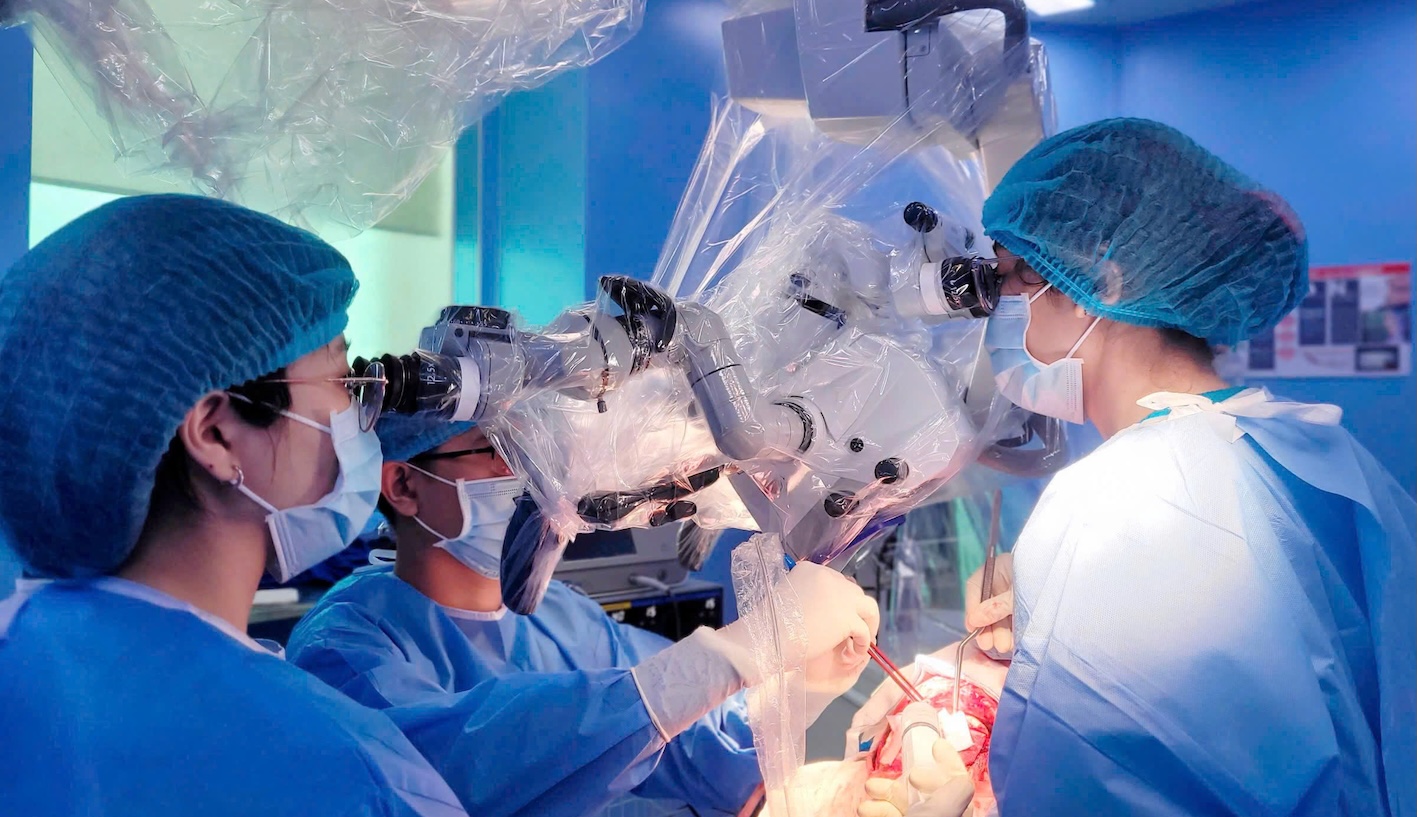
Doctors operate on the child patient. Photo: Hospital provided

After surgery, the child was transferred to the intensive care unit in a sedated coma, on mechanical ventilation via an endotracheal tube. Over the next 5 days, the patient received intensive treatment, including respiratory support, anti-brain swelling measures, ventricular drainage care, infection prevention, and early mobilization exercises. Currently, the child is responsive to calls, follows commands, breathes well independently, and has been extubated, with a good prognosis for recovery.

Stroke in children differs from adults, with most cases of brain hemorrhage linked to congenital cerebral vascular malformations. This field remains a challenge for many medical facilities due to the rarity of the condition, its rapid progression, and the demand for in-depth coordination among multiple specialties, alongside modern equipment for emergency care and treatment.

Before a stroke, children may only experience transient headaches, seizures, loss of consciousness, or weakness on one side of the body, making symptoms easily overlooked. Therefore, parents should not be complacent if a child exhibits persistent headaches, facial drooping, limb weakness, speech difficulties, or unusual seizures, as these could be warning signs of a stroke or a dangerous neurological condition.

How a stroke occurs:

Video: Ted-ed

Le Phuong

By VnExpress: https://vnexpress.net/be-9-tuoi-dot-quy-vo-mach-mau-nao-5074545.html
Tags: stroke hemiplegia brain hemorrhage

News in the same category

How drinking coffee may help you live longer

How drinking coffee may help you live longer

Coffee contains numerous antioxidant compounds that can support cardiovascular and brain health, and is linked to a slower aging process when consumed in moderation.

What is intraoperative neurophysiological monitoring during brain tumor surgery?

What is intraoperative neurophysiological monitoring during brain tumor surgery?

I have been advised to use an intraoperative neurophysiological monitoring system for brain tumor surgery. What is this method, and is it safe? (Duc Tuyen, 56)

Warning signs of age-related macular degeneration

Warning signs of age-related macular degeneration

Age-related macular degeneration often progresses silently but can lead to blurry vision, distorted images, difficulty reading, or recognizing faces.

Does eating rice cause more weight gain than noodles?

Does eating rice cause more weight gain than noodles?

I'm trying to lose weight, so I eat less rice and opt for noodle dishes like bun and pho because they feel "lighter" and I believe they lead to less weight gain. Is this approach correct? (Nguyen Hang, 30)

Millionaire spending millions on anti-aging recommends a 'zero-cost menu'

Millionaire spending millions on anti-aging recommends a 'zero-cost menu'

After investing heavily in extreme rejuvenation therapies, millionaire Bryan Johnson surprises many by asserting that "simple, everyday habits are the golden key to a youthful body."

Does hepatitis B cause hair loss?

Does hepatitis B cause hair loss?

I have chronic hepatitis B, currently undergoing treatment and monitoring. Recently, I've experienced significant hair loss; is it due to hepatitis B? (Thanh Mai, Tay Ninh)

Can radiotherapy completely cure nasopharyngeal cancer?

Can radiotherapy completely cure nasopharyngeal cancer?

I have early-stage nasopharyngeal tumor; can radiotherapy completely cure it? (Hai Nam, 57)

Thought to be lung cancer, tumor revealed as benign

Thought to be lung cancer, tumor revealed as benign

Mr. Thanh, 59, who underwent colon cancer surgery a year ago, developed a lung tumor initially suspected to be malignant, but a biopsy confirmed it was benign.

How do sprains and fractures differ?

How do sprains and fractures differ?

Sprains cause joint looseness, weakness, and restricted movement, while fractures can deform limbs, cause bleeding, and even lead to fainting.

What happens when you arbitrarily stop hypertension medication?

What happens when you arbitrarily stop hypertension medication?

A patient from TP HCM, Nhung Le, asks about the health implications of stopping hypertension medication after her condition stabilized, citing concerns about kidney damage from prolonged use.

Eng English
China 中国人
  • News
  • World
  • Business
  • Entertainment
  • Sports
  • Law
  • Education
  • Health
  • Lifestyle
  • Travel
  • Science
  • Digital
  • Automobiles
FPT Tower, 10 Pham Van Bach Street, Dich Vong Ward,
Cau Giay District, Hanoi, Vietnam
Email: contacts@vnportal.net
Tel: 028 7300 9999 - Ext 8556
Advertise with us: 090 293 9644
Register
© Copyright 2026 vnnow.net. All rights reserved.
Terms of use Privacy policy Cookies