Eng English
China 中国人

Eng English
China 中国人
  • News
  • World
  • Business
  • Entertainment
  • Sports
  • Law
  • Education
  • Health
  • Lifestyle
  • Travel
  • Science
  • Digital
  • Automobiles
  • Trở lại Thể thao
  • Health
Saturday, 16/5/2026 | 13:01 GMT+7

Warning signs of age-related macular degeneration

Age-related macular degeneration often progresses silently but can lead to blurry vision, distorted images, difficulty reading, or recognizing faces.

Age-related macular degeneration (AMD) is a condition that damages the macula – the most important central area of the retina. This region is densely packed with light-sensing cells that create sharp images and enable color perception. When the macula is damaged, central vision gradually declines over time, making it difficult for patients to read, recognize faces, or perform tasks requiring high precision.

According to Doctor Bui Viet Hung, Head of the Vitreoretinal Department, High-Tech Eye Center, Tam Anh General Hospital Hanoi, age is the biggest risk factor for AMD. Additionally, smoking, high blood pressure, cardiovascular disease, obesity, a family history, or a diet lacking omega-3 and dark leafy greens can also increase the risk of macular degeneration.
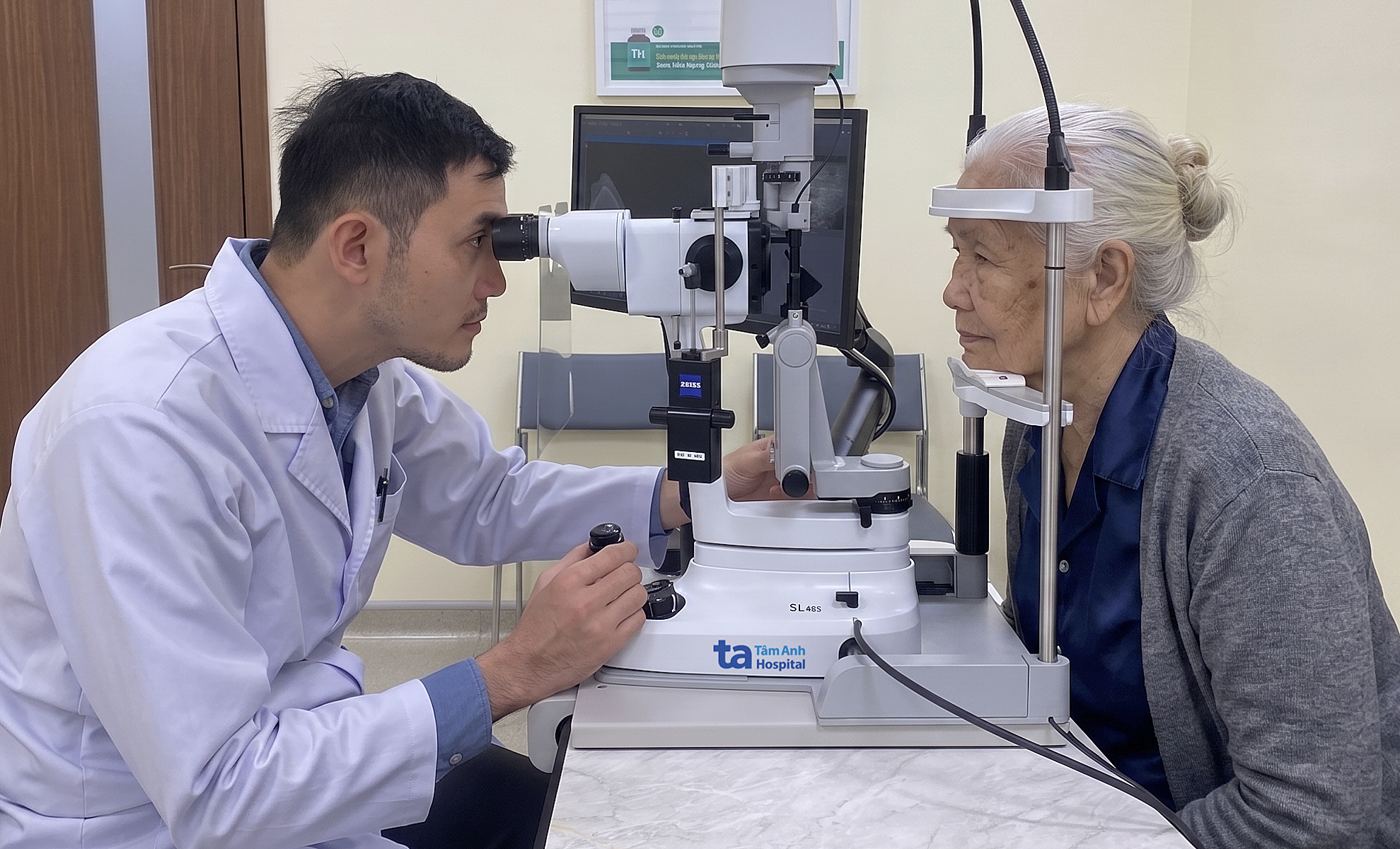
Doctor Hung examines a patient's eyes. *Illustration: Tam Anh General Hospital*

The disease is divided into two main forms: dry and wet. The dry form is more common and progresses slowly as macular cells gradually degenerate, retinal tissue thins, and deposits called drusen accumulate. This condition typically affects both eyes but develops silently over a long period.

Conversely, the wet form is less common but more dangerous due to the growth of abnormal blood vessels under the retina. These vessels leak fluid or blood and can form scar tissue, leading to rapid vision loss. This form usually begins in one eye but can spread to the other if not managed.

Symptoms also differ between the two forms. In the dry form, central vision decreases gradually; patients may experience blurry images, difficulty seeing fine details, or require more light when reading. As the disease progresses, a central blind spot may appear.

In contrast, the wet form often progresses rapidly, with symptoms such as distorted vision, straight lines appearing wavy or bent, and a central blurry area developing in a short time. Peripheral vision is usually preserved, but reading, watching television, or recognizing faces becomes challenging.

Currently, there is no method to fully restore damage in the dry form. However, lifestyle changes can help slow down the degeneration process. Patients should quit smoking, control blood pressure and cholesterol, maintain a healthy weight, and increase their intake of foods rich in omega-3, lutein, and dark leafy greens.

For the wet form, treatment primarily involves intravitreal injections to inhibit the growth of abnormal blood vessels. In some cases, laser therapy may be combined to help preserve vision.

Doctor Hung advises individuals over 50 or those with risk factors to undergo regular eye exams for early detection of retinal abnormalities. If symptoms like blurry vision, distorted images, or a central blind spot appear, prompt examination is necessary for timely diagnosis and intervention to limit the risk of vision loss.

Thu Giang

Readers can submit questions about ophthalmic diseases here for doctors to answer.
By VnExpress: https://vnexpress.net/dau-hieu-canh-bao-thoai-hoa-hoang-diem-tuoi-gia-5074646.html
Tags: eye disease macula degeneration signs

News in the same category

Imexpharm organizes workshop supporting musculoskeletal disease control

Imexpharm organizes workshop supporting musculoskeletal disease control

Imexpharm updates solutions supporting pain relief and anti-inflammation for musculoskeletal diseases, which are increasingly common and affecting younger demographics.

How drinking coffee may help you live longer

How drinking coffee may help you live longer

Coffee contains numerous antioxidant compounds that can support cardiovascular and brain health, and is linked to a slower aging process when consumed in moderation.

What is intraoperative neurophysiological monitoring during brain tumor surgery?

What is intraoperative neurophysiological monitoring during brain tumor surgery?

I have been advised to use an intraoperative neurophysiological monitoring system for brain tumor surgery. What is this method, and is it safe? (Duc Tuyen, 56)

Does eating rice cause more weight gain than noodles?

Does eating rice cause more weight gain than noodles?

I'm trying to lose weight, so I eat less rice and opt for noodle dishes like bun and pho because they feel "lighter" and I believe they lead to less weight gain. Is this approach correct? (Nguyen Hang, 30)

Millionaire spending millions on anti-aging recommends a 'zero-cost menu'

Millionaire spending millions on anti-aging recommends a 'zero-cost menu'

After investing heavily in extreme rejuvenation therapies, millionaire Bryan Johnson surprises many by asserting that "simple, everyday habits are the golden key to a youthful body."

9-year-old suffers stroke, brain blood vessel rupture

9-year-old suffers stroke, brain blood vessel rupture

A 9-year-old girl fell into a coma after sudden disorientation and left-sided paralysis, diagnosed with a severe hemorrhagic stroke caused by a ruptured cerebral arteriovenous malformation.

Does hepatitis B cause hair loss?

Does hepatitis B cause hair loss?

I have chronic hepatitis B, currently undergoing treatment and monitoring. Recently, I've experienced significant hair loss; is it due to hepatitis B? (Thanh Mai, Tay Ninh)

Can radiotherapy completely cure nasopharyngeal cancer?

Can radiotherapy completely cure nasopharyngeal cancer?

I have early-stage nasopharyngeal tumor; can radiotherapy completely cure it? (Hai Nam, 57)

Thought to be lung cancer, tumor revealed as benign

Thought to be lung cancer, tumor revealed as benign

Mr. Thanh, 59, who underwent colon cancer surgery a year ago, developed a lung tumor initially suspected to be malignant, but a biopsy confirmed it was benign.

How do sprains and fractures differ?

How do sprains and fractures differ?

Sprains cause joint looseness, weakness, and restricted movement, while fractures can deform limbs, cause bleeding, and even lead to fainting.

Eng English
China 中国人
  • News
  • World
  • Business
  • Entertainment
  • Sports
  • Law
  • Education
  • Health
  • Lifestyle
  • Travel
  • Science
  • Digital
  • Automobiles
FPT Tower, 10 Pham Van Bach Street, Dich Vong Ward,
Cau Giay District, Hanoi, Vietnam
Email: contacts@vnportal.net
Tel: 028 7300 9999 - Ext 8556
Advertise with us: 090 293 9644
Register
© Copyright 2026 vnnow.net. All rights reserved.
Terms of use Privacy policy Cookies