Representatives from Nhan Dan Gia Dinh Hospital announced on 2/1 that the patient has fully recovered after seven days of intensive treatment and was discharged in time to celebrate the New Year with his family. Cardiac MRI results confirmed he suffered from acute myocarditis and pericarditis, with complications leading to ventricular arrhythmia and sudden death.
The incident occurred when the patient was playing badminton with colleagues at a training court in An Khanh ward. Despite having a habit of exercising two hours daily and being a non-smoker, he suddenly felt palpitations, shortness of breath, and then severe chest pain after only 30 minutes of activity. He quickly fell into a coma and was taken to the nearest medical facility in critical condition. Doctors immediately performed cardiopulmonary resuscitation (CPR) and activated an inter-hospital "red alert" protocol with Nhan Dan Gia Dinh Hospital.
 |
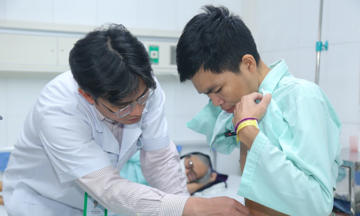
Doctors examining the patient. Photo: Hospital provided |
Doctors examining the patient. Photo: Hospital provided
Just 15 minutes later, the patient was transferred to the Emergency Department at Nhan Dan Gia Dinh Hospital. The on-duty team maintained resuscitation while establishing a veno-arterial extracorporeal membrane oxygenation (V-A ECMO) system to support the exhausted heart's circulation. Once vital signs were temporarily stable, doctors performed a whole-body computed tomography (CT) scan to rule out common causes of sudden death, such as myocardial infarction, pulmonary embolism, or aortic disease.
Suspecting the patient had acute viral myocarditis, the treatment team applied an intensive resuscitation protocol including ECMO, therapeutic hypothermia, continuous hemodialysis, and high-dose corticosteroids. After 48 hours, the patient was conscious, free of arrhythmias, with good heart function recovery, and was weaned off ECMO.
Dr. Vo Van Trang, from the Cardiovascular Intensive Care Department, explained that acute viral myocarditis often appears during cold or rainy seasons. The illness begins with symptoms easily mistaken for conditions like flu or digestive disorders. However, over 80% of patients experience chest pain, and 20-50% report shortness of breath accompanied by palpitations. Some cases rapidly progress to heart failure, hypotension, and swift death if not promptly intervened.
According to Dr. Nguyen Thanh Thao, also from the Cardiovascular Intensive Care Department, the patient's case was very fortunate because he received emergency care during the "golden hour." The doctor advises patients to limit physical exertion for at least the first three months after discharge to avoid the risk of recurrent arrhythmias. For cases of diffuse myocarditis, patients need to undergo additional screening for genetic factors and adhere strictly to follow-up appointments.
Le Phuong