After giving birth to her first son, Nga experienced an ectopic pregnancy and a tubal abscess, leading to the removal of both fallopian tubes. This left her unable to conceive naturally. In 2017, she and her husband began in vitro fertilization (IVF) treatment at a hospital in Ho Chi Minh City. However, they faced three failed embryo transfers due to biochemical pregnancies and four canceled cycles because her uterine lining was too thin for transfer.
Doctor of first-degree specialization Chau Hoang Phuong Thao, Head of the Assisted Reproduction Unit at Tam Anh General Hospital - District 8 (IVF Tam Anh - District 8), diagnosed Nga with a thin uterine lining, indicating poor embryo receptivity. A hysteroscopy revealed chronic endometritis and fibrosis. This condition made it difficult for her uterine lining to reach the required thickness, reducing the embryo's ability to implant. This was likely the primary reason for Nga's previous consecutive failed embryo transfers.
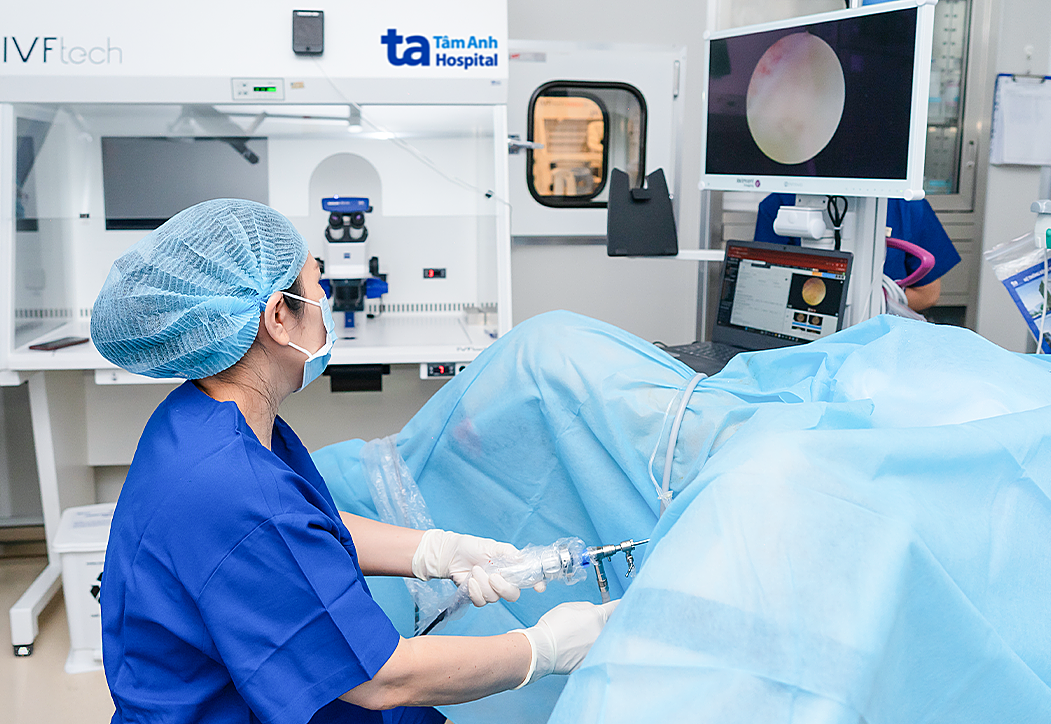 |
Doctor Thao performs a hysteroscopy to identify the cause of Nga's failed embryo transfers. Photo: IVF Tam Anh |
Doctor Thao performs a hysteroscopy to identify the cause of Nga's failed embryo transfers. Photo: IVF Tam Anh
Doctor Thao prescribed medication to treat the inflammation and prepare the uterine lining. However, Nga experienced three more failed day-5 embryo transfers due to biochemical pregnancies. Consequently, in the next egg retrieval cycle, the doctor expanded the assessment to include embryo quality. At this point, Nga was 37 years old, increasing the risk of chromosomal abnormalities in the embryos. The results of preimplantation genetic testing for aneuploidy (PGT-A) showed that all four day-5 embryos were abnormal, leading to the cancellation of the cycle.
Last year, Nga embarked on her third egg retrieval cycle, which yielded two good-quality day-5 embryos and one medium-quality day-6 embryo. She opted not to undergo chromosomal screening. Despite further uterine lining preparation for transfer, she experienced two more failures due to biochemical pregnancies.
With only one medium-quality day-6 embryo remaining, Doctor Thao revised the uterine lining treatment protocol, continuously adjusting hormone medication to increase its thickness. After three consecutive cycles had to be canceled due to poor lining response, the fourth cycle saw the lining finally reach 9 mm. Doctor Thao proceeded with the embryo transfer, and Nga ultimately conceived after nine years of persistent treatment.
The couple's second son was born healthy in early May, weighing 3 kg. "Sometimes I wanted to give up, I never thought I'd be a mother again", she shared.
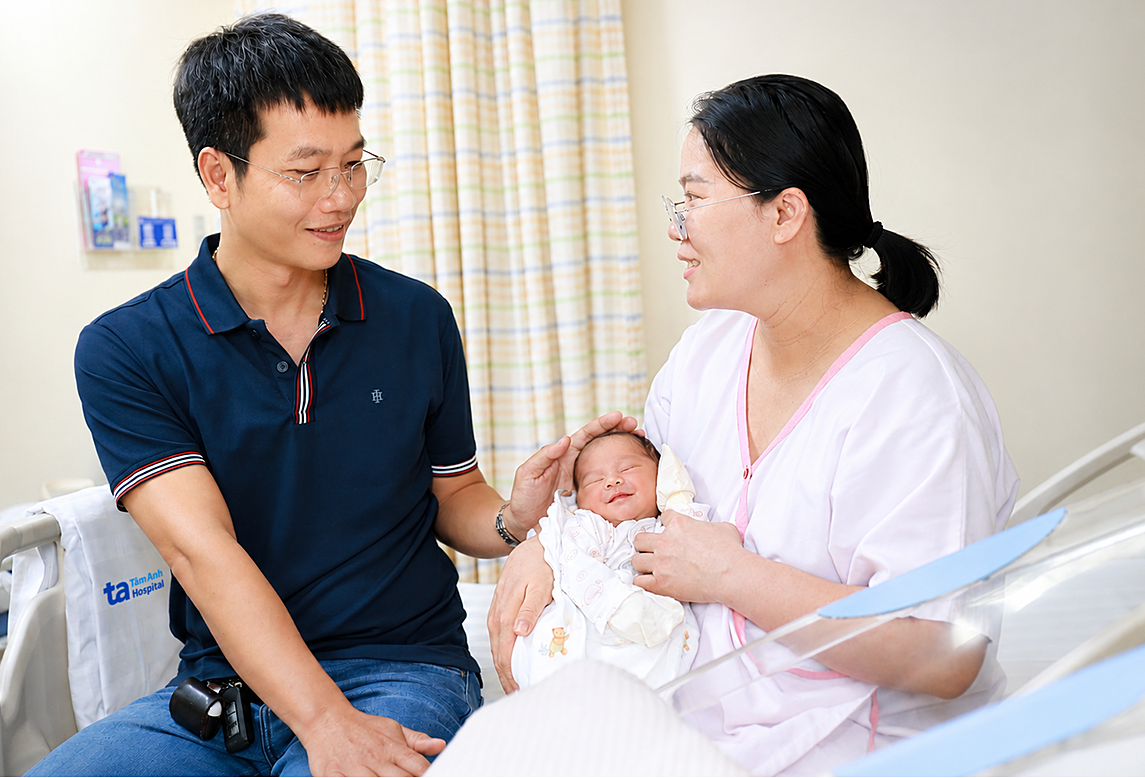 |
Nga and her husband with their four-day-old "test-tube baby". Photo: IVF Tam Anh |
Nga and her husband with their four-day-old "test-tube baby". Photo: IVF Tam Anh
According to Doctor Thao, approximately 60% of embryo transfer failures are related to embryo quality, 30% to the uterine lining, and the remainder have unknown causes. A thin uterine lining (under 7 mm) is a common reason why embryos struggle to implant or increase the risk of biochemical pregnancies. Common signs include irregular periods, light menstrual flow, or difficulty conceiving naturally over an extended period.
At IVF Tam Anh, patients receive individualized treatment protocols based on the cause of their thin uterine lining. Doctors may adjust hormone levels to increase thickness, combine medications to improve uterine blood flow, or treat any uterine cavity abnormalities. For those with two or more failed embryo transfers, hysteroscopy may be recommended to detect issues such as chronic endometritis, polyps, uterine adhesions, or fibroids, which are often difficult to identify with conventional ultrasound. Some cases require extended uterine lining preparation and adjusted embryo transfer timing to enhance the chances of successful pregnancy.
By Nguyet Nhi
| Tam Anh General Hospital is launching a promotional program, "Golden Pregnancy Charm - Support up to 10 million dong", for infertile couples undergoing in vitro fertilization (IVF) across its entire system from 9/5 to 9/7/2026. Learn more here. |