A recent survey across 34 Vietnamese provinces revealed that over half of female middle school students engage in physical activity outside of school, yet only 20.8% meet the World Health Organization's recommendation of at least one hour daily. Professor Le Anh Vinh, Director of the Vietnam Institute of Educational Sciences, presented these findings on 18/6 at a workshop addressing the promotion of sports participation among middle school girls in Vietnam. The online survey included 524,674 students and indicated that 52.36% of female students participate in physical activity, exercise, or sports beyond school hours, a rate lower than that of male students.
Despite these figures, the survey indicated that girls are not indifferent to sports. Many female students expressed a desire to exercise to improve health, enhance physique, reduce academic pressure, and develop life skills. However, they face various obstacles: a lack of suitable sports, monotonous physical education classes, fear of ridicule, concerns about injuries, or shyness when exercising with male peers.
Parental awareness is also a factor influencing children's activity levels. Many families prioritize academic achievements in cultural subjects over physical activity.
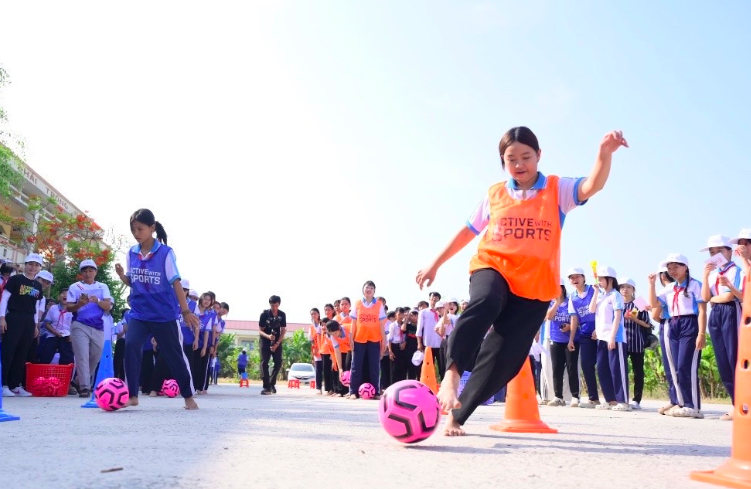 |
Children participating in school activities. *Mai Ngoc*.
Nguyen Thi Ha, a lecturer in the Faculty of Physical Education at Hanoi National University of Education 2, emphasized that summer breaks offer a prime opportunity for children to increase physical activity and establish healthy habits. Children who spend excessive time on television, phones, or other electronic devices without sufficient physical activity face increased risks of obesity, reduced concentration, and other health issues.
Regular physical activity aids children's physical development, supports academic performance, and improves mental health. For adolescent girls, sports help alleviate stress, boost self-confidence, and develop soft skills such as communication, cooperation, and teamwork.
According to the World Health Organization (WHO), about 80% of global adolescents do not meet necessary activity levels. The WHO recommends children engage in a minimum of 60 minutes of purposeful physical activity daily. However, students currently receive only about two physical education classes per week, totaling 70 minutes, which is insufficient to meet these recommended activity needs.
The WHO has set a global target to reduce physical inactivity by 15% by 2030, identifying schools as a key environment for behavioral change. To improve cardiovascular and muscular health, bone health, biological and metabolic indicators, and reduce symptoms of anxiety and depression, children aged 5 to 17 are advised to engage in at least 60 minutes of moderate-to-vigorous physical activity daily. This should include high-intensity activities, such as muscle- and bone-strengthening exercises, at least three times per week.
Experts highlight physical activity as one of three crucial factors determining stature development, alongside genetics and nutrition. Maintaining regular exercise habits helps improve cardiovascular health, the skeletal system, and concentration, contributing to a strong physical and mental foundation for children in the future.
Le Nga