Ms. Kieu faced challenges with a low egg count, while her husband had weak sperm. Two cycles of in vitro fertilization (IVF) at a hospital had previously failed. They managed to create only one embryo, which was of poor quality and unsuitable for uterine transfer.
Dr. Dinh Thi Ngoc Ngan, from the Center for Reproductive Support at Tam Anh General Hospital TP HCM (IVF Tam Anh TP HCM), noted that Ms. Kieu's history of multiple embryo creation failures suggested oocyte quality was a primary cause. Tests revealed she had an average ovarian reserve but a poor ovarian response, resulting in a low number of follicles. Her husband's grade one varicocele also contributed to reduced sperm quality.
 |
Doctor Ngan consults Ms. Kieu on egg collection and embryo cultivation techniques. *Photo: IVF Tam Anh* |
To improve oocyte quality and, consequently, embryo quality, Dr. Ngan implemented an individualized ovarian stimulation protocol for Ms. Kieu. This approach aimed for more natural follicular development, while also reducing costs and minimizing treatment side effects. After two oocyte collection cycles, Ms. Kieu yielded 17 eggs.
The oocytes were fertilized using intracytoplasmic sperm injection (ICSI) within an ISO 6 "lab in lab" system, designed to provide a maximally stable environment for gametes and embryos. Embryos were then cultured in an ISO 5 lab, utilizing a time-lapse incubator system integrated with artificial intelligence (AI). This system continuously updated the embryo development process. AI analyzed and scored the image data, enabling embryologists to assess each embryo's developmental potential and quality. Factors such as temperature, humidity, and gas composition in the lab created a stable culture environment, mimicking the uterus, and protecting gametes and embryos during development.
The result was positive: from 10 day-three embryos, Ms. Kieu and her husband obtained five high-quality day-five embryos. After two cycles of preparing her uterine lining to the optimal thickness, Ms. Kieu underwent embryo transfer and conceived successfully on the first attempt.
Her pregnancy is currently over 30 weeks and progressing well. The remaining embryos have been cryopreserved for future use, allowing the couple to have more children.
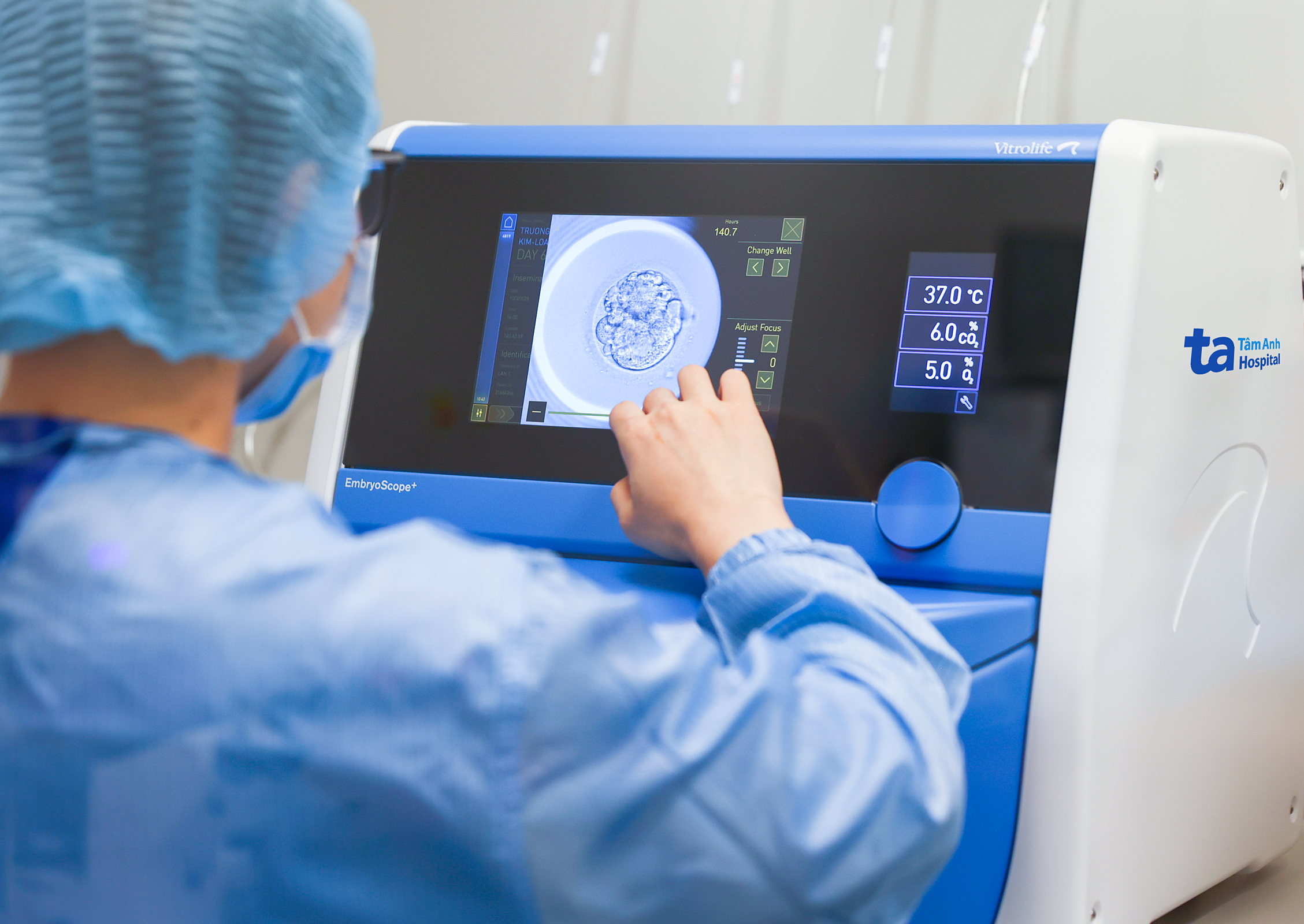 |
The time-lapse embryo culture system with artificial intelligence (AI) in the ISO 5 lab. *Photo: IVF Tam Anh* |
Doctor Ngan emphasized that in in vitro fertilization, while a higher number of oocytes increases the chance of creating embryos, embryo quality is the critical factor influencing pregnancy success. Poor quality sperm and oocytes, or those carrying genetic abnormalities, can reduce the rate of embryo creation and result in lower quality embryos.
Doctor Ngan advises couples who have been trying to conceive for one year without success to seek early, comprehensive assessment. Women over 35 or those with gynecological conditions should seek evaluation after six months of unsuccessful attempts. Early detection and treatment enhance the chances of conception and help mitigate the decline in both the quantity and quality of ovarian reserve and sperm over time.
Statistics from 2021-2025 at IVF Tam Anh show that, thanks to the application of oocyte and embryo pooling protocols and AI embryo culture technology, the average cumulative pregnancy rate reached 82,8%. For patients under 28 years old, this rate was even higher, at 90,3%.
Nguyet Nhi
*Character names have been changed.
| Tam Anh General Hospital is running a promotional program, "Nha Via Bau Vang - Support up to 10 million VND", for infertile couples undergoing in vitro fertilization (IVF) across its system from now until 9/7/2026. More information is available here. |