Magnetic resonance imaging (MRI) results at Tam Anh General Hospital, Hanoi, revealed a large abscess exceeding 5 cm along the anal fistula tract, with another abscess extending into the ischiorectal fossa. Dr. Le Van Luong, a specialist in the General Surgery Department, diagnosed the patient with a perianal abscess, confirming it was not hemorrhoids.
Dr. Luong explained that anal abscesses and anal fistulas represent two distinct stages of a common anal condition. This disease has multiple causes, primarily bacterial infection. When inflammation occurs, pus spreads, potentially along the septa and loose spaces around the anus, or to the skin, forming an abscess.
Initially, patients experience swelling and pain in the anal region, often mistaking it for hemorrhoids and attempting self-treatment. Anal abscesses occur in a sensitive area, and patients tend to delay seeking medical attention. This delay can worsen the infection and lead to a widespread inflammatory pus collection. Some cases may result in high fever and severe infection.
When abscess pus spreads to the skin, it can rupture, creating an external fistula opening. This may temporarily resolve but recurs in episodes, eventually forming an anal fistula – small openings near the anus that discharge fluid or pus. The condition recurs in waves, potentially leading to new abscesses, drainage, and repeated recurrences that widen the fistula tract or create multiple external openings. In some cases, two or three separate fistula tracts may appear in the same patient.
Anh Dzung was scheduled for a single-stage surgery, involving incision and drainage of the abscess to remove pus, followed by immediate treatment of the internal fistula opening during the same operation.
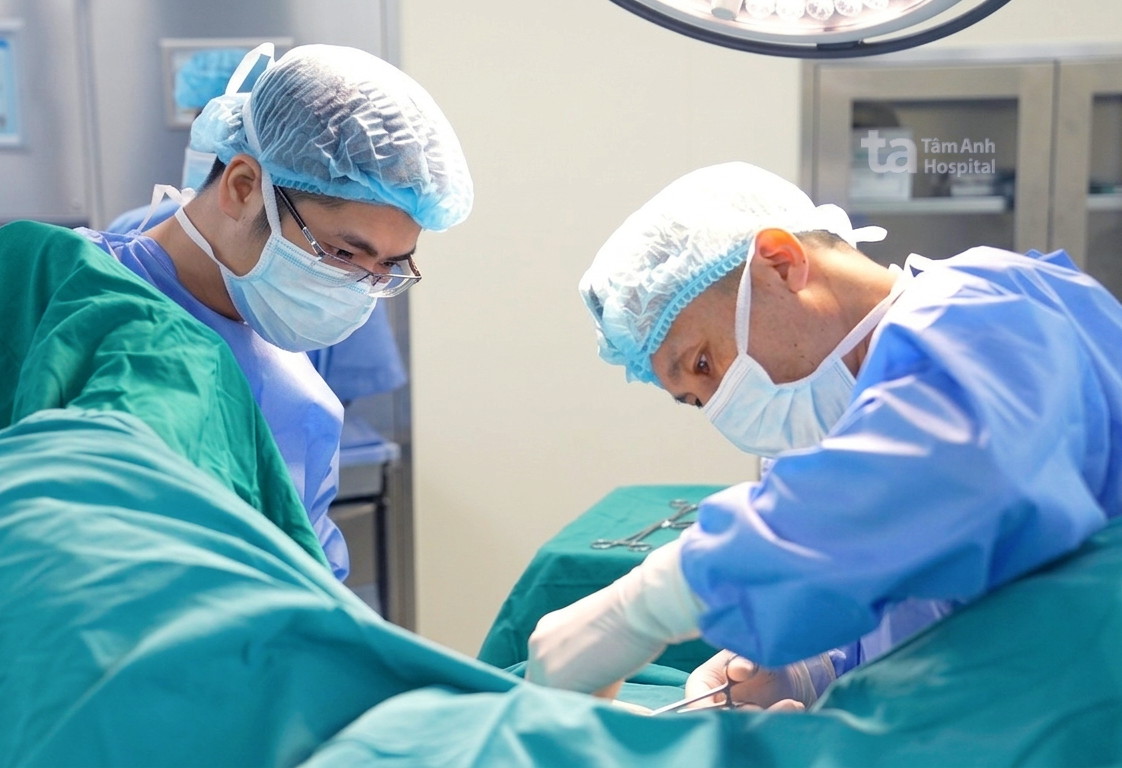 |
Dr. Luong (right) performs surgery on Anh Dzung. *Photo: Tam Anh General Hospital*
After administering spinal anesthesia to the patient, doctors incised and drained the abscess, collecting pus for bacterial culture and antibiotic susceptibility testing, and thoroughly cleaning the abscess cavity. For the anal fistula, the surgeon incised and removed the fistula tract, performed a partial sphincterotomy, made a skin incision, and meticulously checked for hemostasis, completing the surgery in 30 minutes.
Anh Dzung remained hospitalized for two days for observation, receiving regular dressing changes, irrigation to further clean the abscess cavity and necrotic tissue, and appropriate antibiotic treatment.
According to Dr. Luong, a magnetic resonance imaging scan 8 weeks after the surgery showed no remaining anal fistula, meaning Anh Dzung did not require a second operation, unlike many other patients who still have fistulas after anal abscess surgery.
Doctors advise that patients experiencing a painful mass in the anal region, foul-smelling discharge, or pain during defecation should seek timely examination and treatment at a specialized hospital.
Thanh Long