The Ministry of Health issued the advisory on the afternoon of 29/5, as the Ebola outbreak, caused by the Bundibugyo strain in the Democratic Republic of Congo and Uganda, continues to escalate. The number of cases is rapidly increasing, and several factors are raising the risk of widespread transmission across the African region.
As of 27/5, Congo recorded 1,077 suspected infections, including 238 suspected Ebola deaths. The nation confirmed 121 Ebola cases, including 17 deaths. Uganda reported 7 cases, including one death. In total, the two countries currently confirm 128 Ebola cases and 18 deaths.
The World Health Organization (WHO) assessed the outbreak risk in Congo as "very high" and the regional risk (including Uganda) as "high". This is due to the presence of community-transmitted virus sources, the potential for missed transmission chains, and an increase in cases related to cross-border movement. Notably, patients in Uganda were identified as imported cases from Congo to the capital Kampala, linked to travel, transportation, and healthcare activities.
The outbreak is currently present in 14 health zones across three Congolese provinces, primarily in Ituri province. Contact tracing efforts face significant challenges due to security instability, large population movements, and mining activities in border areas.
The Bundibugyo strain currently has no specific vaccine or treatment.
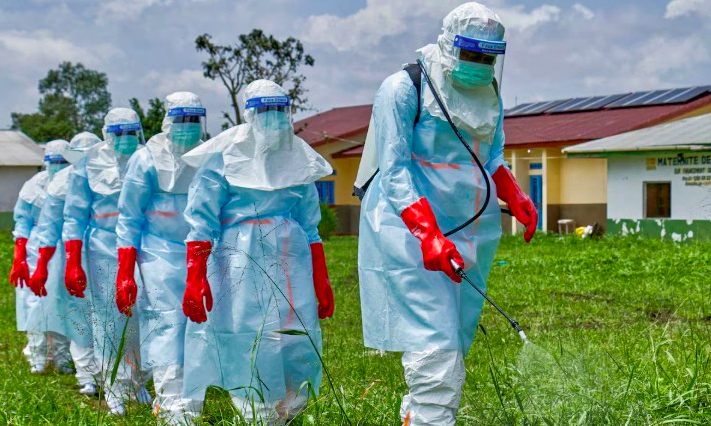 |
Red Cross personnel disinfect at Rwampara General Hospital, Democratic Republic of Congo, before handling the body of an Ebola victim, on 21/5. *Photo: Gradel Muyisa Mumbere/Reuters*. |
According to the Ministry of Health, Vietnam has not recorded any cases, and the current risk is low, but the possibility of imported cases cannot be ruled out as international exchange and travel activities continue to increase. The health sector has proactively implemented surveillance measures at border gates, healthcare facilities, and in the community; simultaneously preparing personnel, isolation areas, supplies, and treatment plans to be ready to respond if the outbreak appears.
The Ministry of Health advises people not to panic but to actively monitor information from official sources and limit travel to affected areas unless absolutely necessary. Those who must travel to outbreak areas should avoid contact with individuals exhibiting symptoms such as fever, vomiting, diarrhea, or suspected illness. Anyone returning from an outbreak area with suspicious signs should contact the nearest healthcare facility for guidance and prompt management.
The Ministry of Health also issued a specialized document: Guidelines for the Diagnosis and Treatment of Ebola Virus Disease. Compared to the 2014 guidelines, this version includes several changes regarding causative agents (adding 6 strains), testing methods, diagnostic criteria for suspected cases, and treatment methods.
According to the guidelines, the disease presents with severe clinical manifestations, often including hemorrhagic syndrome and multi-organ failure, with an average mortality rate of 50% (ranging from 25% to 90%). The average incubation period is 2-21 days.
Common symptoms include: acute fever, fatigue, headache, muscle aches, sore throat, vomiting/nausea, diarrhea, abdominal pain, conjunctivitis, and rash.
Le Nga