Answer:
Given your high-risk factor, specifically a family history of cancer, regular gastric endoscopy is recommended by a doctor. This allows for early detection of the disease, significantly improving treatment efficacy.
Gastric endoscopy is considered the "gold standard" for diagnosing stomach conditions, including cancer. This method allows doctors to directly observe the gastric lining, detecting very small lesions that other techniques might struggle to identify.
Through endoscopy, doctors can identify early-stage lesions such as: atrophic gastritis, intestinal metaplasia, and dysplasia. These are pre-cancerous conditions. When a suspicious area is found, a biopsy is performed for histopathological examination to accurately determine if the lesion is benign or malignant. Detecting cancer at an early stage greatly enhances treatment effectiveness and increases the patient's chances of survival.
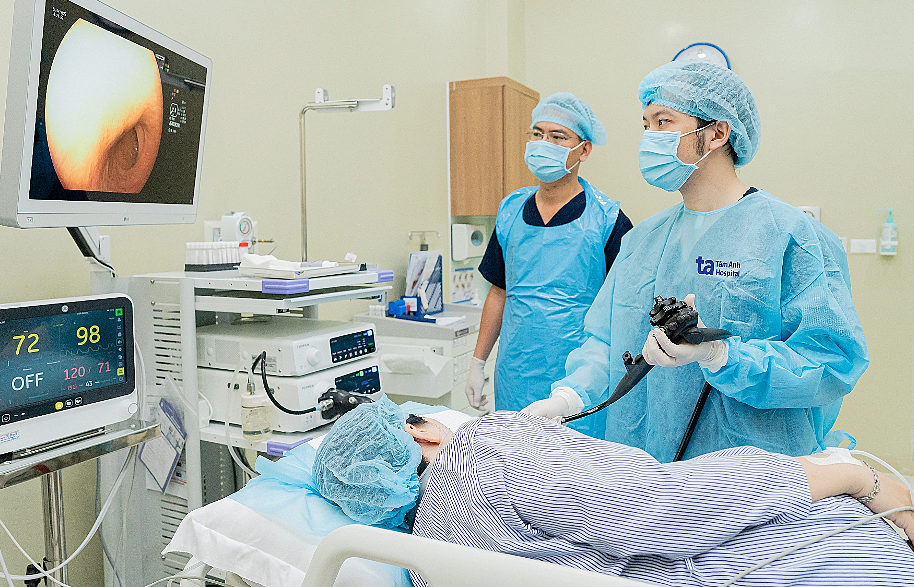 |
Doctor Phu performing a gastric endoscopy on a patient. Photo: Tam Anh General Hospital
Today, advanced endoscopy systems offer high magnification and sharp light technology, enabling doctors to clearly visualize microvascular structures and mucosal surfaces. This helps in detecting flat lesions, only a few millimeters in size, or those located beneath the mucosa, which are often missed during conventional gastric endoscopy.
Electronic and optical staining technology increases the contrast of the mucosa, highlighting structural and vascular abnormalities. This allows doctors to quickly identify the nature of the lesion (benign or malignant) during the endoscopy. Some systems also integrate bleeding detection technology, expanded viewing areas, or increased depth of field, enhancing the comprehensive assessment of lesions.
Endoscopy also plays a therapeutic role. When polyps or pre-cancerous lesions are detected, doctors can remove them immediately during the procedure to prevent progression to cancer. For early stomach cancer, interventional techniques like endoscopic mucosal resection (emr) or endoscopic submucosal dissection (esd) are performed via endoscopy. These methods radically remove lesions without the need for open surgery.
The advantages of these procedures include minimal invasiveness, preservation of the stomach's anatomical structure, reduced pain, and a shorter recovery time for patients.
Doctor Ho Quang Phu
Specialist in Gastrointestinal Endoscopy
Tam Anh General Clinic District 7
| Readers can submit questions about digestive diseases here for doctors to answer |