Ms. Bong was admitted to Tay Nguyen Regional General Hospital a few days prior, presenting with a heart rate that fluctuated between a rapid 179 beats/minute and a slow 30-40 beats/minute. A normal adult heart rate typically ranges from 60-100 beats/minute. Doctors administered intravenous antiarrhythmic drugs to stabilize her heart rate, but the treatment proved ineffective. The situation was complex: further medication to reduce the fast rhythm risked dangerously slowing her already low heart rate, threatening her life. Consequently, she was transferred to Cho Ray Hospital in Ho Chi Minh City.
Dr. Tran Le Uyen Phuong, deputy head of the Arrhythmia Treatment Department, diagnosed Ms. Bong with paroxysmal supraventricular tachycardia interspersed with sinus bradycardia. The elderly patient also suffered from chronic kidney disease, hypertension, and severe malnutrition. Treating a 104-year-old patient presented significant challenges due to her aged body, tortuous blood vessels, and low weight of only 32 kg, making any intervention inherently risky.
Doctors decided to perform an electrophysiological study and 3D mapping to pinpoint the origin of the fast heart rhythm for ablation. However, the team faced a major hurdle: the abnormal focus requiring ablation was located perilously close to the His bundle, a vital electrical conduction pathway of the heart, only 2-3 millimeters away. Accidental damage to the His bundle could result in atrioventricular block, necessitating a permanent pacemaker. For a frail patient with minimal fat or muscle tissue for device implantation, the risk of complications and infection would be high.
"That is a scenario no doctor wishes for," Dr. Phuong stated.
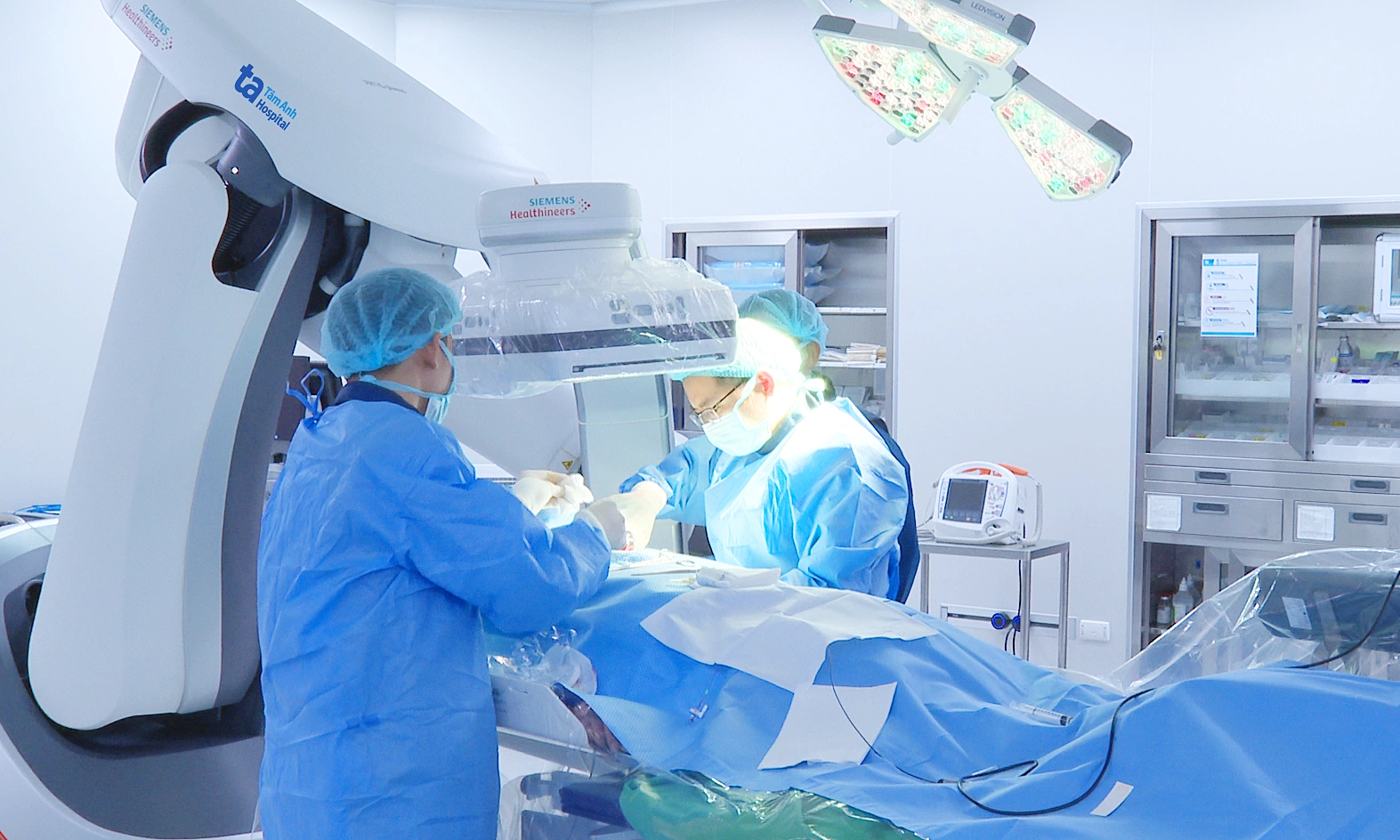
The medical team proceeded with extreme caution, extending the procedure to over one hour 15 minutes, significantly longer than the typical 30 minutes. The abnormal pacing site was completely ablated without affecting the heart's conduction pathway. Although doctors had prepared for pacemaker implantation in case of atrioventricular block during the intervention, the procedure was successful, and Ms. Bong did not require a device.
 |
Dr. Tran Le Uyen Phuong examining Ms. Bong on the morning of 24/9. Photo: Hospital provided |
Dr. Kieu Ngoc Dung, Specialist Level 2, head of the Arrhythmia Treatment Department at Cho Ray Hospital, noted that arrhythmias are common in older adults, with incidence increasing with age. Some patients may experience both fast and slow rhythms simultaneously, limiting the effectiveness of medication for rate control.
According to Dr. Dung, advanced age does not preclude arrhythmia treatment. With current methods and equipment, elderly patients can undergo interventions when indicated. However, due to common coexisting medical conditions, these patients require thorough assessment of their physical condition and underlying diseases, along with careful preparation before intervention, to minimize complication risks and achieve optimal treatment outcomes.
For Ms. Bong, the ablation procedure eliminated the source of recurrent fast heart rhythms, reducing the need for repeated hospital admissions for symptom control. Previously, each episode required her family to transport her for emergency care, sometimes traveling a long distance from Dak Lak.
On the morning of 24/9, Ms. Bong was discharged from the hospital, walking, eating, and conversing cheerfully. When a doctor asked if the hospital food was good, she smiled and replied, "Very delicious."
Le Phuong