The baby was born via C-section at 37 weeks gestation, initially stable, and had skin-to-skin contact with his mother in the delivery room at Tam Anh General Hospital, TP HCM. Approximately 4 hours later, the baby became cyanotic, exhibited chest retractions, and had a decreased blood oxygen saturation (SpO2). He was transferred to the Neonatal Intensive Care Unit (NICU) for respiratory support.
Doctor Nguyen Minh Thanh Giang, a first-degree specialist at the Neonatal Center, stated that babies born via elective C-section at 37 weeks due to fetal malnutrition might not have experienced labor. The lack of uterine contractions and hormones released during labor can lead to slower absorption of lung fluid, affecting respiratory function. Babies also risk surfactant deficiency, a substance that helps maintain the openness of air sacs in the lungs.
Most respiratory cases improve within 24-48 hours. However, this patient remained oxygen-dependent, had labored breathing, and a chest X-ray revealed pneumothorax. This condition involves air accumulating in the space between the lung and chest wall, which can cause partial or complete lung collapse and lead to respiratory failure. The baby also showed signs of inflammation, and doctors diagnosed pneumonia of unknown cause.
The medical team intubated the baby and placed him on a ventilator to stabilize respiration, but his condition did not improve; the air volume continued to increase, compressing the lung parenchyma. Doctors at the Neonatal Center held an urgent consultation and decided to insert a chest tube to relieve the pressure.
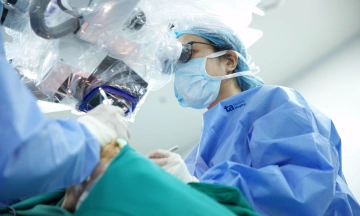
Doctors inserted a specialized drainage tube into the pleural space under ultrasound guidance, then connected it to a closed drainage system. This method helps remove air, relieve pressure in the chest, and minimize the risk of external air entering the pleural space.
After the successful intervention, the team continuously monitored SpO2, respiratory rate, ventilator parameters, and the amount of air draining through the system. The baby received enteral feeding combined with antibiotic treatment to ensure nutrition and control inflammation.
After approximately 4 days, the drainage system no longer recorded air leakage, and the patient stopped exhibiting chest retractions. Doctors decided to remove the chest tube and endotracheal tube, transitioning to non-invasive respiratory support. The baby began feeding well and had daily skin-to-skin contact with his mother. By 10 days old, the baby was breathing completely on his own, his health was stable, he received all vaccinations, was discharged, and scheduled for regular follow-up appointments.
 |
Nurses caring for the baby at the Neonatal Intensive Care Unit (NICU). *Photo: Tam Anh General Hospital*
Doctor Pham Le My Hanh, a second-degree specialist and Head of the Neonatal Department at the Neonatal Center, Tam Anh General Hospital, TP HCM, stated that pneumothorax can occur spontaneously in healthy full-term infants or as a common complication of lung disease or respiratory support in preterm infants with multiple medical conditions.
Newborns with pneumothorax may exhibit rapid, labored breathing, grunting, chest retractions, cyanosis, hypoxemia, pale skin, bradycardia, and hypotension. Some mild cases may not show clear symptoms.
Treatment depends on the amount of air in the pleural space and the baby's condition. Mild, asymptomatic cases can be monitored with oxygen support. If there is significant pneumothorax or the baby is symptomatic, doctors may insert a chest tube to remove air until the air leak seals. For tension pneumothorax, emergency decompression is performed with a needle.
Most babies can recover if diagnosed and treated appropriately. Doctor Hanh recommends that parents bring their children to a medical facility immediately if they observe abnormal respiratory signs such as rapid breathing, difficulty breathing, chest retractions, cyanosis, or hypoxemia.
Ngoc Chau
| Readers can submit questions about children's diseases here to be answered by doctors. |