A 73-year-old man, Mr. Duyen, suffering from benign prostatic hyperplasia for a decade, recently underwent a pioneering procedure at Tam Anh General Hospital Hanoi. Doctors successfully treated his condition using a novel combination of embolization beads and biological glue, offering a less invasive alternative to traditional surgery. Diagnostic imaging, including ultrasound and magnetic resonance imaging (MRI), revealed Mr. Duyen’s prostate gland measured approximately 40x42x51 mm, weighing 45 g—1,5 times larger than normal. Uroflowmetry results showed a significantly reduced maximum urinary flow rate, and his bladder wall was mildly thickened from prolonged effort to expel urine past the compressed urethra.
Given Mr. Duyen’s multiple underlying health conditions, associate professor, doctor Nguyen Xuan Hien, Director of the Center for Diagnostic Imaging and Interventional Radiology, recommended prostate artery embolization. This minimally invasive method is ideal for elderly patients, those with comorbidities, or individuals seeking non-surgical options. The procedure works by reducing blood supply to the enlarged prostatic tissue, causing it to gradually shrink and alleviate urinary obstruction. Patients benefit from local anesthesia, minimal bleeding, no pain, a short hospital stay, rapid recovery, and preserved prostate anatomy.
During the intervention, the medical team accessed the right femoral artery. Using a digital subtraction angiography (DSA) system for guidance, doctors meticulously mapped the blood vessels supplying the prostate. They identified two arteries on the left side, one of which connected to the penile artery. Associate professor Hien emphasized the importance of fully identifying these branches, as embolization material could otherwise mistakenly enter adjacent organs, potentially causing penile ischemia. To prevent this, the team strategically placed coils (metal spirals) to protect the communicating branch before proceeding with the embolization of the prostate-supplying arteries.
The doctors employed an advanced embolization technique, uniquely combining embolization beads and biological glue. This approach involved first using beads to penetrate deep into the prostate's microvascular system. Subsequently, biological glue was injected to completely block the arteries nourishing the enlarged tissue. This dual-material strategy significantly enhances treatment effectiveness and ensures maximum preservation of renal parenchyma for the patient.
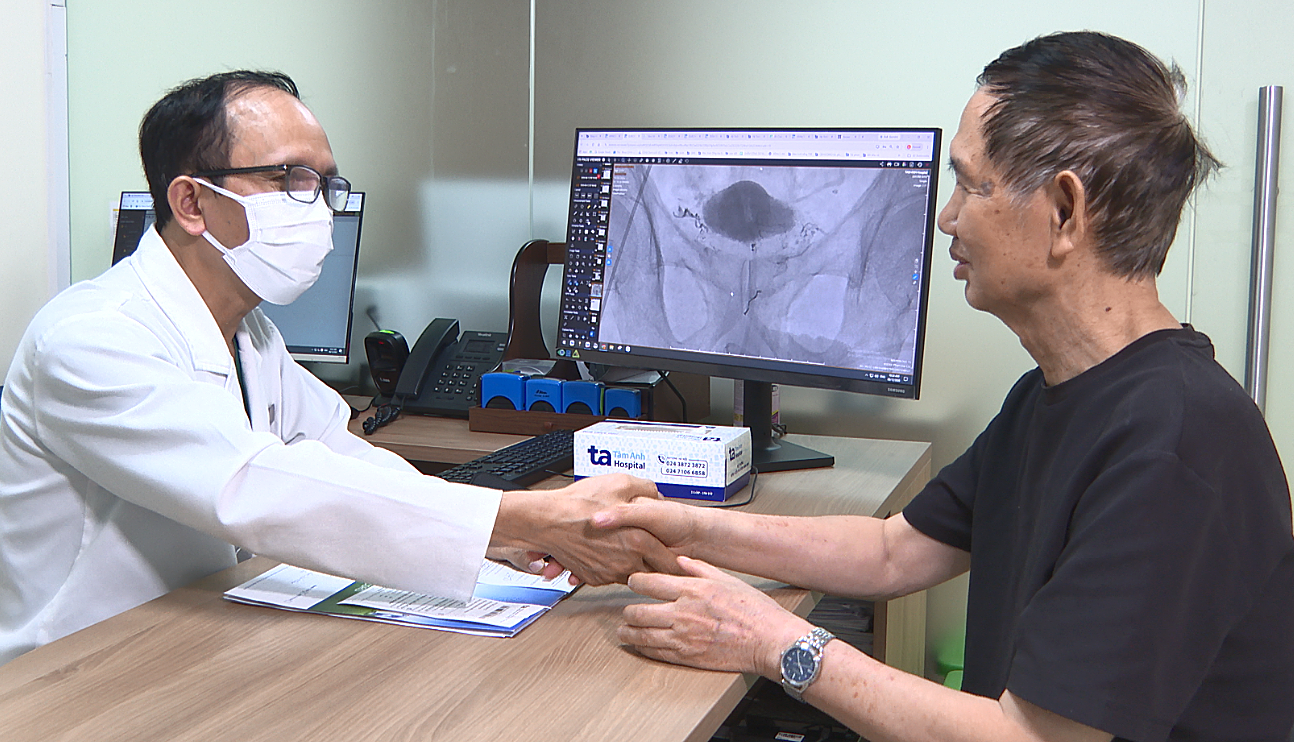 |
Mr. Duyen undergoing a follow-up examination with associate professor Hien one month after prostate artery embolization for benign prostatic hyperplasia. Photo: Tam Anh General Hospital |
Post-intervention imaging confirmed the complete occlusion of the prostate-supplying arteries, while critical surrounding blood vessels remained unaffected. The successful procedure concluded in 45 minutes. Mr. Duyen was discharged one day later, and a one-month follow-up revealed stable health and significant symptom improvement. His urination frequency decreased from once every one hour to once every 3-4 hours, and he now wakes only once at night, no longer suffering from insomnia.
Benign prostatic hyperplasia (BPH) is a common condition affecting older men. While its specific cause is unknown, it is strongly associated with the aging process. The enlarged prostate compresses the urethra, leading to a range of bothersome urinary symptoms, including frequent urination, nocturia, a weak urinary stream, intermittent urination, and a feeling of incomplete bladder emptying.
Treatment for BPH varies based on symptom severity, prostate size, and the patient's overall health. Early-stage cases often involve medical management with medication. If medication becomes ineffective or complications arise, such as urinary retention, recurrent urinary tract infections, or bladder stones, doctors may recommend interventional procedures or surgical removal of the prostate. Embolization is gaining widespread use for various conditions, including benign prostatic hyperplasia, liver tumors, uterine fibroids, and vascular malformations.
Associate professor Hien advises men over 50 experiencing symptoms such as frequent urination, nocturia, a weak urinary stream, intermittent urination, or incomplete bladder emptying to seek early examination. Timely diagnosis and treatment are crucial to prevent adverse effects on urinary tract function.
Hieu Nguyen