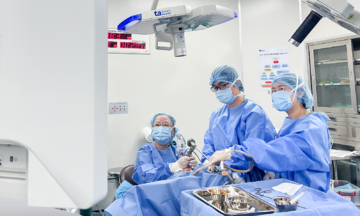
Mr. My's examination at Tam Anh General Hospital Ho Chi Minh City revealed a cyst located in the midline of his neck, measuring approximately 5 cm. The cyst was clearly defined, soft, painless, and moved with swallowing, which are typical characteristics of a thyroglossal duct cyst. Ultrasound results showed normal thyroid and major salivary glands, no pathological cervical lymph nodes, and a thick-walled cyst containing fluid without increased vascularity.
According to Master of Science, Doctor, First Degree Specialist Huynh Ba Tan from the Department of Breast, Head, and Neck Surgery, Mr. My’s condition is a thyroglossal duct cyst, a congenital anomaly. This condition forms because the thyroglossal duct fails to completely involute during embryonic development. Normally, the thyroid gland forms at the base of the tongue and descends to its position in the anterior neck before birth, and the thyroglossal duct disappears. If remnants of the duct persist, fluid can accumulate over time, forming a cyst. Most patients seek medical attention when the cyst becomes large or inflamed, causing discomfort.
Doctor Tan states that thyroglossal duct cysts are mostly benign. However, if left untreated, they can lead to recurrent inflammation, causing redness, pain, fever, and rupture, which can create a fistula and lead to purulent discharge, increasing the risk of infection. A long-standing cyst can also affect the aesthetic appearance of the neck, and subsequent surgery may become more complex, requiring longer operating times and increasing risks.
Following a consultation, doctors recommended the Sistrunk procedure to remove the cyst, the entire thyroglossal duct remnant, and part of the hyoid bone, to prevent recurrence. The surgery was successful after 90 minutes, significantly reducing the risk of recurrence for the patient. Post-operatively, the patient recovered quickly, with a dry incision, no complications, and no more difficulty swallowing.
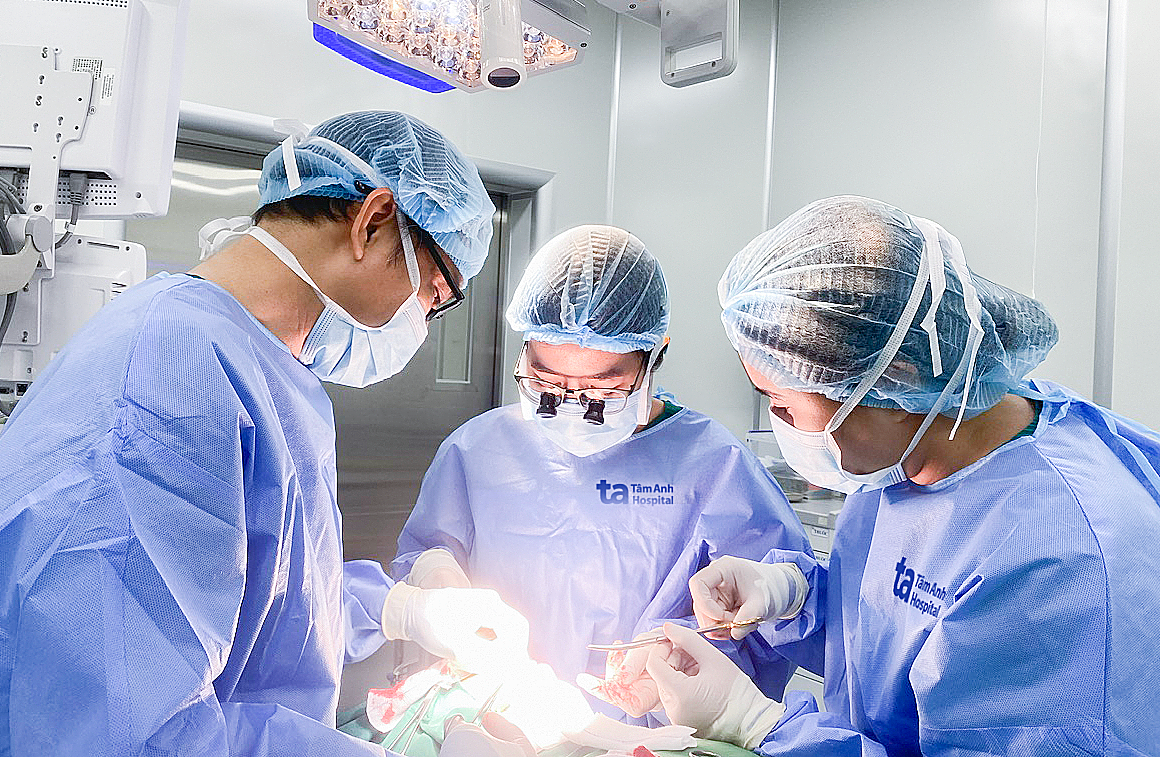 |
Medical team performing thyroglossal duct cyst surgery on Mr. My. *Photo: Tam Anh General Hospital* |
Thyroglossal duct cysts are typically round, soft, slow-growing, and painless. Because they often do not cause significant discomfort, patients may not be aware of their presence until the cyst grows large or becomes inflamed. Doctor Tan advises that individuals who notice any abnormalities in their neck should visit a hospital for examination. They may be recommended for ultrasound or other necessary clinical tests to ensure an accurate diagnosis.
Minh Tam
*Patient's name has been changed
| Readers can ask questions about cancer here for doctors to answer |