Minh was examined at Tam Anh General Hospital, Ho Chi Minh City, where his Haller index was 3,66, higher than the normal range (below 2,56). Associate Professor, Doctor Vu Huu Vinh, Director of the Thoracic - Vascular Surgery Center, stated that Minh's deeply sunken sternum reduced his chest cavity volume, compressing his heart and lungs. This prevented internal organs from functioning optimally, leading to impaired metabolism and reduced endurance.
"This represents one of the most challenging forms of pectus excavatum due to its deep and wide depression, coupled with a very flat chest", stated Associate Professor Vinh. He explained that if a conventional (arched) bar were used, the lifting force would be insufficient, preventing the chest wall from being adequately elevated.
Associate Professor Vinh opted for the two-level bended bar technique. Unlike conventional bars, which create a simple curve, this method involves forming two bending joints on the bar's body. Once inserted into the chest, these joint points press firmly against the ribs, creating stable fulcrums that evenly lift the entire sternum and reshape the chest naturally. Performing this technique requires the surgeon's experience and precise calculations.
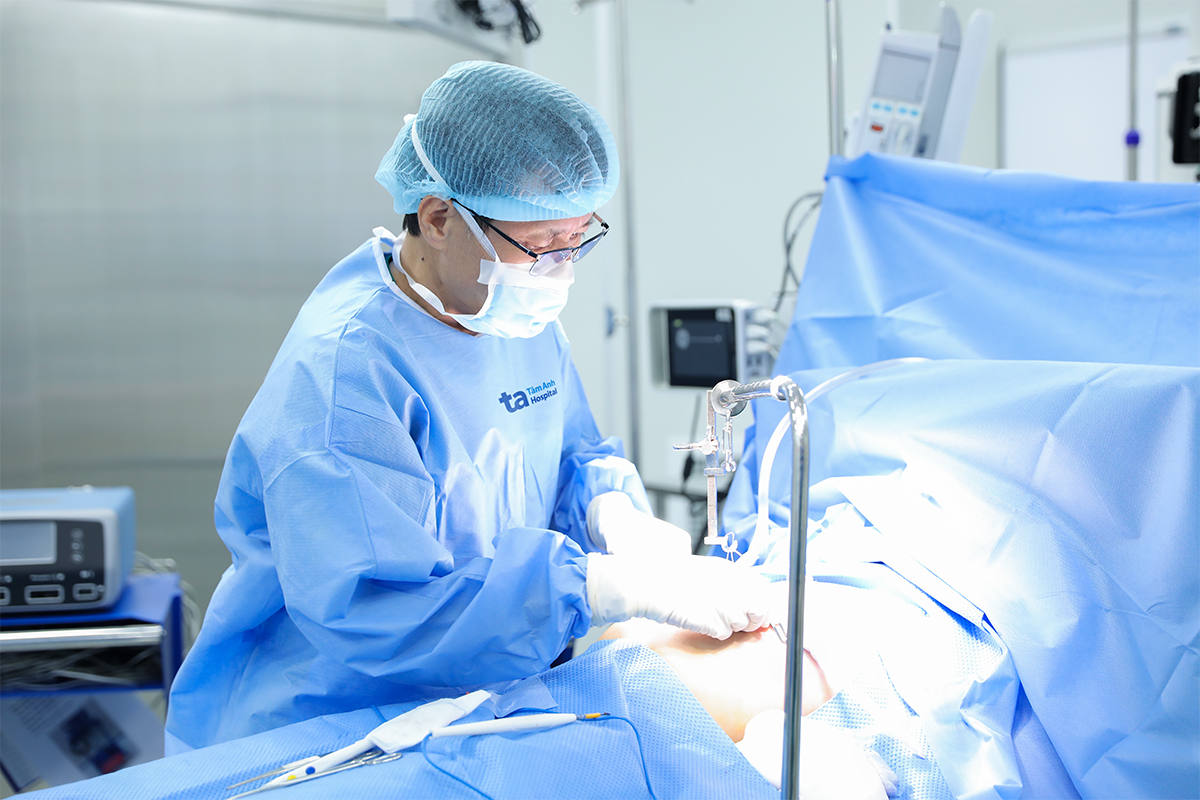 |
Associate Professor Vinh performing pectus excavatum surgery on a patient. Photo: Tam Anh General Hospital.
Post-surgery, Minh experienced minimal pain, and his chest returned to a normal shape. His heart and lungs were no longer compressed, and he was discharged after three days. The corrective bar will remain in his body for approximately three years to stabilize the skeletal frame in its new form, after which it will be surgically removed.
Many parents mistakenly believe that pectus excavatum is solely a cosmetic concern. In reality, this deformity can compress the heart and lungs, causing chest pain, reducing exercise capacity, and impacting physical development. Associate Professor Vinh advises parents to seek early medical consultation if their children show an abnormal chest shape, accompanied by shortness of breath, gasping during sports, or persistent fatigue.
Bao Anh
* The patient's name has been changed.
Readers can submit questions about cardiovascular diseases here for a doctor's response.