Kyoto University Hospital held a press conference on 7/8 to announce a "serious medical error" that occurred during brain tumor removal surgery for a woman in her 50s. The surgical team mistakenly removed healthy brain tissue from the patient. This incident resulted in brain damage, causing the patient to lose the ability to breathe independently and requiring life support via a ventilator, according to The Sankei Shimbun.
A hospital representative stated that the lead surgeon was a highly experienced doctor, having performed over 2,000 neurosurgical procedures, including about 100 cases involving similar lesion locations as the patient, without any prior errors.
Professor Akifumi Takaori, Director of Kyoto University Hospital, said, "I extend my sincerest apologies for the immense harm and anxiety we have caused the patient and their family."
The hospital pledged to commit fully to the patient's treatment and conduct an independent investigation to clarify the cause, promising transparent disclosure of information to the public. The hospital has reported the incident to the Japanese government, the Kyoto prefectural and city authorities, and the police.
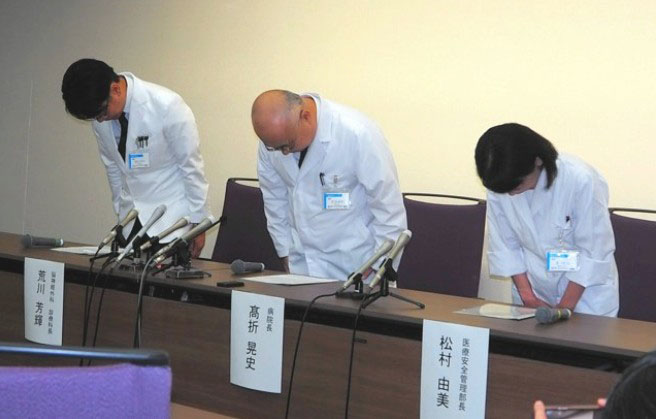 |
Mr. Akifumi Takaori (center), Director of Kyoto University Hospital, along with hospital leaders, bows in apology at a press conference regarding the medical error in Sakyo district, Kyoto city, Japan, on 7/8. Photo: Tairiku Kurosawa
Japanese media reported that the incident occurred last month. The patient sought medical attention for symptoms such as dizziness and was found to have a benign tumor, approximately 3 cm in size, located deep within her brain. The tumor showed a tendency to grow, and the patient underwent surgery in late July. During the tumor removal procedure, the doctor took tissue samples from the suspected tumor site for examination.
The pathological examination results indicated "no clear tumor cells detected". However, the doctor continued the dissection, believing that "the biopsy sample was only taken from the surrounding peripheral tissue and therefore did not yet contain tumor cells." When the results of the second pathological examination again concluded "not a tumor," the doctor proceeded with the removal.
After the surgery, when the patient failed to regain consciousness or spontaneous breathing, doctors performed a magnetic resonance imaging (MRI) scan. The MRI revealed that the original tumor remained intact, while the patient's respiratory center had sustained severe damage.
According to MBS News, a hospital representative stated that before surgery, the patient's daily life was normal, with only symptoms of dizziness and slight unsteadiness. However, currently, due to damage to the crucial neural cell groups that transmit respiratory commands, the patient is unable to breathe independently, suffers from complete quadriplegia, and is receiving intensive care on a ventilator.
Currently, the woman can only interact and answer questions by blinking. Doctors are continuing intensive treatment and monitoring the patient's potential for recovery.
Binh Minh (According to Asahi, Yomiuri, The Sankei Shimbun)