In recent years, air fryers have become a popular kitchen appliance, seen as a versatile solution for novice cooks due to their ability to fry almost anything. However, recent online rumors suggesting that "food cooked in an air fryer can cause cancer" have caused considerable consumer concern.
Addressing these concerns on CCTV News, Professor Pham Chi Hong from the College of Food Science and Nutritional Engineering at China Agricultural University explained that carcinogens or suspected carcinogens only form when food is heated to specific temperatures, not inherently from using conventional pots, ovens, or air fryers.
Experts confirm that not all high-temperature cooking causes cancer, and consumers need not worry excessively if consumption is low. However, regularly eating heavily charred or dark brown food over extended periods will certainly increase disease risk.
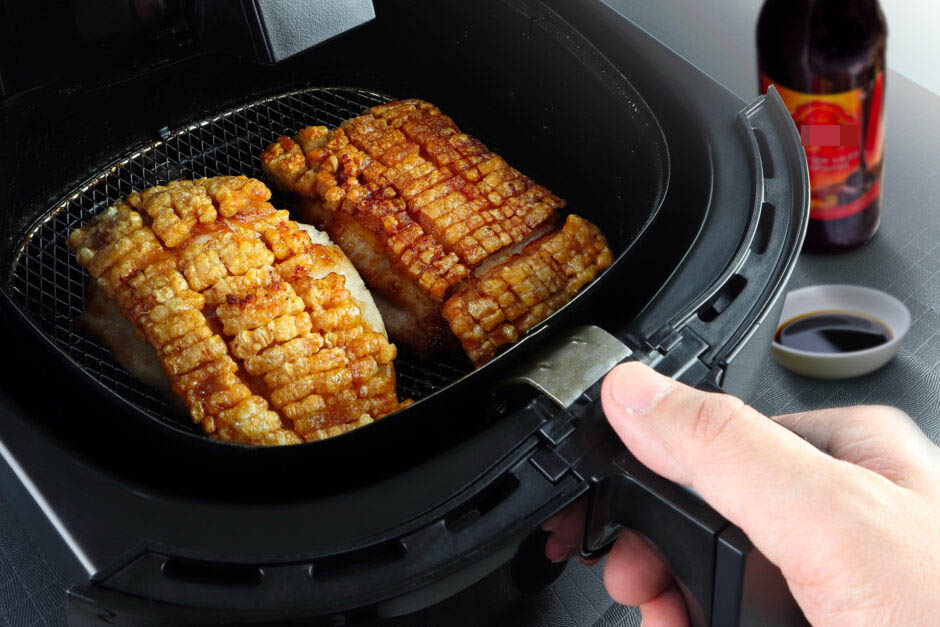 |
Illustrative photo: Asianinspirations |
Essentially, an air fryer functions like a mini oven with a convection fan. A continuous flow of hot air removes moisture from the food's surface, creating a dry and crispy exterior. Compared to traditional deep-frying, air fryers require minimal or no cooking oil to prepare food. Consequently, dishes cooked in an air fryer typically have lower fat content, produce less oil smoke, and significantly reduce the amount of carcinogens in the smoke.
Professor Pham noted that for foods already containing oil, the air frying process helps remove some of this fat. Therefore, from the perspective of limiting fat intake, air fryers offer clear advantages.
To minimize the formation of harmful substances during cooking, experts advise cleaning any food residue from the air fryer before use, avoiding cutting food into excessively small pieces, and selecting slightly lower temperatures and shorter cooking times than the default instructions.
Additionally, since more harmful substances are produced as food becomes charred, users should monitor the food's color to control cooking time. Food should be cooked until it achieves an even golden state. At this stage, the dish's flavor begins to develop its characteristic aroma without turning overly browned.
Beyond food safety, many are concerned whether the air fryer's inner coating releases harmful substances, especially if it peels. Experts from the China Household Electrical Appliances Research Institute explain that most standard air fryers today use a Teflon (PTFE) non-stick coating, a material known for its chemical stability and heat resistance.
Test data shows this coating only risks decomposing and producing harmful substances when temperatures reach 260°C, whereas typical air fryer temperatures are usually below 200°C, well within the safe range. Nevertheless, users must avoid operating the air fryer empty or using it at excessively high temperatures for extended periods.
Experts also warn that the Teflon coating typically rests on an aluminum base. If the coating peels, the aluminum core will directly contact food. In such cases, cooking acidic foods like tomatoes, lemons, or vinegar can cause aluminum to leach into the food, posing certain health risks if consumed long-term.
Binh Minh (According to Sina, CCTV News, Fast Technology)