Dr. Mai Ba Tien Dung, Head of Andrology at Binh Dan Hospital, stated on 5/6 that recent clinical observations reveal a concerning rise in late-stage male genital cancer cases.
Binh Dan Hospital performs approximately 5-6 penile cancer surgeries weekly. However, most patients are admitted at a late stage (T3), with early detection (T1) being rare. At stage T3, opportunities for organ-preserving treatment are minimal, often necessitating partial penile amputation.
According to Dr. Dung, while penile cancer typically affects men aged 40 and above, a clear trend of younger patients is now observed. The hospital has treated patients as young as 25, with many around 28 years old requiring amputation due to late detection.
Recently, a 28-year-old male patient, stable and recurrence-free after treatment, sought reconstructive surgery to enable standing urination and improve his quality of life. Doctors utilized a radial forearm fasciocutaneous flap to reconstruct the genital organ.
Often mistaken for genital warts
Penile cancer progresses insidiously, not rapidly. Initially, patients notice a small papule on the glans or under the foreskin. After about 6 months to one year, the lesion gradually spreads into a large, cauliflower-like mass that bleeds easily. Many cases are mistaken for genital warts, leading to incorrect treatment and missing the "golden window" for intervention.
"Genital warts typically have a distinct localized base, whereas cancerous lesions are more broadly attached and bleed more easily," Dr. Dung explained.
Testicular cancer also progresses insidiously. Binh Dan Hospital performs two to three surgeries weekly for this condition. The early stage is often painless; patients usually discover a small hard lump in the testicle by chance during bathing or only seek medical attention when the testicle becomes significantly swollen.
Therefore, doctors advise men to proactively self-examine their genitals daily during bathing, retracting the foreskin for hygiene and to observe any abnormalities such as papules, ulcers, or hard lumps. For testicles, self-palpation of both sides is crucial for early tumor detection.
"The best doctor for each person is oneself," Dr. Dung stated, noting that current routine health check-up packages do not include specialized screening for these two conditions.
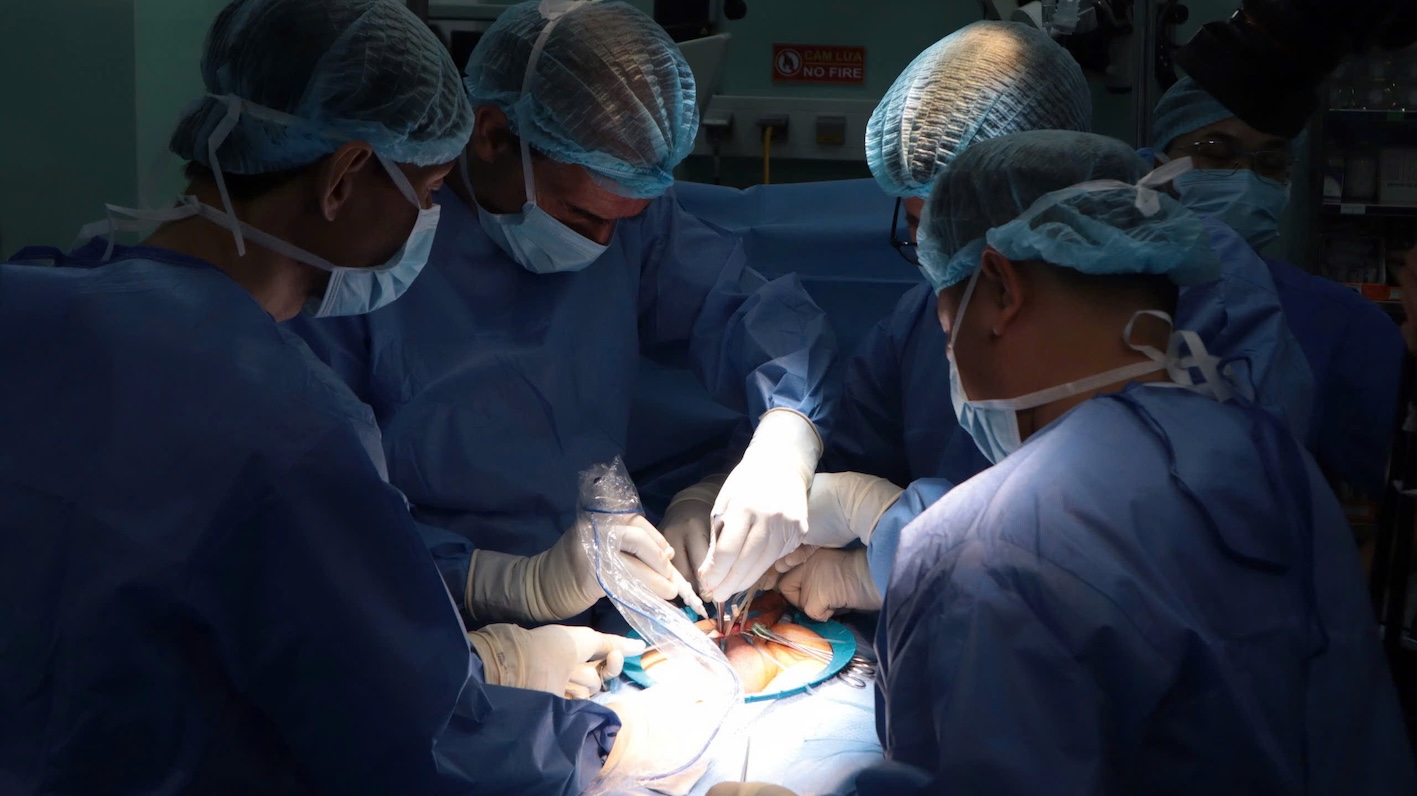 |
Surgical experts demonstrate at Binh Dan Hospital on 5/6. *Photo: Hospital provided*
Preserving fertility for cancer patients
Beyond life-threatening implications, male genital cancers significantly impact fertility. According to Dr. Dung, chemotherapy and radiation therapy, two crucial treatment methods, can severely damage spermatogenic cells, leading to a loss of sperm production. Therefore, preserving fertility before treatment is considered a mandatory and humanitarian strategy.
For children under 15, the current approach involves preserving germ cells within testicular tissue to maintain fertility. If radiation therapy is necessary, doctors prioritize localized radiation techniques or relocating the testicles outside the radiation field to minimize damage to the spermatogenic system.
For adult men who can still ejaculate, the optimal solution is sperm cryopreservation before treatment for future in vitro fertilization (IVF). In cases where ejaculation is not possible due to testicular cancer or other genital cancers, sperm can be isolated directly from testicular tissue for storage.
However, the sperm recovery rate after thawing is not absolute. According to Dr. Dung, a 60-65% recovery rate is considered successful. Currently, micro-droplet cryopreservation technique is viewed as a promising direction for better stabilizing sperm quality.
In the coming period, Vietnam's urology sector plans to collaborate with the European Association of Urology to implement large-scale screening, research, and statistical programs for these conditions.
Le Phuong