Germany's Federal Statistical Office (Destatis) announced on 8/7 that the average life expectancy for women increased by two months and for men by three months compared to 2024. This marks a strong recovery after a period of decline attributed to the Covid-19 pandemic.
This growth rate becomes more evident when comparing it to 2022 figures. German statistical experts highlight that in the past three years alone, women's life expectancy in the country has increased by approximately nine months, while men's has risen by more than one year. A similar trend is also observed among the elderly population.
Destatis noted that the number of additional years lived by individuals aged 65 increased by one month for women and two months for men last year. Consequently, a 65-year-old woman can now expect to live an average of 21,2 more years, reaching a maximum projected age of 86,2 years. For men of the same age, this figure is 18,2 additional years, equating to a maximum life expectancy of 83,2 years.
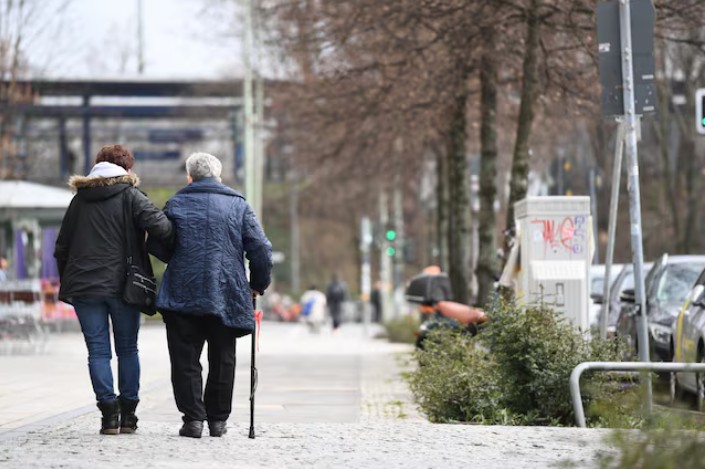 |
Two elderly people walk in Berlin, Germany, in 3/2020. *Photo: Reuters*
Statistical data reveals a clear disparity in living standards and healthcare conditions across Germany's geographical regions. In the most recent three-year calculation cycle, the southern state of Baden-Württemberg continues to lead the nation, with an average life expectancy of 84,4 years for women and 80,3 years for men. Conversely, residents in Saarland have the lowest average life expectancy for women nationwide at 82 years, while Saxony-Anhalt records the lowest for men at 76,4 years.
Scientists at the Max Planck Institute for Demographic Research explain that despite consistently setting new peaks, the growth rate of average life expectancy in Germany has slowed significantly compared to the first half of the 20th century. The core reason is that medical advancements reduced infant mortality rates to a near minimum decades ago, leaving little room for further improvement in this indicator.
This upward trend in life expectancy is prompting German officials to seek financial solutions for the national pension fund, which faces pressure from an aging population. The country's Pension Committee recently proposed a method to link the retirement age to the average life expectancy of the population using a "2:1" formula.
If the German government approves this proposal, for every one year increase in a generation's average life expectancy, workers from that generation will need to work an additional eight months, receiving only four more months of pension benefits.
Binh Minh (According to Spiegel Science)