Ho Chi Minh City has launched a new digital dashboard to centralize public feedback on healthcare services, a move aimed at improving transparency and accountability across its medical facilities. This initiative, officially operational from december 22, allows residents to easily submit their input and monitor the resolution process, according to Tang Chi Thuong, director of the Ho Chi Minh City Department of Health. The system, developed and tested over time, ensures that every piece of public feedback is received, categorized, processed, and addressed on a unified digital platform, replacing previous manual tracking methods.
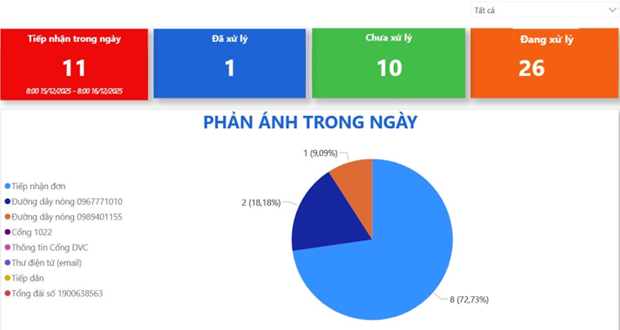 |
Interface of the dashboard for receiving and tracking public feedback in the healthcare sector, officially operational from december 22. *Photo: Ho Chi Minh City Department of Health*
The primary goal of this digital transformation is to enhance patient voice and foster a more responsive healthcare environment. By centralizing feedback, the system provides a clear record of interactions, which clarifies the responsibilities of each healthcare unit. This approach also generates a valuable data repository, enabling the health sector to analyze trends, refine professional procedures, and enhance service attitudes based on real-world experiences.
Previously, the Department of Health handled feedback primarily through a hotline. Call center staff would contact relevant healthcare facilities to investigate and resolve issues, then report the outcomes. While this approach addressed many cases quickly, the data remained fragmented and lacked full digitization. This made it challenging for long-term management and continuous quality improvement. The new dashboard directly addresses these limitations.
The system integrates feedback from various channels, including hotlines, suggestion letters, citizen reception, complaint and denunciation resolution, and other legal avenues. The scope of feedback encompasses nearly all aspects of healthcare operations: staff conduct, professional quality, administrative processes, medical examination and treatment costs, health insurance, infrastructure, medications, vaccines, emergency services, preventive medicine, and patient rights.
Tang Chi Thuong emphasizes that every piece of public feedback, regardless of its perceived size, offers a real-world perspective on patient experiences with medical services. This feedback is crucial for initiating long-term quality improvement cycles, enabling hospitals to objectively and factually assess their operations. To ensure the system's effectiveness, the Department of Health mandates that directors of hospitals and healthcare facilities directly supervise the reception, processing, and response to public feedback. This responsibility is designated as a regular duty, integral to the role of the institutional head. The proactive engagement of these facilities, coupled with public oversight, is expected to significantly enhance service quality and patient satisfaction.
Le Phuong