On 24/9, Doctor Nguyen Duy Long, Director of the Ho Chi Minh City 115 Emergency Center, reported that from 14 to 22/9, the hotline received 15,684 calls. Of these, 1,482 calls showed signs of an emergency, while the rest were primarily requests for advice on handling situations. The entire network carried out 1,242 vehicle dispatches, averaging 138 dispatches per day, a nearly 10% increase compared to the previous average. Notably, on 19/9, the hotline recorded 2,003 calls, marking the first time it surpassed the 2,000-call threshold in one day.
These figures represent a record for 115 Emergency to date.
Heavy rains have consistently affected Ho Chi Minh City in recent days, leading to widespread flooding and traffic congestion. These conditions have impacted residents' travel and daily lives, and are considered the primary reason for the surge in emergency calls.
According to Doctor Long, practical experience from 115 Emergency operations shows that during heavy rain, slippery roads, flooding, and reduced visibility make commuters prone to traffic accidents. Trees, branches, and billboards can fall, and residents are more likely to slip and fall when navigating flooded areas.
Notable risks include drowning, being swept away by water, and electrocution. Electrocution can occur inside homes when floodwaters contact outlets, wires, or electrical appliances.
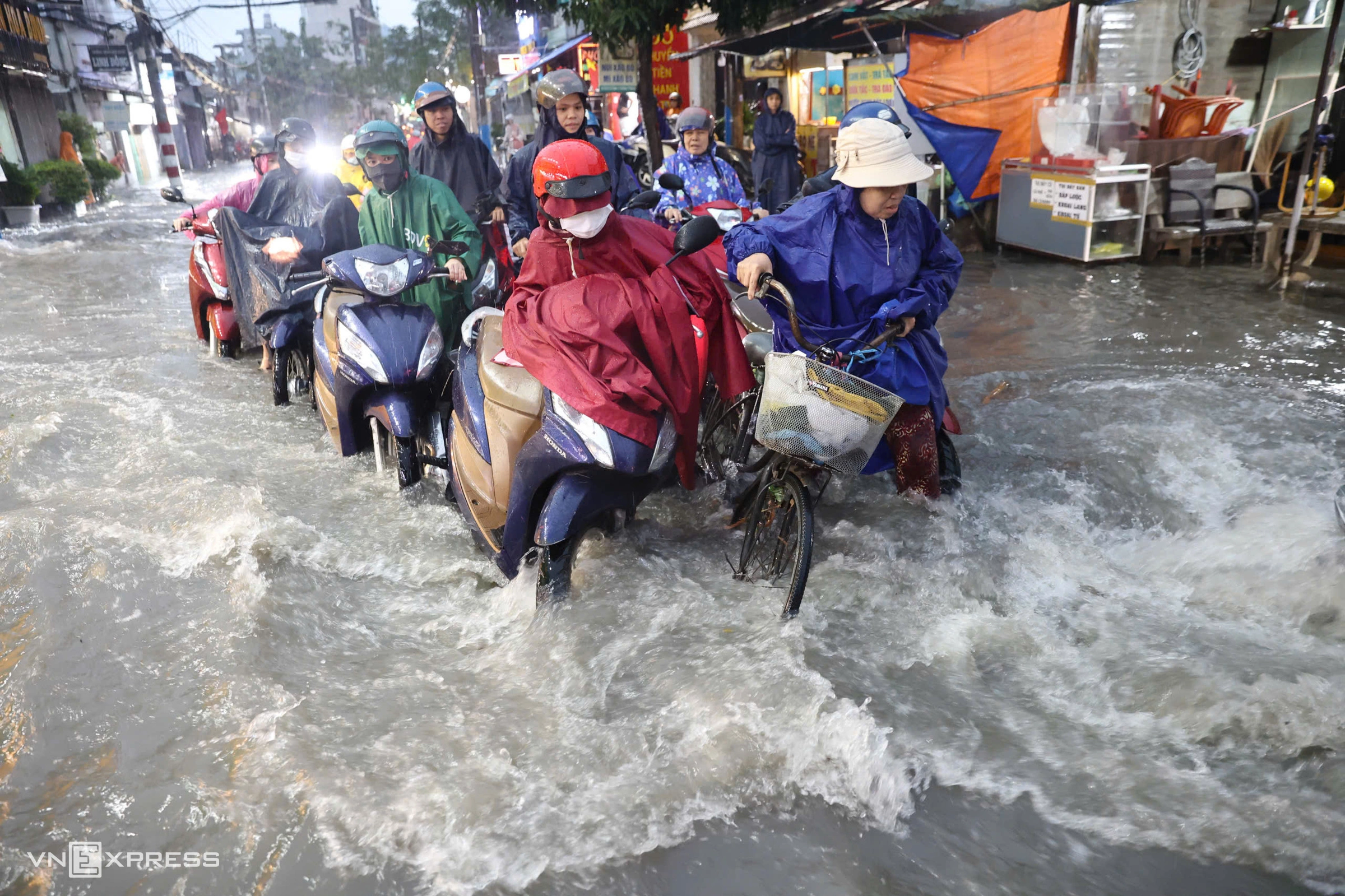 |
Widespread heavy rain caused strong water flow, cascading like a waterfall on Ly Te Xuyen street, at its intersection with Linh Dong street (former Thu Duc City) on the afternoon of 22/9. *Photo: Quynh Tran* |
The Ho Chi Minh City 115 Emergency Center advises residents to reduce speed and maintain distance when driving in the rain. They also recommend avoiding deeply flooded areas, strong currents, or roads where the surface is not clearly visible. Furthermore, people should avoid standing under large trees, electricity poles, or billboards during stormy weather.
If homes are flooded, exercise caution with power sources. Do not touch electrical appliances or areas of water suspected of having electrical leaks until safety is ensured. Special attention should be given to young children, the elderly, and individuals with mobility issues when homes are flooded.
When encountering a victim, ensure your own safety before offering assistance, especially in flooded environments, areas with electricity, or strong currents. "Do not let one victim become two victims", Mr. Long emphasized.
In an emergency, residents should call 115 promptly, providing the exact location, the victim's condition, and any hazards at the scene. Callers should also follow the instructions given by the hotline operator.
During periods of high call volume, the 115 Emergency Center requests that residents use the 115 hotline for its intended purpose, communicating briefly and accurately. This ensures the line remains prioritized for genuine emergencies.
Le Phuong