Monitoring and supporting children's and adolescents' height development is gaining increasing attention. According to 2026 data from World Population Review on average height in several countries and territories, 19-year-old males in Taiwan (China) have an average height of 173,5 cm, while females average 160,7 cm. This growth still shows a gap compared to some neighboring countries, indicating considerable room for further assessment of children's physical condition and development.
Su Ben-hua, Chair of the Taiwan Precision Child Health Association, states that height is a key indicator reflecting overall nutritional status and living environment. Early detection of developmental abnormalities and timely medical examination enables parents to leverage the "golden period" for intervention.
Warning signs of slow development risk
According to Su Ben-hua, if a child, from the age of six, falls below the 3rd percentile for their age, or does not grow more than 4 cm within one year, these are potential warning signs of slow development.
In a child's growth chart, the 3rd percentile is a statistical threshold used to compare a child's height or weight with peers of the same age and gender. If a child's height is at the 3rd percentile, it means that if 100 children of the same age and gender were lined up from shortest to tallest, your child would be the third from the bottom. This implies that 97% of children in their age group are taller, and only 2% are shorter.
At this point, parents should take their child to pediatric specialists in genetics, endocrinology, or metabolism for a comprehensive evaluation.
Furthermore, height development is closely linked to bone age. Doctor Tung Yi-ching, a pediatric endocrinologist at Taipei Medical University Hospital, adds that growth plates in girls typically begin to close around bone age 16, and around bone age 18 for boys. After this period, the potential for further height growth significantly diminishes. Therefore, regularly recording and monitoring growth charts is crucial for identifying the optimal time for medical intervention.
A survey on height development and self-confidence in children and adolescents aged 6-18, conducted by the Taiwan Precision Child Health Association, found that 36,6% of parents consider their child to be "short". However, understanding when to seek medical attention showed a significant disparity: 77,8% of parents were unaware that if their child's height is below the 3rd percentile or grows less than 4 cm in a year, a specialized check-up is necessary.
The survey also indicated that approximately 46% of parents observed their children experiencing negative emotions due to their height or short stature. Despite this, the proportion of parents who proactively sought medical examinations for their children was only about 30%, with even fewer children actually commencing treatment. This highlights a gap between parental concern and actual action. Expert Su Ben-hua recommends that if the developmental gap between a child and their peers widens, families should seek professional advice to avoid missing the appropriate intervention window.
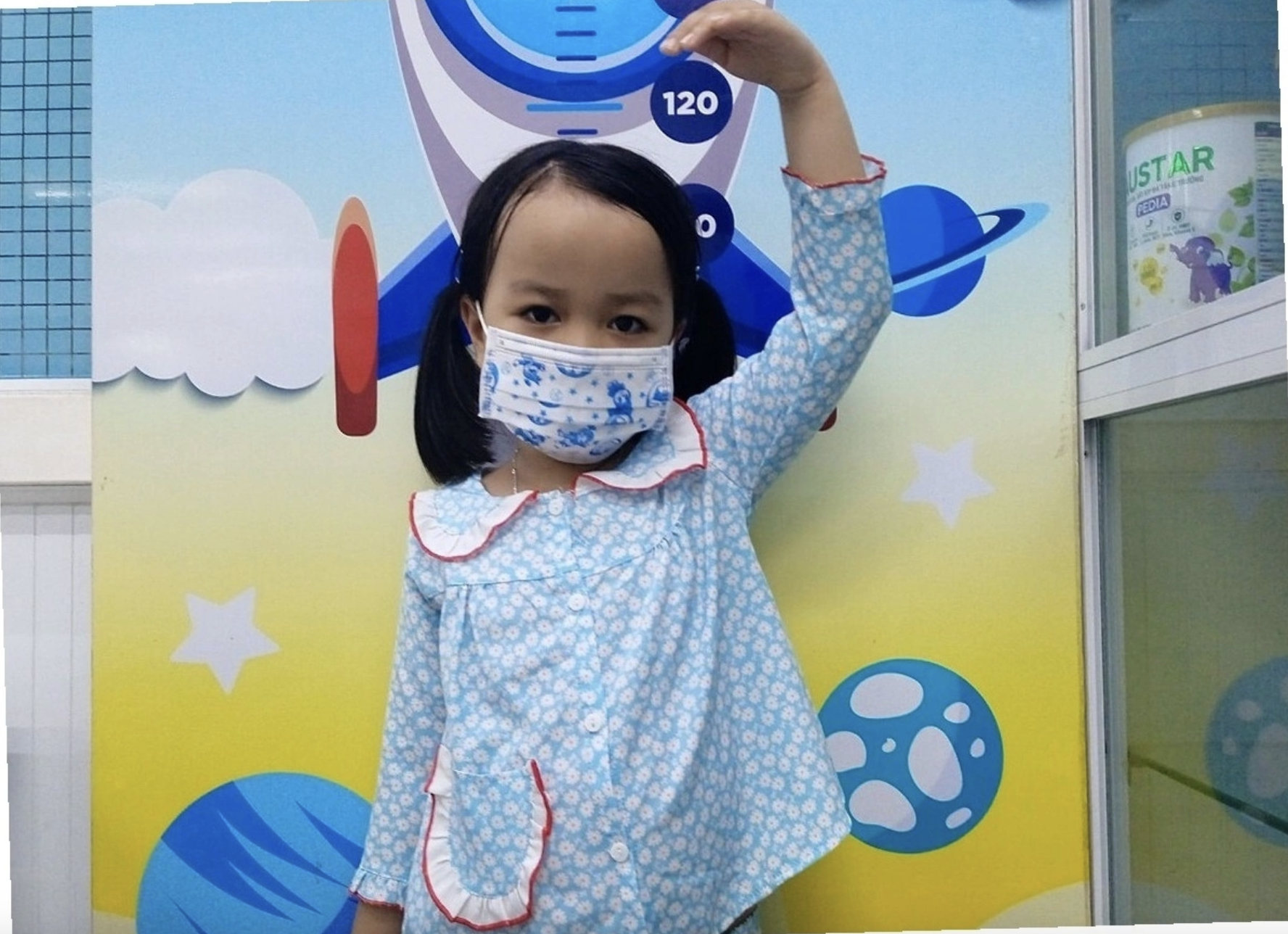 |
Parents should regularly monitor their child's height to assess growth rate. Photo: Kim Uyen
Growth treatment
Doctor Tung Yi-ching explains that the main conditions affecting height include early puberty, growth hormone deficiency, and certain genetic conditions. Clinical growth hormone deficiency, in particular, requires a prolonged period of monitoring and testing for a definitive diagnosis.
First, the diagnostic and treatment process requires continuous observation. Doctors typically need to monitor a child's growth trajectory for three to six months, combined with specialized tests, before determining if treatment is necessary.
Second, with some previous treatment methods, prolonged use can lead to reduced treatment response, which is often difficult to detect in the early stages.
Third, traditional daily growth hormone injections create psychological pressure and behavioral barriers for both children and families. This directly reduces treatment adherence; clinical practice shows many cases where injections are forgotten or administered inconsistently.
Doctor Tung Yi-ching emphasizes that the treatment journey affects not only physical development but also inadvertently strains parent-child interactions. Therefore, enhancing the feasibility and convenience of long-term treatment regimens is a key focus for clinicians.
With advancements in medicine, a long-acting growth hormone administered once a week is now available. This new solution offers a significantly different dosing frequency compared to the previous daily injection regimen. Doctor Tung Yi-ching states that the design goal of this medication is to reduce injection frequency, thereby helping patients maintain more stable treatment adherence throughout the long-term process.
Some clinical studies report that compared to daily injections, the new generation weekly growth hormone reduces injection pain and has not shown cases of antibody development. Under specific conditions, this helps maintain stable drug concentrations and minimizes the risk of missed doses. However, the choice of specific treatment method still requires direct assessment and prescription from a specialist for each individual case.
Building a healthy lifestyle and monitoring habits to capture the "golden period"
Doctor Tung Yi-ching notes that alongside medical intervention, children's and adolescents' height development relies on a foundation of healthy living. This includes: maintaining sufficient and timely sleep, a balanced diet, and appropriate physical activity.
Parents are also advised to regularly measure and record changes in their child's height. As soon as a child's height falls below the 3rd percentile for their age, or if they grow less than 4 cm in one year, parents should seek early medical consultation to discuss a suitable monitoring or treatment strategy with a specialist, avoiding the missed opportunity of the most important developmental period in a child's life.
My Y (Source: HK01)