Breast implants are a cosmetic choice for women desiring fuller breasts. Breast cancer screening is necessary both before and after implant placement, but post-implant screening can be more challenging.
Mammography is considered the "gold standard" for breast cancer screening, effective at detecting microcalcifications. However, X-rays cannot penetrate silicone or saline implant materials. During the procedure, a technician will gently push the implant towards the chest wall, pull breast tissue forward, and take images from various positions and angles with appropriate compression to ensure full visualization of the breast tissue.
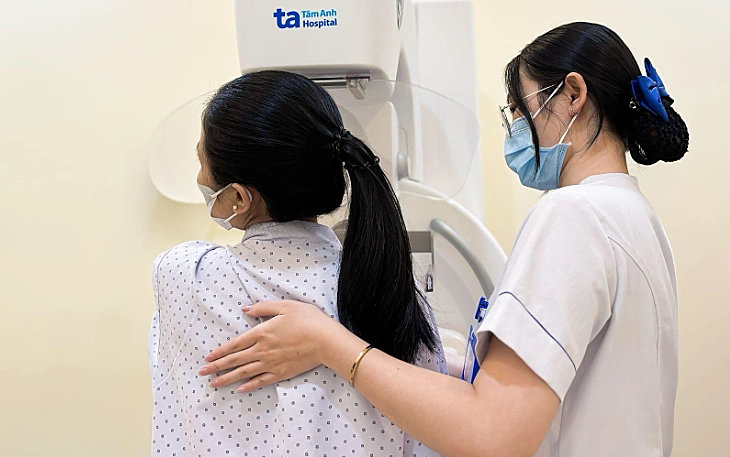 |
A patient undergoes mammography at Tam Anh General Hospital, TP HCM. Photo: Hospital provided |
Women who have undergone breast cancer treatment, involving a complete mastectomy and reconstruction with implants, do not require mammography for the reconstructed breast. The remaining breast, if unaffected by cancer, should still be screened with mammography.
Breast ultrasound is a common screening method that uses high-frequency sound waves to detect abnormalities in breast tissue. Ultrasound does not emit radiation and is low-cost; however, this method is less sensitive to small microcalcifications. In cases where mammography cannot fully visualize all breast tissue, doctors may recommend supplementary ultrasound to examine the remaining breast tissue.
MRI is often used for breast cancer screening in individuals with breast implants. An MRI machine can detect implant leaks or ruptures that ultrasound or mammography might miss. Women should have their breast implants checked in the fifth or sixth year after their initial surgery, followed by routine check-ups every two to three years.
Doctors will recommend suitable screening methods based on individual risk factors and condition, potentially combining diagnostic approaches to avoid missing any lesions.
Regarding your situation, Ngoc Ha, since your breast implants show no signs of pain or deformation, annual mammography and ultrasound are recommended for screening. If you are in a high-risk group due to carrying a BRCA gene mutation, have a family history of breast cancer, or suspect an implant rupture, an MRI should be considered.
Huynh Ba Tan, Master of Science, Doctor, First-Degree Specialist
Department of Surgical Oncology
Oncology Center
Tam Anh General Hospital, TP HCM