Doctor Nguyen Hoang Duc, Head of Urology at the Center for Urology - Nephrology - Andrology, Tam Anh General Hospital, TP HCM, states that prostate cancer is common in men over 50 and tends to increase with age. In its early stages, prostate cancer often has no clear symptoms and is easily mistaken for benign prostatic hyperplasia.
When symptoms such as blood in urine or bone pain appear, the disease is typically already in an advanced stage. The tumor can invade and metastasize to other organs like bones (causing pain and fractures), lymph nodes, liver, and lungs. Within the urinary system, the disease can lead to urinary incontinence, acute urinary retention, kidney failure due to tumor invasion of the ureters, and erectile dysfunction.
According to Doctor Duc, prostate cancer can be treated effectively. Depending on the disease stage, prostate-specific antigen (PSA) levels, malignancy grade, and the patient's overall health, doctors may prescribe treatment using the following methods:
Radical prostatectomy
This is the primary method for early stages (stage one and stage two), when cancer cells are confined to the prostate. Doctors remove the entire prostate, seminal vesicles, and surrounding tissues, either through open surgery or endoscopic surgery.
Currently, endoscopic surgery assisted by the Da Vinci Xi robot offers many advantages in radical prostatectomy. Thanks to a 3D camera system that magnifies 15 times and flexible robotic arms that rotate 540 degrees, surgeons can perform precise dissections, avoid large blood vessels, and preserve the neurovascular bundles, minimizing the risk of erectile dysfunction and urinary incontinence after surgery. If performed in the early stages, the cure rate can be over 90%, according to Doctor Duc.
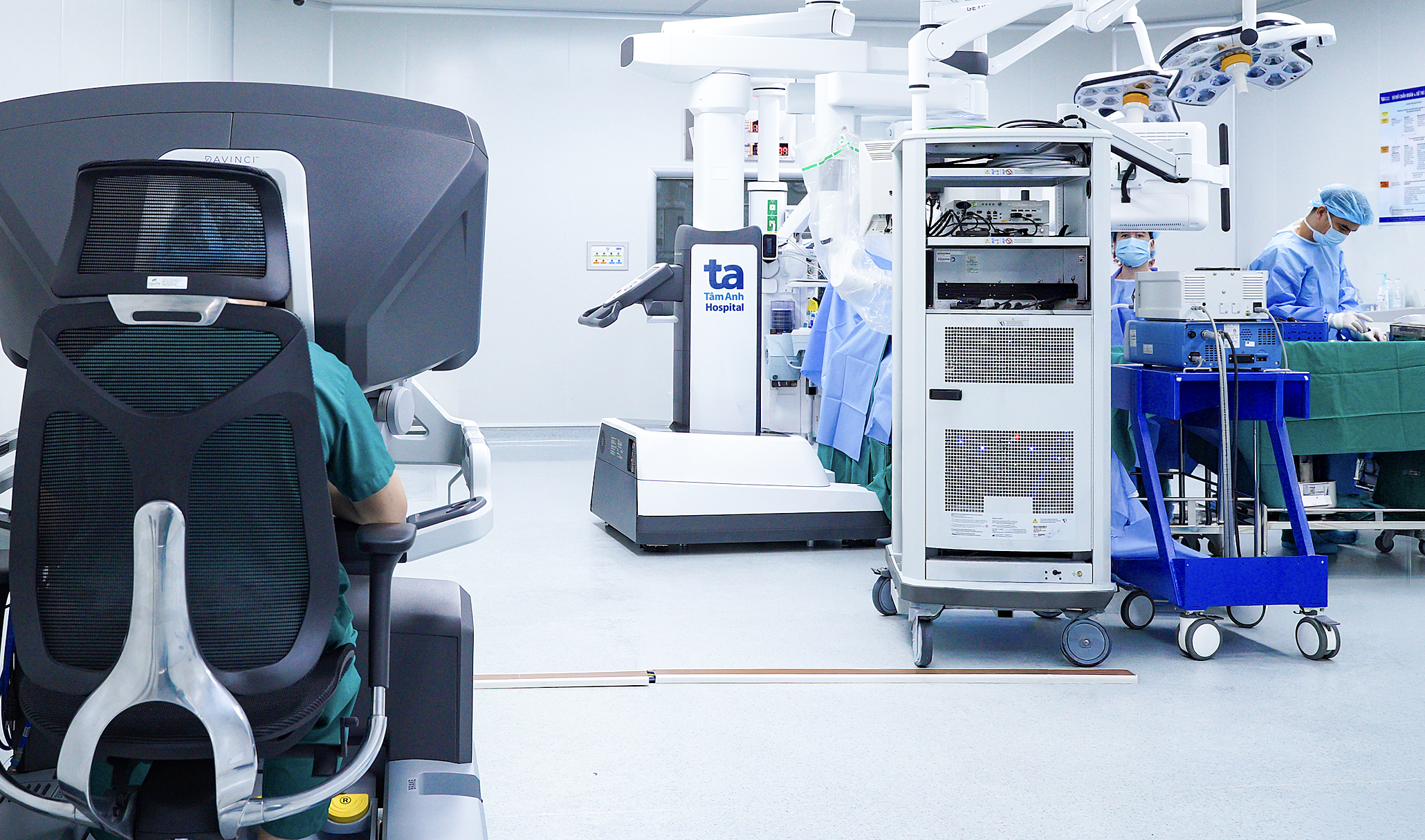 |
Doctor Duc (seated) operates the Da Vinci Xi robot to treat prostate cancer for a patient. Photo: Tam Anh General Hospital
Radiation therapy
This method is typically reserved for stages where cancer has spread significantly beyond the prostate capsule or for elderly patients with underlying health conditions who are not strong enough for surgery. Doctors use high-energy X-rays to destroy malignant cells. A course of radiation therapy usually lasts 4-6 weeks and causes few side effects.
Hormone therapy
This method does not aim to cure prostate cancer but primarily to control tumor growth, often applied to patients with distant metastases (such as bone metastasis). The goal is to suppress the source of testosterone (the male hormone) to prevent cancer cells from developing for a certain period. Patients can choose surgical removal of both testicles or regular injections (usually every 28 days) continuously for 6-12 months, with equal effectiveness in reducing testosterone.
In some cases of radiation therapy, doctors may also combine it with hormone therapy to enhance cancer control to the best possible level.
After intervention, monitoring PSA levels is very important; if PSA levels fall to the lowest possible level (ideally below 0.1 ng/mL), it is considered a success. If PSA increases to 0.2-0.4 ng/mL, a PSMA PET CT scan is necessary to assess and detect the early risk of cancer recurrence.
Globocan 2022 reported prostate cancer as the 4th most common and 8th deadliest cancer globally. Doctor Duc recommends that men over 50 (or from 40 if there is a family history of the disease) undergo PSA testing and regular check-ups for early detection and timely treatment.
Dinh Lam