Due to her condition, Phuong experiences cognitive delays and slower processing compared to typical development. Two years ago, she was pregnant with her first child, who was diagnosed with microcephaly and severe brain abnormalities. Genetic testing of amniotic fluid samples revealed the fetus had both deletions and duplications in two distinct regions on chromosome 18, leading to the difficult decision to terminate the pregnancy.
Earlier this year, Phuong and her husband sought consultation at the Reproductive Support Center, Tam Anh General Hospital TP HCM (IVF Tam Anh TP HCM). Phuong's karyotype test revealed chromosomal abnormalities identical to those found in her previous fetus. Since her husband's karyotype was normal, there was a 50% risk of Phuong's genetic abnormality being inherited by their child, potentially causing birth defects primarily affecting brain development and intellectual function.
According to Master Ma Pham Que Mai, a genetic counselor, Phuong and her husband still had the opportunity to have a healthy child through in vitro fertilization (IVF) and preimplantation genetic testing (PGT). This approach involves identifying embryos that carry the chromosome 18 abnormality inherited from the mother.
Doctors stimulated Phuong's ovaries, retrieving 9 mature oocytes. These were then fertilized with her husband's sperm, resulting in 4 good quality day 5 embryos. At day 5, embryos typically comprise 100-200 cells and have differentiated into two distinct groups: those that will develop into the fetus and those that will form the placenta. Embryologists performed a biopsy on 5-10 cells from the placental precursor cells for genetic testing. The results indicated that two embryos carried chromosomal abnormalities identical to Phuong's.
In late August, doctors prepared Phuong's uterine lining and transferred one healthy embryo, which led to a successful pregnancy. The fetus is currently 18 weeks old, with ultrasound and non-invasive prenatal testing (NIPT) results confirming healthy development.
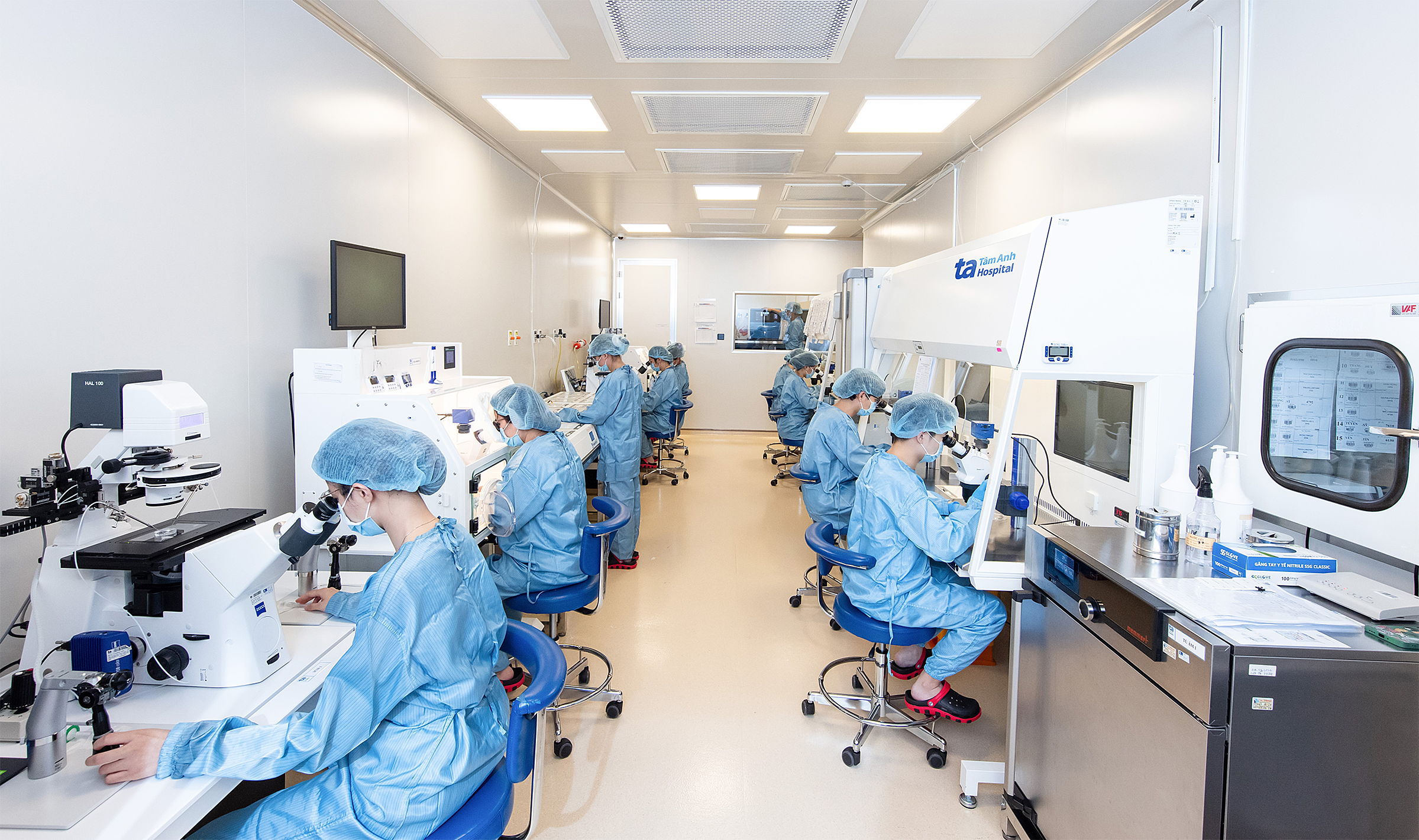 |
Embryologists perform specialized in vitro fertilization and genetic analysis techniques within the "lab-in-lab" system. *Photo: Tam Anh General Hospital* |
Master Mai explained that the human genome comprises approximately 3 billion DNA base pairs, organized across 46 chromosomes. Common chromosomal abnormalities include numerical variations (excess or deficiency), such as: Down syndrome, Turner syndrome, Klinefelter syndrome, and Jacob syndrome. Structural abnormalities, like deletions, duplications, inversions, or translocations, are also frequently observed. At the gene level, there are around 7,000 known genetic diseases. A notable example is autism spectrum disorder, which directly impacts the nervous system and can reduce a child's intellectual capacity.
To identify the root cause of genetic abnormalities, specialized genetic testing is essential. At IVF Tam Anh TP HCM, advanced day 5 embryo culture technology combined with preimplantation genetic testing (PGT) techniques enables screening for over 7,000 genetic conditions that cause birth defects and disabilities. These include: thalassemia, spinal muscular atrophy, hereditary polycystic kidney disease, and cystic fibrosis. This allows doctors to select embryos free of genetic abnormalities for uterine transfer, significantly increasing successful pregnancy rates and the likelihood of a healthy birth. For such cases, the healthy birth rate approaches 70%.
Hoai Thuong
*Patient's name has been changed