


The Centers for Disease Control and Prevention (CDC) activated Title 42 on 18/5, a public health law that allows the US to restrict entry during infectious disease outbreaks. This measure, effective for at least 30 days, targets individuals who have spent time in Congo, Uganda, or South Sudan within the last three weeks, aiming to curb the spread of Ebola.
Title 42, enacted in 1944, has been invoked only two times. Its first use was from 3/2020 to 5/2023 during the Covid-19 pandemic. The recent activation marks the second instance of the law being utilized in response to a public health crisis.
In a related development, the Vietnam Ministry of Health issued a recommendation on 17/5, urging citizens returning from affected areas not to panic but to self-monitor their health for 21 days.
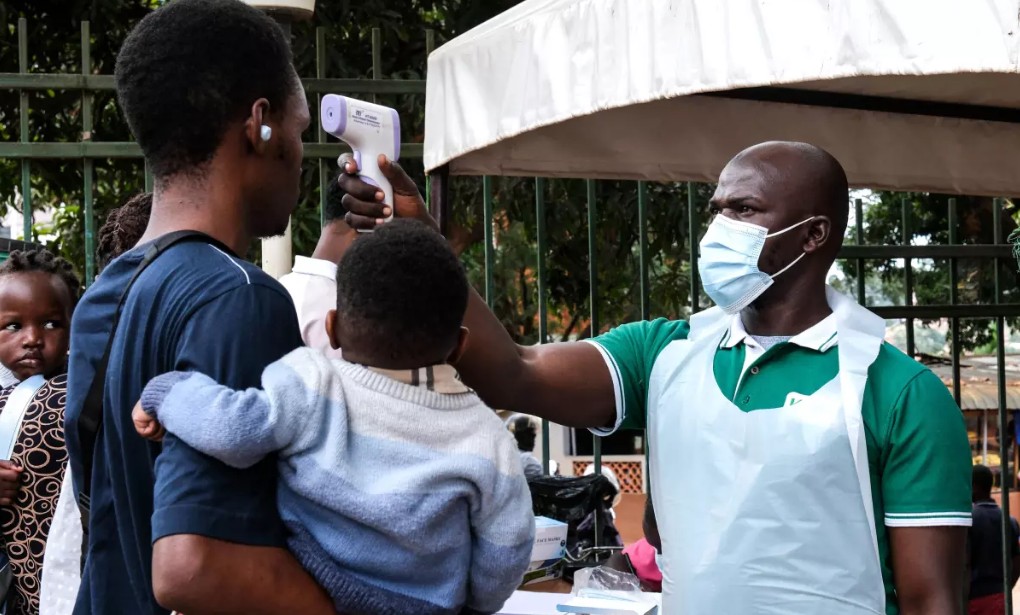 |
Healthcare workers use thermometers to check body temperature for people outside Kibuli Muslim Hospital in Kampala, Uganda, on 16/5. Photo: Hajarah Nalwadda/AP |
Healthcare workers use thermometers to check body temperature for people outside Kibuli Muslim Hospital in Kampala, Uganda, on 16/5. Photo: Hajarah Nalwadda/AP
Africa CDC announced yesterday that the current Ebola outbreak has resulted in 395 suspected cases and 106 deaths across Congo and Uganda. Africa CDC Director General Jean Kaseya described this casualty figure as "unacceptable."
The World Health Organization (WHO) immediately declared a global health emergency last weekend after Uganda reported two imported cases. Subsequently, the Ugandan government postponed a major religious event to mitigate the risk of pathogen transmission among large gatherings of pilgrims.
US health officials identified at least six US citizens who were exposed to the Ebola virus while working in Africa. The charity Serge confirmed that missionary doctor Peter Stafford tested positive for Ebola after exposure in Congo. The US government is arranging the evacuation of doctor Stafford, his wife, four children, and a colleague to Landstuhl Regional Medical Center in Germany for isolation and treatment.
Landstuhl Regional Medical Center, the largest US hospital outside its territory, serves as a crucial evacuation and treatment hub for US military personnel in Africa, Europe, and the Middle East. This 65-bed medical facility played a similar role during the 2014-2015 Ebola outbreak in West Africa, when the US deployed 3,000 military personnel to assist in disease control efforts.
To mitigate risks, the US Department of State has advised its citizens to avoid travel to Congo and Uganda. It has also dispatched health experts to assist these nations with epidemiological tracing.
Experts have identified the Bundibugyo virus strain, which caused the current outbreak, as rare. It transmits through direct contact with infected body fluids or contaminated objects. There is currently no vaccine or specific treatment for this virus, which has a mortality rate of 25-40%. Former Mongbwalu Mayor Jean Pierre Badombo indicated that the outbreak began in mid-April, spreading silently for weeks after a large funeral in Ituri province.
 |
Doctors Peter and Rebekah Stafford. Photo: Serge |
Doctors Peter and Rebekah Stafford. Photo: Serge
Public health expert Ahmed Ogwell noted that local lifestyle habits, closely linked to the jungle, increase residents' exposure to fruit bats carrying the pathogen. International organizations are rapidly deploying personnel and supplies to the epicenter to address challenges posed by poverty and security instability in the region.
By Binh Minh (The Telegraph, CNN)


