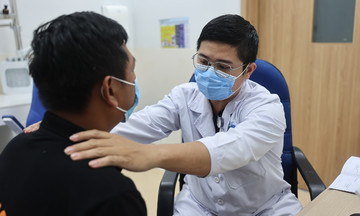
Associate Professor Dong Van He, Deputy Director of Viet Duc Hospital and Chairman of the Vietnam Neurosurgical Association, announced this data at an international conference on epilepsy surgery on 11/12. He noted that a large number of patients do not receive proper treatment, leading to a high rate of drug resistance.
This marks the first time data on epilepsy patients in Vietnam has been publicly released.
Drug-resistant epilepsy refers to seizures that persist despite the use of at least two anti-epileptic medications. This condition affects approximately 30% of epilepsy patients. For many decades, epilepsy in Vietnam has primarily been managed with medication, seizure monitoring, and rehabilitation support. However, for drug-resistant patients, conventional treatment protocols are largely ineffective. This significantly impacts patients' quality of life, as they continue to experience seizures, cognitive decline, and mental health issues.
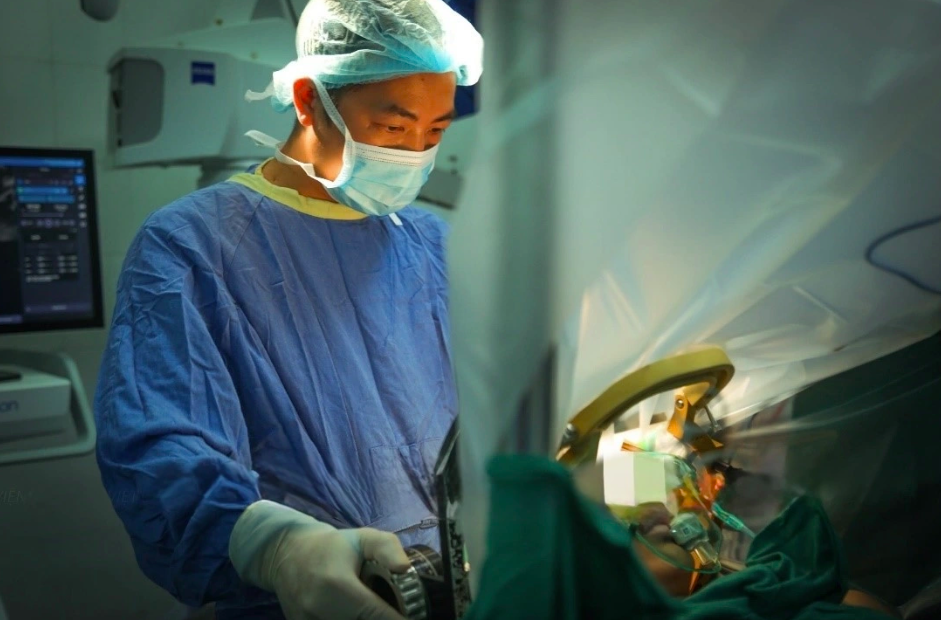 |
A neurosurgery procedure at Viet Duc Hospital. Photo: Hospital provided |
"When medication fails to control seizures, surgery is the only way to improve quality of life and reduce the risk of long-term complications," Associate Professor He stated. A crucial condition for successful surgery is precisely identifying the epileptogenic zone—the part of the brain responsible for initiating and spreading seizures. If this area is removed or intervened without causing significant damage to normal brain function, patients experience a reduction in or complete cessation of seizures.
In cases where the suspected epileptogenic zone is complex—for instance, if seizures originate in deep or bilateral regions, or if magnetic resonance imaging shows unclear lesions—doctors use invasive methods such as deep electroencephalography or stereoelectroencephalography (SEEG).
SEEG is a technique involving the placement of depth electrodes through the skull into the brain, precisely positioned in three dimensions, to record electrical brain activity from deep and complex regions. This approach allows doctors to collect electroencephalography data during the "inter-ictal" phase (between seizures) from multiple areas simultaneously, unlike shallower methods such as surface electrode grids.
Associate Professor He reported that studies indicate a low complication rate with SEEG. For example, a systematic analysis of 57 articles involving over 2,500 patients showed a bleeding rate of approximately 1% and an infection rate of about 0,8%. The total complication rate was around 1,3%.
However, any invasive procedure carries risks, including intracranial bleeding, damage to small blood vessels, infection along the electrode pathway, or postoperative complications. Therefore, doctors carefully weigh potential benefits against risks, and patients must receive thorough counseling before undergoing the procedure. The application of SEEG is a mandatory requirement at major neurosurgical centers worldwide, and Vietnam is currently in the initial stage of adopting this process.
Over the past 10 years, Viet Duc Hospital's Neurosurgery Center has examined and screened hundreds of thousands of epilepsy patients, performing surgery on over 150 cases of drug-resistant epilepsy. Currently, the seizure control rate is 80%, leading to a notable improvement in patients' quality of life.
Le Nga