Dr. Diep Bao Tuan, Director of Ho Chi Minh City Oncology Hospital, stated that the hospital estimates over 1,08 million patient visits this year, an increase of more than 200,000 visits from 880,000 last year, representing over 22%. Among the more than 42,000 new cancer cases at the hospital this year, thyroid cancer topped the list at 23,2%, followed by breast cancer at 18,1%. In recent years, thyroid cancer has consistently held the highest position, replacing breast cancer, which previously led.
According to Globocan 2022, thyroid cancer ranks 6th in new incidence rates in Vietnam and 21st in mortality rates. Dr. Tuan explained that the increase in detected cases is primarily due to increasingly accurate diagnostic techniques. Previously, tumors needed to be one to two cm to be detected; now, lesions of three to four mm can be identified via ultrasound and confirmed through cell aspiration.
"Thanks to early detection, treatment is often straightforward, requiring only a thyroid lobectomy with a success rate of up to 98%," Dr. Tuan stated. Patients with thyroid cancer have a good prognosis, with a five-year survival rate exceeding 90% if treated correctly. However, if left untreated, the disease can invade the larynx, esophagus, or metastasize to lymph nodes, lungs, and bones.
The disease can affect all age groups, with women being three times more likely to develop it than men. Risk factors include iodine-deficient diets, exposure to radiation, and a family history of the disease. Individuals with a family member who has been diagnosed are advised to undergo regular thyroid ultrasounds. In its early stages, thyroid cancer often presents no symptoms, and hormone tests remain normal; most cases are discovered when a mass is felt in the neck or through an ultrasound. In later stages, the tumor can cause hoarseness, difficulty swallowing, and shortness of breath due to compression of nerves, the esophagus, or the trachea.
Many people worry that X-rays increase the risk of thyroid cancer. However, Dr. Tuan affirmed that the radiation dose in modern X-rays is very low, with exposure times of only milliseconds, "insufficient to cause the disease." Only cases involving multiple scans in a short period or radiation therapy pose a risk of adverse effects.
Depending on the type of thyroid cancer and the extent of metastasis, treatment options include surgery, radioactive iodine, targeted therapy, or immunotherapy. Surgery remains the foundational method in thyroid cancer treatment.
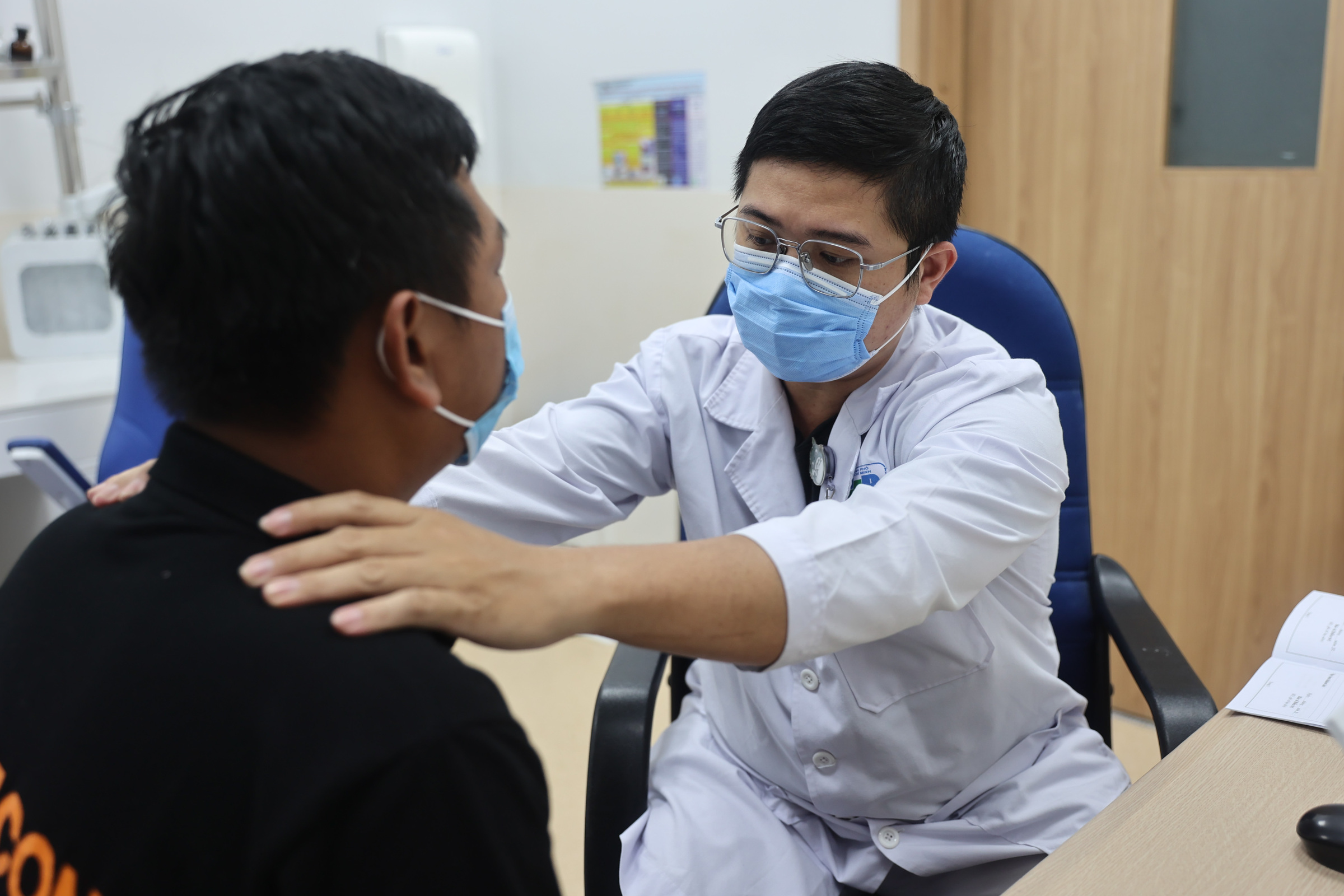 |
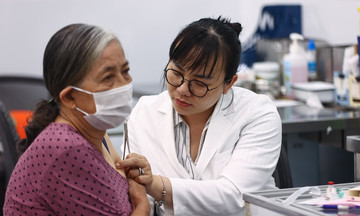
A doctor examines a patient at Ho Chi Minh City Oncology Hospital. Photo: Quynh Tran |
Hospital leadership attributed the increase in patient visits to several factors: the hospital serves as a tertiary care facility, patients have improved economic conditions, and travel has become more convenient due to expressway systems connecting the Mekong Delta and Central Vietnam to Ho Chi Minh City. Epidemiological factors, such as lifestyle or environmental influences, require further research to determine their precise impact.
A study conducted at five large hospitals revealed that 50% to 80% of patients arrive at the hospital when their cancer is already in stage 3 or 4, resulting in high mortality rates and expensive treatment costs. The primary reason for this is that people only seek medical attention when symptoms appear, neglecting regular health check-ups.
Ho Chi Minh City Oncology Hospital is standardizing international screening procedures and transferring these protocols to provincial hospitals to enhance early detection effectiveness. Ho Chi Minh City is also promoting regular health check-ups and cancer screening for its residents. The hospital plans to convert Facility one into a health check-up and screening center for healthy individuals and will open two specialized cancer screening clinics in december.
Le Phuong