Spinal muscular atrophy (SMA) affects patients with varying symptoms depending on the age of onset and disease severity. According to Dr. Nguyen Phuong Thao, a specialist in fetal medicine at Tam Anh District 7 General Clinic, the estimated incidence of SMA is 1/6,000 to 1/10,000 live births. Children may experience progressive muscle weakness, starting from muscles close to the body's center, such as the shoulders, thighs, pelvis, forearms, and legs, or affecting swallowing and respiratory muscles, leading to a risk of mortality.
Vien, 31, carries a heterozygous SMN1 gene mutation with exon deletion, meaning she is a healthy carrier of the spinal muscular atrophy gene (one copy of the SMN1 gene is mutated, while the other copy remains normal). Genetic testing for her 42-year-old boyfriend also revealed a similar gene abnormality. Dr. Thao explained that this means for each pregnancy, there is a 50% chance of having a child who is a healthy carrier (heterozygous), a 25% chance of having a healthy child who does not carry the gene, and a 25% chance of having a child affected by the disease (homozygous).
Spinal muscular atrophy has five levels, from 0 to 4. SMA1 is the most severe and common type, accounting for about 50% of diagnosed patients. Children with SMA1 typically develop symptoms before six months of age and rarely survive beyond two years due to respiratory failure. This is one of the most common genetic causes of infant mortality. Children with SMA2 show symptoms between six and 18 months of age. They may be able to sit independently but cannot stand or walk, facing risks of motor development delays, scoliosis, difficulty swallowing, and respiratory muscle weakness, with an average life expectancy of about 25, according to Dr. Thao.
Vien's specialized genetic test indicated an exon 7 deletion on the SMN1 gene. This is a crucial DNA sequence located at the end of the SMN1 gene. This gene plays a role in controlling the activity of motor neurons in the spinal cord and brainstem. SMN1 gene mutations cause spinal muscular atrophy (SMA), leading to muscle weakness and affecting breathing, swallowing, speech, and walking functions. Spinal muscular atrophy is inherited in an autosomal recessive pattern on chromosome 5, meaning a child only develops the disease if they inherit two copies of the mutated gene, one from each parent. The carrier rate is approximately 1/50.
 |
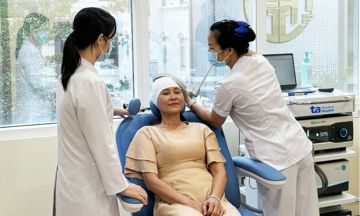
Vien's boyfriend undergoes genetic testing. Photo: Tam Anh District 7 General Clinic |
Dr. Thao advised Vien to supplement with folic acid one to three months before pregnancy to prevent the risk of neural tube defects in the fetus. Her boyfriend needs to change his lifestyle to manage high blood fat levels by exercising 30 minutes daily, eating healthy, and limiting alcohol consumption.
If Vien wishes to eliminate the possibility of having a child with birth defects entirely, she can opt for in vitro fertilization to screen healthy embryos before uterine transfer. For natural pregnancies, doctors can perform chorionic villus sampling from the 12th week of pregnancy or amniocentesis at the 16th week to accurately diagnose whether the fetus has spinal muscular atrophy. If the fetus is abnormal, depending on the family's choice, doctors will provide support for treatment during and after pregnancy.
Currently, the primary treatment method focuses on preventing complications and supporting vital functions for patients. Dr. Thao stated that scientists have researched drugs to help alleviate symptoms of spinal muscular atrophy, however, the cost can be as high as 10-20 billion VND. Furthermore, advanced methods like gene editing, stem cell transplantation, and enzyme replacement therapy are being researched for genetic diseases but have not yet become definitive cures. Therefore, premarital or pre-pregnancy gene screening and prenatal screening at specialized medical centers are optimal preventive measures for genetic diseases.
Ngoc Chau
* Patient's name has been changed
| At 8 p.m. on 26/11, the Tam Anh General Hospital System will host an online consultation program, "Wedding Season - Birth Season: Premarital and Pre-pregnancy Health Checks for Men and Women - Live Happily, Have Healthy Children," broadcast on the hospital's fanpage and VnExpress. Participating doctors include Dr. Nguyen Phuong Thao, Dr. Ha Ngoc Dai, and Dr. Doan Ngoc Thien. Readers can submit questions here for answers. |