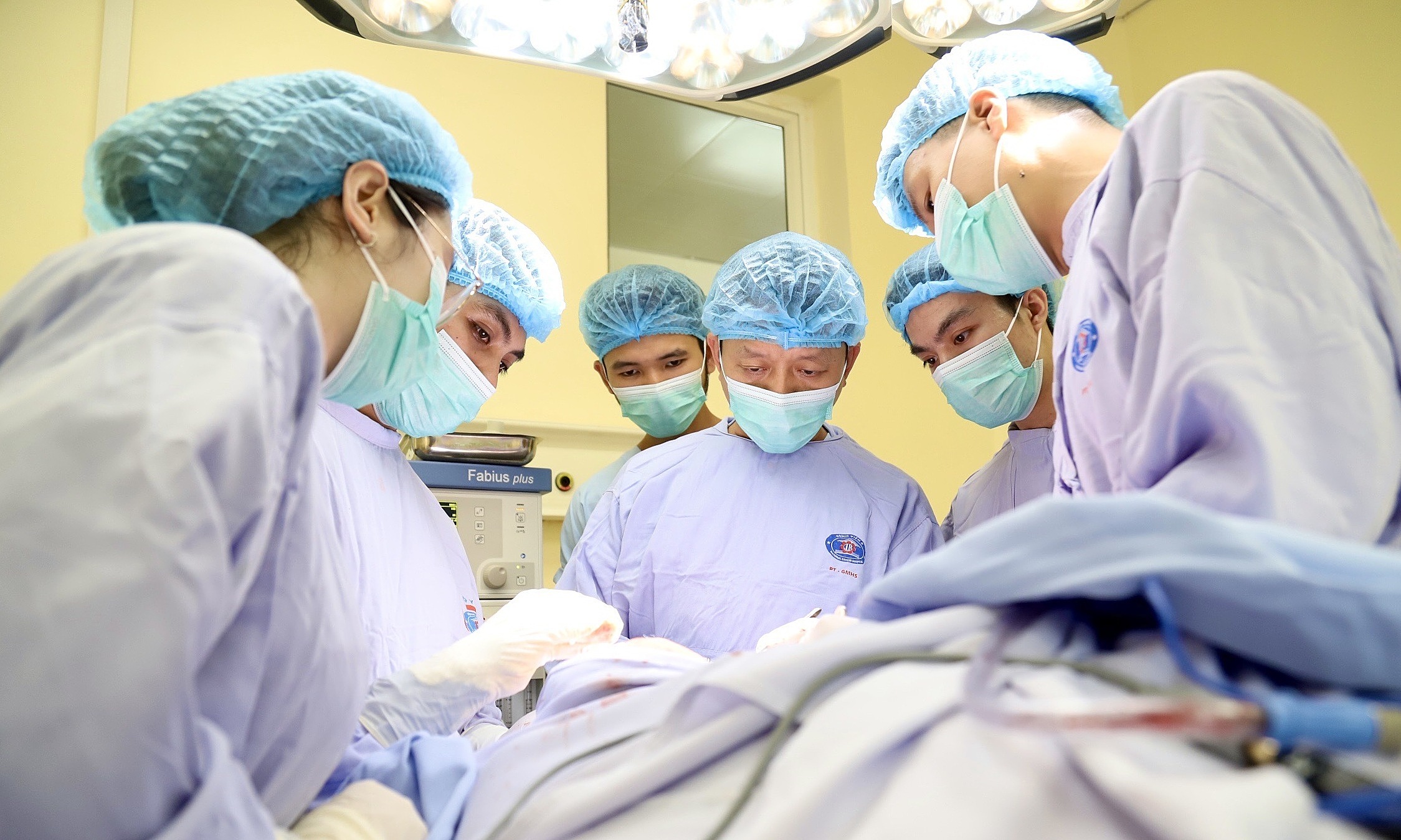
A bolus is a tissue-equivalent, flexible material that conforms to natural surfaces without causing additional harm to already weakened skin. "This marks the first time Tam Anh General Hospital has used a bolus in radiation therapy for head and scalp cancer," stated Doctor Nguyen The Hien, Head of the Radiation Therapy Department at the Oncology Center. Based on CT data, engineers and technicians created a personalized 3D bolus for Mr. Huu, designed to precisely fit every curve and irregularity of his scalp.
Mr. Huu noticed an unusual hard, swollen, and thickened area on his scalp one year ago. Initially diagnosed as a benign tumor, it was surgically removed. However, when the tumor recurred, requiring a second surgery, doctors informed him he had cell sarcoma, a rare cancer with an incidence rate of 0,17 per 1,000,000 people.
Within one year, Mr. Huu underwent several more surgeries, ranging from tumor removal to scalp grafting. These procedures left the treatment area uneven and deformed, making further surgery impossible. Consequently, he was referred to Tam Anh General Hospital, Ho Chi Minh City, for radiation therapy.
According to Doctor Hien, the scalp is a challenging area for radiation therapy. High-energy radiation beams have deep penetration characteristics, passing several centimeters through the treatment area. However, the scalp is a very shallow tissue layer, located directly above the skull. Without proper control, radiation doses could penetrate the skull, risking cerebral cortex necrosis and dementia. Conversely, if the radiation dose is too low, the affected skin area might not receive sufficient treatment.
 |
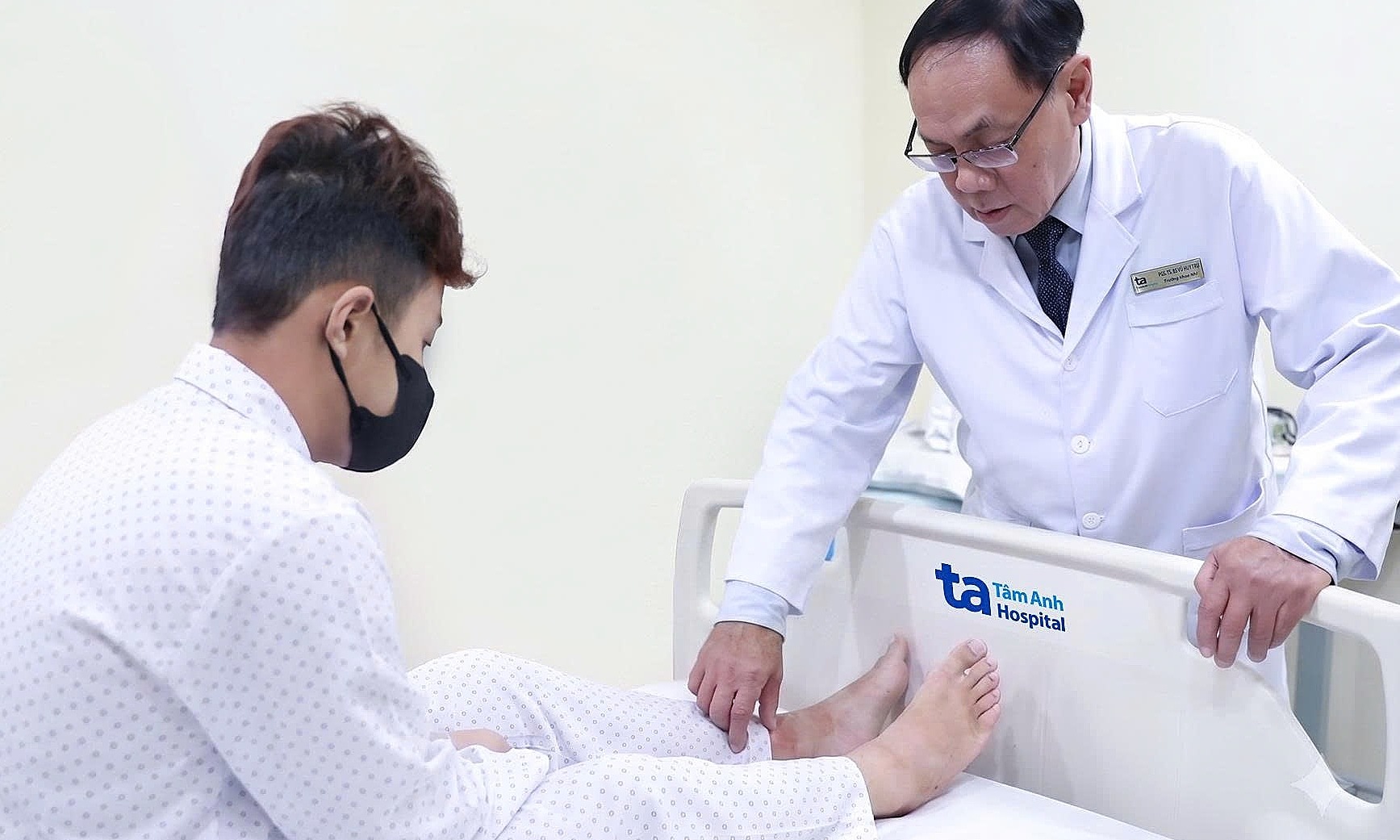
Doctor Hien examining and counseling Mr. Huu about his treatment. *Photo: Tam Anh General Hospital* |
Doctor Hien highlighted that the greatest challenge in whole-scalp radiation therapy is ensuring uniform dose distribution across a complex, curved surface. The skull is spherical, while radiation beams travel in straight lines. When radiation is directed at the scalp, areas like the crown receive an adequate dose. However, areas such as the temples, nape, or irregular contours around the earlobes, bridge of the nose, and nape folds are prone to underdosing due to air gaps, which reduce radiation interaction and treatment effectiveness.
Furthermore, Mr. Huu's multiple surgeries had left his treatment area uneven and deformed. Even small air gaps between the skin and air could reduce the effectiveness of radiation at the target site.
Following a consultation, the medical team decided to treat Mr. Huu using intensity-modulated radiation therapy (IMRT) to precisely focus the radiation dose on the tumor. Concurrently, based on CT data, engineers and technicians created a personalized 3D bolus tailored to every contour and irregularity of his scalp.
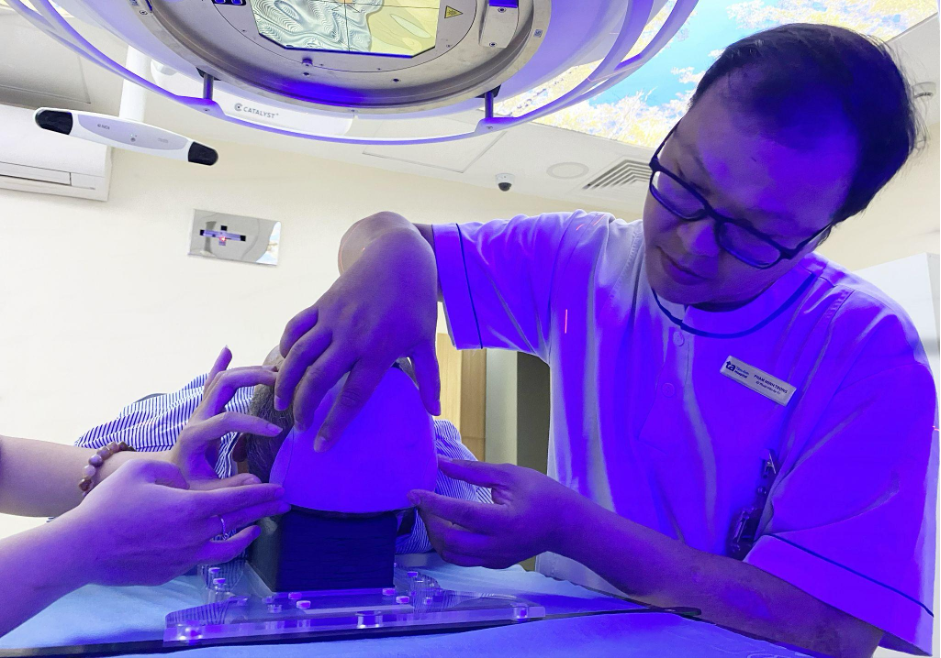 |
A technician placing the bolus on Mr. Huu's scalp in preparation for radiation therapy. *Photo: Tam Anh General Hospital* |
When placed on the scalp, the bolus fills air gaps, transforming a curved and inconsistent surface into a structure where radiation can act effectively. Additionally, Mr. Huu wore a personalized mask to ensure stable positioning during each treatment session. This combination allowed the radiation beams to focus on the shallow tissue layer containing cancer cells, minimizing unnecessary doses from penetrating deep into the skull.
The team employed intensity-modulated radiation therapy, adjusting the radiation beams according to each treatment stage. After every session, doctors applied a specialized moisturizing cream to the patient's scalp to soothe and reduce dryness. Mr. Huu experienced no headaches or visual impairment, and his mobility and eating habits remained normal.
Doctor Hien further noted that advancements in radiation therapy technology and personalized solutions, such as intensity-modulated radiation therapy and custom boluses, enhance treatment effectiveness and reduce the financial burden on patients.
By Nguyen Tram
*Patient's name has been changed
| Readers can submit questions about cancer here for doctors to answer |