Tuan experienced prolonged cough, chest pain, and shortness of breath with exertion, leading him to seek examination at Tam Anh General Hospital, Ho Chi Minh City. Doctors discovered his lung tumor was about one cm. Initial medical treatment was chosen due to surgical difficulties. After 4 months, the tumor grew to 3 cm and metastasized to his supraclavicular lymph nodes.
Associate Professor, Doctor Vu Huu Vinh, Director of the Thoracic and Vascular Surgery Center, noted the patient's weakened state due to prolonged medical treatment. He prescribed Da Vinci Xi robot-assisted endoscopic surgery combined with radiofrequency ablation to completely remove the tumor while maximally preserving healthy lung parenchyma.
Radiofrequency ablation uses heat to destroy localized cancer cells, applicable for primary or metastatic tumors. This method suits patients with a weakened constitution and poor respiratory function because it precisely targets the tumor, limiting damage to healthy lung parenchyma.
According to Associate Professor Vinh, this technique extends lifespan and improves quality of life for late-stage patients who are no longer candidates for conventional surgery. However, lung interventions are complex, demanding experienced doctors and modern equipment to ensure safety.
 |
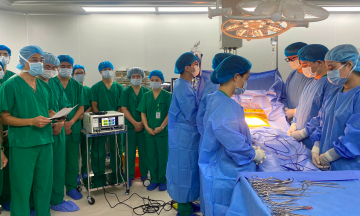
Associate Professor Vinh (left) controls the surgical robot to treat metastatic lung cancer for the patient. *Photo: Tam Anh General Hospital* |
Tuan received special nutrition, intravenous fluids, and supportive care to ensure he was fit for surgery. Guided by a high-resolution 3D camera system and flexible robotic arms, doctors accessed the lesion in the confined chest cavity, precisely dissecting the tumor without damaging adjacent structures. The team sent the biopsy sample for frozen section analysis, yielding a malignant result after 40 minutes, and completely removed the tumor from his lung.
After tumor removal, doctors used radiofrequency waves to ablate the lung parenchyma near the lesion. This aimed to destroy any remaining malignant cells without needing to remove additional healthy lung tissue, thereby reducing the risk of local recurrence.
Tuan experienced minimal post-surgery pain and doctors discharged him after two days. Analysis of the tissue sample guided doctors in developing a treatment regimen. Once his health stabilizes, the patient will continue with adjuvant therapy.
Associate Professor Vinh stated that combining robot-assisted surgery with minimally invasive techniques like radiofrequency ablation creates treatment opportunities for many patients with advanced lung cancer that is otherwise difficult to intervene on, while also helping to preserve respiratory function.
Early-stage lung cancer often presents without obvious symptoms, making it easily mistaken for other conditions and difficult to detect through routine clinical examinations. Associate Professor Vinh advises older adults, current or former smokers, individuals working in dusty environments, or those with a family history of lung cancer to undergo regular health check-ups at least once a year, including screenings as recommended by a doctor.
Bao Anh
| From 4/6 to 30/6, the Tam Anh General Hospital system is hosting a consultation program titled "New generation 'super machines' and surgical robots support safe, accurate diagnosis and treatment, rapid recovery." The program features experienced doctors, and readers can submit questions here for answers. |