Huong had used various traditional and Western medicines, joint injections, and herbal remedies for over 10 years; however, her osteoarthritis progressively worsened. Both knee joints caused severe pain, emitting creaking sounds, making it difficult for her to walk and requiring daily pain medication.
Dr. Truong Huu Bao, a Master and First-Degree Specialist, and Head of Orthopedic Trauma at Tam Anh General Clinic, District 7, stated that Huong was diagnosed with end-stage knee osteoarthritis. Her joint cartilage had almost completely disappeared, causing her two bone ends to rub against each other during movement, leading to severe pain and accelerating joint deformation. If surgery was not performed promptly, the patient faced a high risk of losing mobility and developing liver and kidney dysfunction due to long-term pain medication abuse.
Huong was scheduled for a left knee replacement with the assistance of the Cuvis-Joint robot. The surgeon analyzed her bone morphology and reconstructed anatomical landmarks to their pre-deformation state. Thanks to integrated artificial intelligence (AI), the robot supported the surgeon in creating a personalized surgical plan. This plan precisely determined the bone cutting location, implant placement, surgical technique, bone cutting direction, and limb alignment, based on the patient's anatomical parameters and 3D CT images of the joint.
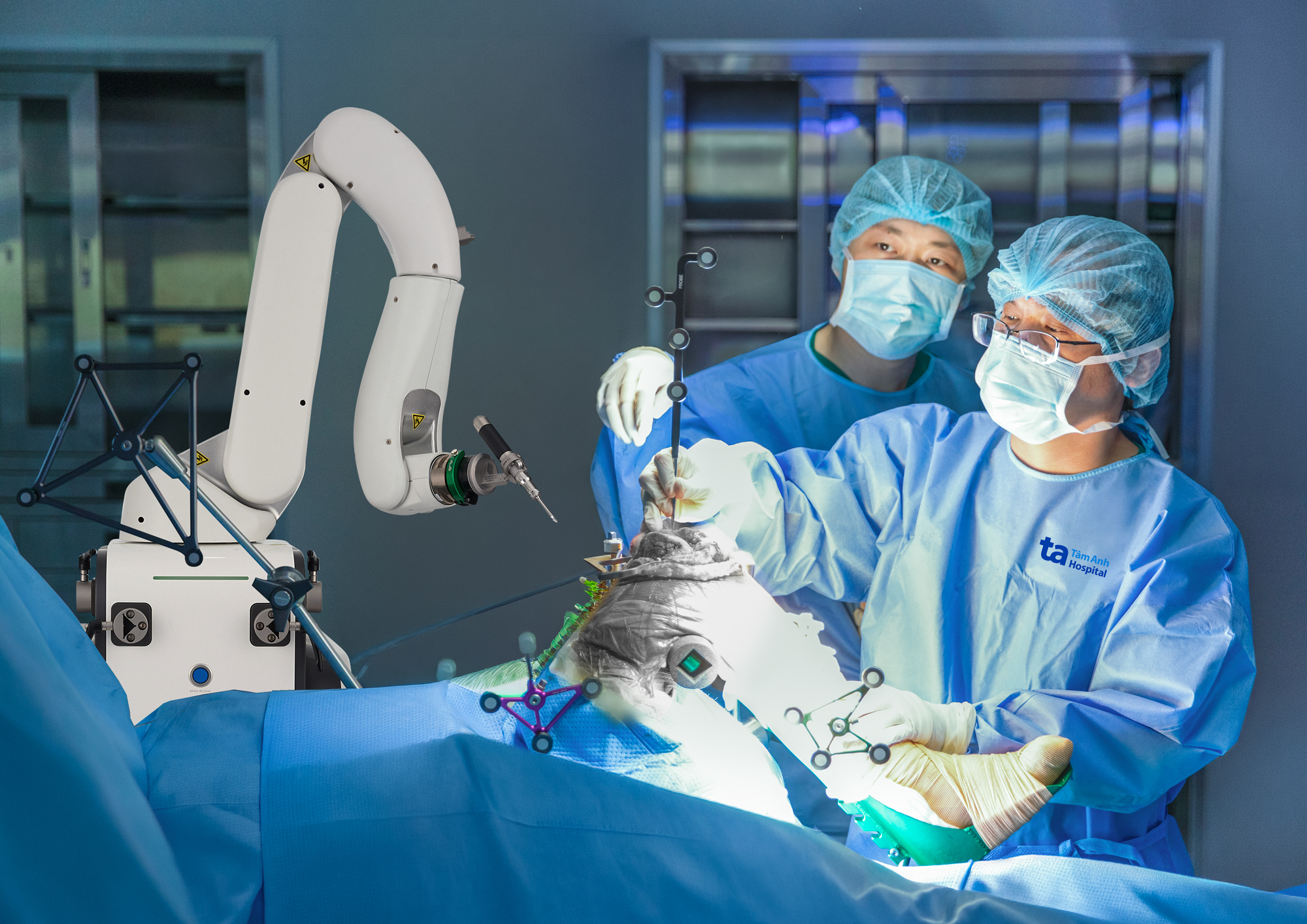 |
Dr. Bao (right) performs knee replacement surgery for Huong with the assistance of the AI Cuvis-Joint robot. Photo: Tam Anh General Hospital
Supported by a real-time optical navigation camera system, the robot directly performed bone cuts precisely according to the surgeon's approved plan. Huong's healthy bone structure was maximally preserved, minimizing the risk of damage to blood vessels, nerves, ligaments, and other soft tissues. The robot also assisted the surgeon in checking and balancing the joint space, optimizing soft tissue balance and limb alignment, and making real-time adjustments during the operation. Afterward, the surgeon perfectly placed the components of the artificial joint into the patient's femur and tibia.
Post-surgery, Huong experienced less pain, began rehabilitation earlier, and prevented the risk of chronic pain, joint stiffness, or looseness. She now enjoys more natural movement and an extended joint lifespan. The patient hopes to have her other knee replaced soon.
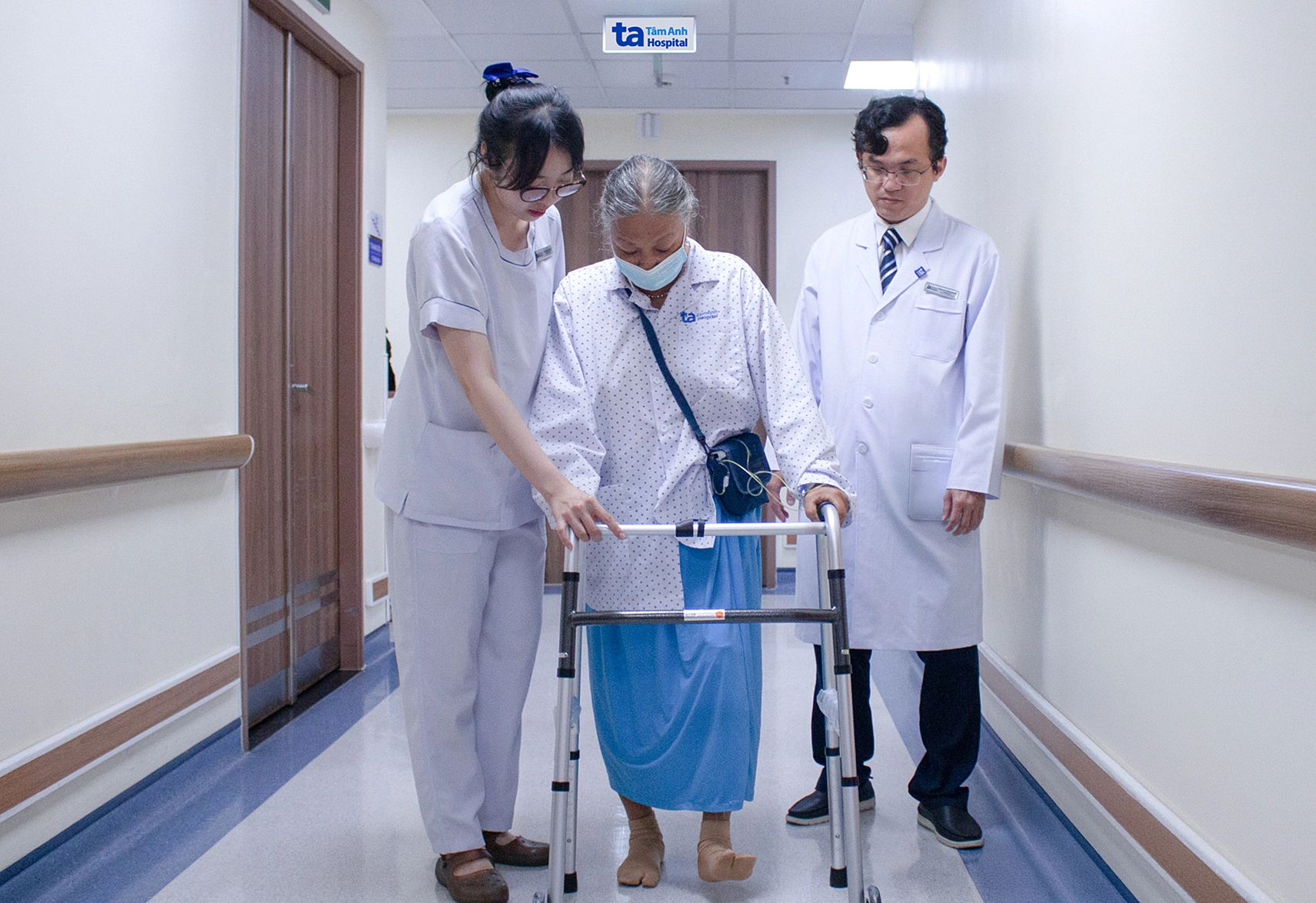 |
Huong practices walking immediately after knee replacement surgery. Photo: Tam Anh General Hospital
Osteoarthritis is a common man tinh disease characterized by typical symptoms such as pain, joint stiffness, and impaired mobility. When conservative treatments involving medication, physical therapy, and joint injections are no longer effective, surgery becomes necessary to alleviate pain and restore motor function. Dr. Bao stated that Tam Anh Hospital is the first hospital in Vietnam to implement joint replacement using the new-generation AI Cuvis-Joint robot, enabling precise surgery even in complex cases such as severely obese patients, those with osteonecrosis, or complicated limb deformities.
Phi Hong