Mr. Loc, 74, had previously been diagnosed with early-stage gastric cardia cancer, which affects the transitional area between the esophagus and stomach, and colon cancer. Although he received treatment two years ago, he did not adhere to medical advice for follow-up appointments. Recently, a health check-up at Tam Anh General Hospital, TP HCM, revealed an abnormal gastric cardia wall on his abdominal CT scan, indicating a suspected malignant lesion. A subsequent biopsy confirmed moderately differentiated invasive adenocarcinoma.
Doctor Do Minh Hung, Director of the Center for Endoscopy and Gastrointestinal Endoscopic Surgery, explained that the tumor posed a risk of developing gastric cardia stenosis. This condition could prevent food from reaching the stomach, leading to dysphagia, malnutrition, and physical exhaustion. The gastric cardia, being the junction between the esophagus and stomach, is a surgically challenging location, and strategies for operating on this area are often debated. To address these difficulties, doctors opted for robotic surgery, which offers enhanced precision and overcomes the limitations of conventional endoscopic procedures.
The surgical procedure involved a partial upper gastrectomy combined with D1 lymphadenectomy. This approach aimed to completely remove the tumor and reduce the risk of recurrence. The D1 lymph node system encompasses nodes situated close to the stomach, along its curvatures, and adjacent to the blood vessels that directly supply the organ.
 |
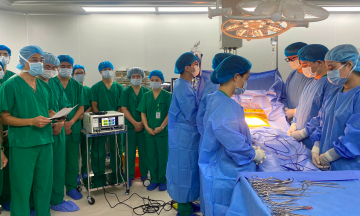
Doctor Minh Hung controls the robotic arm to remove Mr. Loc's tumor. *Photo: Tam Anh General Hospital.*
The robotic system used in the surgery is equipped with one camera and three operating arms. Its highly magnified 3D images provide surgeons with clear visualization of anatomical structures, enabling them to distinguish cancerous tissue from healthy structures, such as the vagus nerve or major blood vessels. The robot also facilitates improved access to the deep gastric cardia, an area located close to the diaphragm and thoracic esophagus, where conventional endoscopic instruments typically struggle with flexible manipulation.
The robotic arms offer flexible rotation at various angles, allowing doctors to precisely dissect tumors in narrow and hidden locations. This capability also assists in dissecting lymph nodes around the celiac trunk and splenic artery, thereby reducing the risk of vascular damage and limiting intraoperative bleeding.
Following the removal of the lesion, the surgical team reconnected the esophagus to the remaining portion of the stomach. An anti-reflux valve was created using automatic instruments, and the anastomosis was performed robotically to restore digestive flow. The anastomotic site was thoroughly checked for tightness to minimize the risk of leakage, which is one of the most serious complications after gastric cardia surgery. According to Doctor Hung, this particular anastomosis is challenging because the esophagus lacks a surrounding serosal layer, making it prone to tension and increasing the risk of leakage.
 |
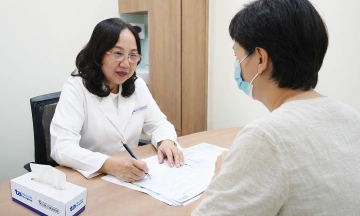
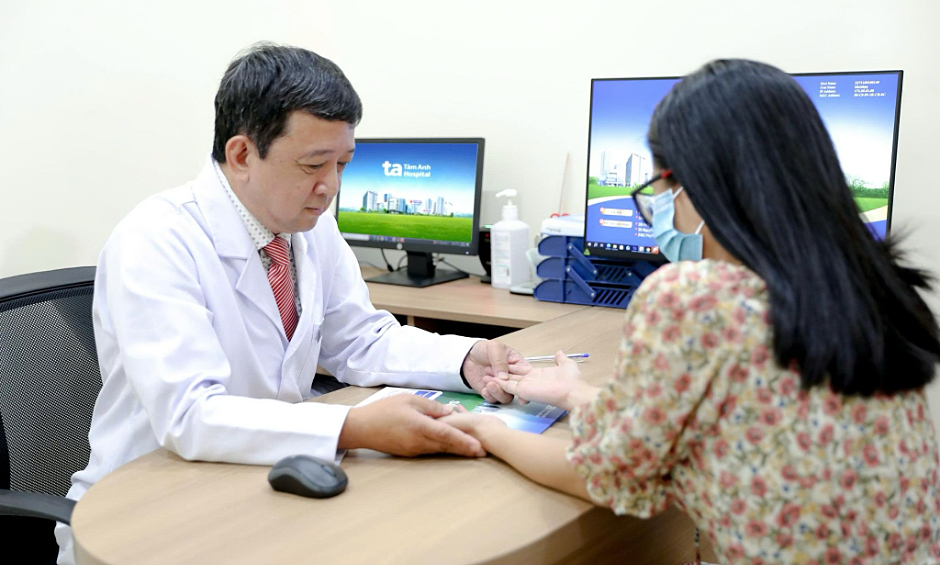
Doctors examine Mr. Loc after the surgery. *Photo: Tam Anh General Hospital.*
After the surgery, Mr. Loc recovered well, experiencing minimal pain. He was able to sit up and walk on the first day. By the third day, the patient began a liquid diet, his incision was dry, and no infection or anastomotic leakage was observed.
The pathology results indicated moderately differentiated invasive adenocarcinoma, with cancer cells invading only the submucosal layer. All 25 removed lymph nodes tested negative, and the resection margins were free of cancer cells. No vascular or perineural invasion was observed. Based on these findings, the patient does not require additional post-operative treatment and will continue with regular follow-up appointments.
Stomach cancer is common in Vietnam. However, the disease often progresses silently, with early stages showing almost no symptoms or only vague manifestations such as bloating, indigestion, and dull pain in the epigastric region, leading many to be complacent.
Doctors advise individuals with a history of gastrointestinal cancer, atrophic gastritis, intestinal metaplasia, Helicobacter pylori (HP) infection, or a family history of stomach cancer to undergo regular endoscopy and follow-up for early detection of lesions. Maintaining a healthy lifestyle, limiting processed foods, quitting smoking, and controlling risk factors can help reduce the likelihood of developing the disease.
Quyen Phan
| Readers can send questions about digestive diseases here for doctors to answer. |