Dr. Nguyen Duc Huy, a specialist doctor level one at the High-Tech Eye Center, Tam Anh General Hospital, TP HCM, used a slit lamp to examine Phong's eyes. He noted numerous sand and dust particles lodged on the inner surface of the eyelids, on the cornea, and in the inner corners of both eyes. The left eye was more irritated due to a larger sand particle deeply embedded in the upper eyelid, with multiple corneal scratches. Both of Phong's eyes also showed signs of irritant conjunctivitis, manifesting as redness, burning pain, and warmth.
Dr. Huy removed the foreign bodies from the patient's eyes with the aid of a slit lamp, applying anesthetic eye drops to reduce pain and discomfort. For larger, deeply embedded particles or those stuck in tissue, the doctor used specialized instruments to dislodge them. Loosely attached and superficial dust was removed with a sterile cotton swab.
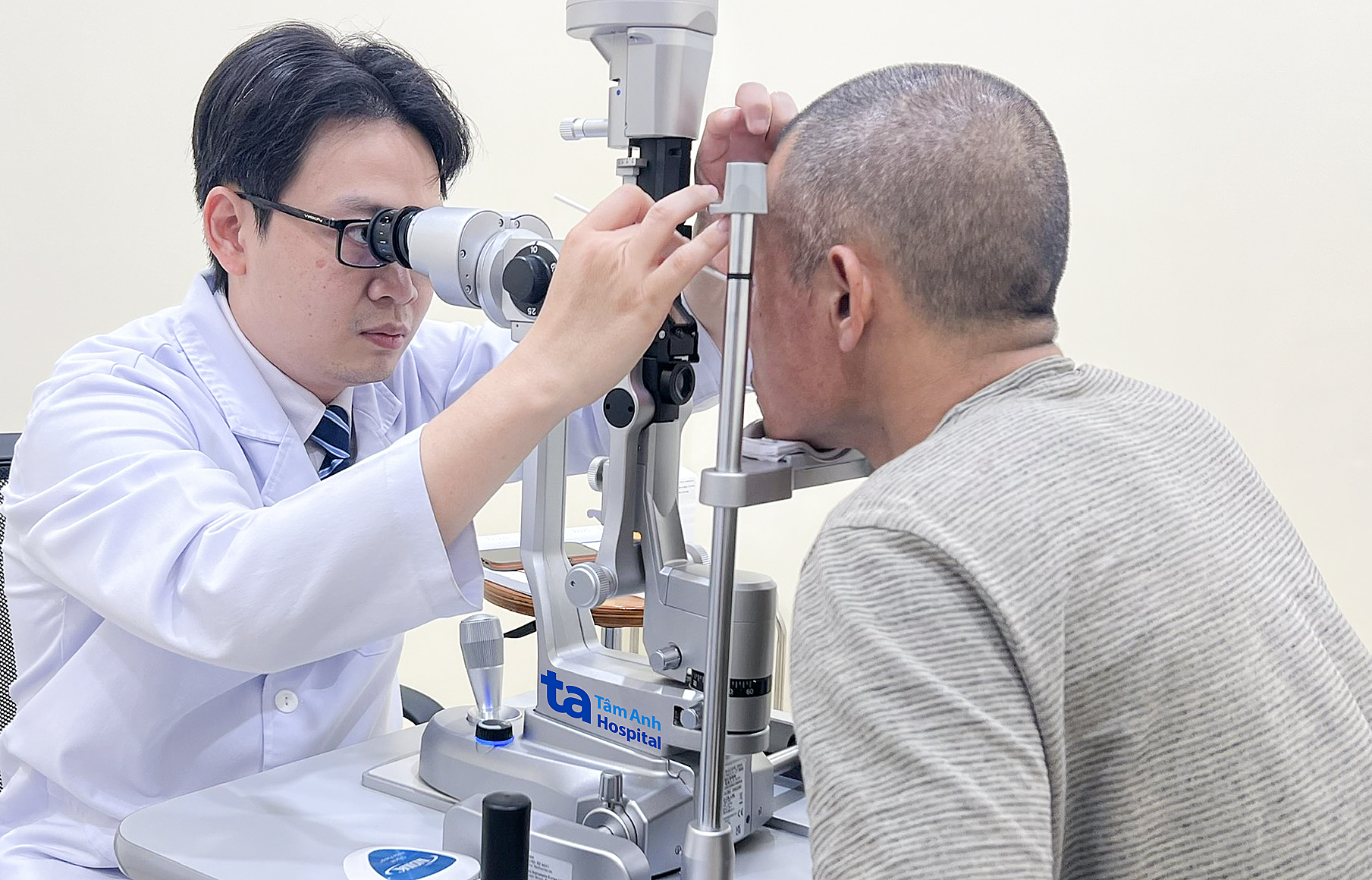 |
Dr. Huy uses a sterile cotton swab to remove a foreign body from Phong's eye, observed through a slit lamp. *Photo: Tam Anh General Hospital*
Patients should use eye wash and wear protective eyewear to guard against sand, dust, and airborne allergens. Dr. Huy stated that eyes might still feel irritated and occasionally sting for a few hours after foreign body removal but will recover quickly. Superficial scratches usually heal within one to three days. The patient was prescribed eye drops and ointment for home use for one week.
According to Dr. Huy, many people instinctively rub their eyes to temporarily relieve itching and irritation when sand or dust enters them. However, rubbing eyes vigorously with sand or dust trapped inside can scratch the cornea and other ocular structures. Bacteria can then enter the eye through these scratches, causing irritation and conjunctivitis. Delayed treatment can lead to conjunctivitis progressing to keratitis, potentially resulting in permanent scarring that severely impairs vision.
The doctor advises that when sand or dust enters the eye, one should blink repeatedly to allow tears to wash the foreign body out. If this does not help, clean water or saline solution can be used to rinse the eye. When rinsing, tilt the head back and gently pour or drop water from the inner corner (near the nose) towards the outer corner of the eye to facilitate the foreign body's removal. If pain, irritation, or redness persists, a specialized eye examination is necessary for appropriate treatment. Patients should not self-medicate with antibiotic or corticosteroid eye drops without a doctor's prescription.
Nhat Minh
*Patient's name has been changed
| Readers can submit questions about ophthalmic diseases here for doctor's answers |