Two days before hospital admission, Khanh suddenly experienced dizziness for three to four minutes, followed by fainting. Doctor Nguyen Huu Hieu, from the Pediatrics Department at Tam Anh General Hospital, Ho Chi Minh City, reported that upon admission, the patient's blood pressure was 75/45 mmHg while sitting and 108/57 mmHg when lying down, indicating orthostatic hypotension. Laboratory tests revealed moderately severe anemia. An esophagogastroduodenoscopy showed two ulcers, 5-10 mm in size, located opposite each other in the duodenal bulb. Tests confirmed the presence of Helicobacter pylori (h. pylori) bacteria.
Doctor Hieu explained that h. pylori bacteria are a causative agent of gastroduodenal ulcers, leading to gastrointestinal bleeding, abdominal pain, and vomiting. Prolonged bleeding causes anemia and makes patients prone to orthostatic hypotension. As a result, patients experience fatigue and dizziness, especially when standing up or changing positions suddenly.
Dark brown vomit is a typical sign of upper gastrointestinal bleeding. When blood in the digestive tract comes into contact with stomach acid, iron in red blood cells is oxidized, causing the vomit to turn a coffee-ground color.
Doctors prescribed intravenous blood and fluid transfusions to compensate for the blood loss. After his condition stabilized, Khanh received ulcer treatment with proton pump inhibitors (PPIs) to reduce stomach acid secretion. After seven days, Khanh was eating and drinking normally, discharged, and continued an outpatient PPI regimen combined with an h. pylori eradication protocol.
 |
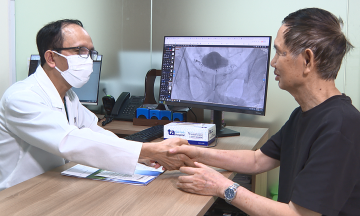
Doctor Hieu examines Khanh before his discharge. Photo: Tam Anh General Hospital |
Doctor Hieu stated that gastroduodenal ulcers in children are often caused by h. pylori bacteria, a gram-negative spirochete that can reside in the stomach lining. Prolonged stress and irregular eating habits in children, combined with h. pylori, can break down the protective mucus layer, damaging the underlying cell layer and leading to ulcer formation.
Gastrointestinal bleeding is a dangerous complication of the condition. Mild cases may manifest as anemia, with signs like pale skin, fatigue, and shortness of breath upon exertion. In more severe cases, like Khanh's, children may vomit blood or dark brown coffee-ground-like fluid, experience orthostatic hypotension, and faint. The disease can also lead to ulcer perforation and an increased risk of stomach cancer later in life.
For prevention, children should develop the habit of washing hands with soap before eating and after using the restroom. They should eat healthy, avoid sharing bowls, chopsticks, or cups, and refrain from spicy food or coffee. It is also important to avoid staying up late and prolonged stress. Parents should take their children to the hospital if they exhibit recurrent or prolonged abdominal pain, nausea, loss of appetite, or unexplained weight loss.
Gian Don
*Patient's name has been changed
| Readers can submit questions about children's diseases here to receive answers from doctors |