My, 46, residing in Canada, suffered from joint pain and swelling that spread from her shoulders and neck down her back. She also experienced progressive leg weakness, persistent fatigue, loss of appetite, and lost about 4 kg. Recently, her condition worsened, especially after sun exposure. Faced with a 6-8 week wait for an appointment at a Canadian hospital, she returned to Vietnam for treatment.
Upon landing at Tan Son Nhat Airport, My experienced severe shortness of breath and intense joint pain, making her unable to walk. Her fingertips turned purple, prompting an emergency visit to Tam Anh General Hospital Ho Chi Minh City. Doctor Dao Duc Cuong, of the Emergency Department, ordered tests that revealed elevated cardiac enzymes, indicating myocardial damage. The patient also presented with multiple other systemic symptoms.
 |
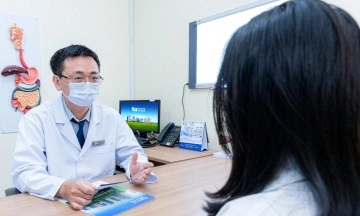
Doctor Cuong, Emergency Department, examines the patient. Photo: Tam Anh General Hospital
Doctor Tran Thi Thanh Tuyen, of the Clinical Immunology Department, observed that the patient's fingertips turned white, then purple, upon exposure to cold, accompanied by fatigue, joint pain, and sun sensitivity—symptoms indicative of Raynaud's syndrome. Advanced immunological tests and multi-organ damage assessment techniques confirmed My had systemic lupus erythematosus. The disease had affected not only her joints but also damaged multiple other organs. High-resolution computed tomography (HRCT) revealed early-stage interstitial lung disease. The patient also suffered from Raynaud's syndrome, myositis, mixed connective tissue disease, pericardial effusion, and mild myocardial damage.
Systemic lupus erythematosus is a chronic autoimmune disease that occurs when the immune system malfunctions and attacks the body's own tissues and organs. The disease can affect the joints, skin, heart, lungs, kidneys, nervous system, and blood vessels. Diagnosing lupus is challenging because early-stage symptoms are often non-specific and easily mistaken for musculoskeletal, cardiovascular, or respiratory conditions.
Doctor Tuyen explained that My did not exhibit the classic butterfly-shaped rash on her face, a typical sign of lupus erythematosus. Instead, her disease manifested with disparate symptoms across various organs. Assessing each symptom individually made it very difficult to pinpoint the true cause. Consequently, many lupus patients take years to receive an accurate diagnosis.
Clinical immunology specialists collaborated with cardiologists to develop a comprehensive treatment plan. The patient received corticosteroids combined with immunosuppressants to control the autoimmune response. Concurrently, treatment addressed her heart damage, monitored the early-stage interstitial lung disease, managed Raynaud's syndrome, and incorporated rehabilitation to improve muscle strength and mobility.
My only stayed in Vietnam for two weeks, so the medical team closely monitored her daily progress to adjust medications promptly and establish a treatment plan for when she returned to Canada. After about 10 days, her shortness of breath and joint pain significantly improved, muscle strength recovered, inflammatory markers decreased, heart damage stabilized, and her fingertips regained their healthy pink color. Following a comprehensive evaluation, she was deemed fit for a long-haul flight and continued her treatment under the coordinated care of doctors in Vietnam and Canada.
According to Doctor Tuyen, not all cases of discolored fingertips when exposed to cold indicate an autoimmune disease. However, if this condition recurs, accompanied by persistent joint pain, fatigue, shortness of breath, or exhaustion after sun exposure, patients should seek early medical attention for timely diagnosis and treatment to prevent damage to the heart, lungs, kidneys, and other organs.
Minh Huong - Nhu Ngoc
*The patient's name has been changed