Khanh was admitted to Tam Anh General Hospital Hanoi with acute diarrhea, a fever of 38.9 degrees Celsius, headache, vomiting, and muscle spasms in his limbs, according to Dr. Do Tien Son from the Pediatrics Department. Tests confirmed rotavirus infection, severe hypocalcemia with ionized calcium levels of only 0.83-0.87 mmol/L (normal range is approximately 1.15-1.33 mmol/L), accompanied by elevated phosphorus and low magnesium. High CK muscle enzymes indicated acute rhabdomyolysis, posing a risk of kidney failure.
Despite Khanh's parathyroid hormone (PTH) level of 23 pg/mL falling within the normal range of 15-65 pg/mL, Dr. Son noted that this level did not increase in response to his severe hypocalcemia. Normally, when blood calcium decreases, the parathyroid glands would secrete more PTH to retain calcium in the body and stimulate the kidneys to produce active vitamin D, enhancing calcium absorption. Therefore, a normal PTH level alongside reduced blood calcium suggests that the parathyroid glands are not responding adequately, indicating potential hypoparathyroidism.
Doctors suspected DiGeorge syndrome, also known as 22q11.2 deletion syndrome, and ordered targeted CNV genetic testing to screen for microdeletions and duplications across 23 chromosomes. Results confirmed a microdeletion at the 22q11.2 locus. This condition involves the absence of a segment of genetic material containing multiple genes crucial for organ formation and development during the embryonic stage. Notably, the TBX1 gene plays a vital role in the development of the heart, parathyroid glands, thymus, and certain craniofacial structures.
The manifestations of DiGeorge syndrome are diverse. In young children, common signs include congenital heart defects, hypocalcemia, and recurrent infections. Hypoparathyroidism, however, can remain latent for many years, only becoming apparent when triggered by factors such as infection, fever, vomiting, diarrhea, or surgery.
Khanh has a history of complex congenital heart disease, having undergone surgery to repair Tetralogy of Fallot at 10 months old. He has always been frail, underweight, and experienced numerous episodes of respiratory infections.
 |
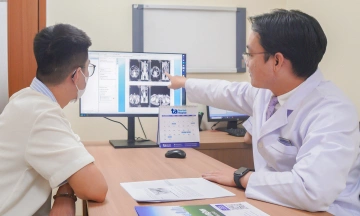
Khanh (left) and his parents during a follow-up appointment with Dr. Son. Photo: Dinh Hue |
Alongside treatment for diarrhea, Khanh received calcium and calcitriol supplements to maintain calcium levels within a low-normal range, minimize urinary calcium excretion, and reduce the risk of kidney stones. After seven days of treatment, his muscle spasms, paresthesia, and cramps resolved, and his CK enzymes returned to normal. Khanh was discharged from the hospital. During a recent follow-up, Khanh's urinary calcium/creatinine ratio increased to 0.84 mmol/mmol, exceeding the safe threshold of 0.7. As a result, doctors reduced his calcium dosage and advised him to drink sufficient water daily and engage in light exercise.
Khanh required pulmonary artery valve replacement surgery due to severe (4/4) valve regurgitation and right heart failure. Dr. Son explained that such surgery could disrupt calcium balance and trigger acute hypocalcemia. Thanks to coordination among specialists and adherence to the treatment protocol, Khanh underwent the surgery safely. Currently, his health is stable; however, hypocalcemia may recur or worsen with changes in body demand or acute illnesses like infection or fever. Khanh must consistently take his medication and be aware of the signs of low calcium.
According to Dr. Son, DiGeorge syndrome is a common chromosomal microdeletion syndrome, estimated to affect approximately one in 4,000 to 6,000 live births. About 90-95% of 22q11.2 deletions are de novo abnormalities, occurring randomly during embryonic development, meaning parents typically do not carry the abnormality. Approximately 5-10% of cases are inherited from a parent carrying the 22q11.2 deletion.
Currently, there is no specific cure for DiGeorge syndrome; treatment primarily focuses on symptom management and long-term monitoring. Individuals with the syndrome can still marry and have children as adults. Assisted reproductive technologies combined with preimplantation genetic testing for monogenic diseases (PGT-M) can help carriers of the mutation have children without the genetic defect.
Dr. Son recommends that pregnant women undergo prenatal genetic screening, such as non-invasive prenatal testing (NIPT), around the 12th week of pregnancy to detect the risk of DiGeorge syndrome in the fetus early. If a child exhibits congenital heart defects, hypocalcemia, recurrent infections, or developmental and learning difficulties, parents should seek medical consultation.
Trinh Mai
*Patient's name has been changed
| Readers can submit questions about children's diseases here to receive answers from doctors. |