Mr. Quang had suffered from chronic pancreatitis for eight years, complicated by diabetes. He frequently experienced abdominal pain, indigestion, and poor appetite. During an examination at a hospital, a pancreatic cyst was found, causing him such fear of cancer that he developed anxiety disorder, insomnia, and weakness.
Recent CT and MRI scans at Tam Anh General Hospital Hanoi revealed a complex cystic lesion measuring 2x2x3 cm in Mr. Quang's pancreatic head, characterized by irregular wall thickening, multiple loculations, and a significantly dilated pancreatic duct measuring 1.2 cm. The pancreatic tail also showed a large cystic lesion, 3x3x4 cm, with splenic infiltration, leading to fibrosis.
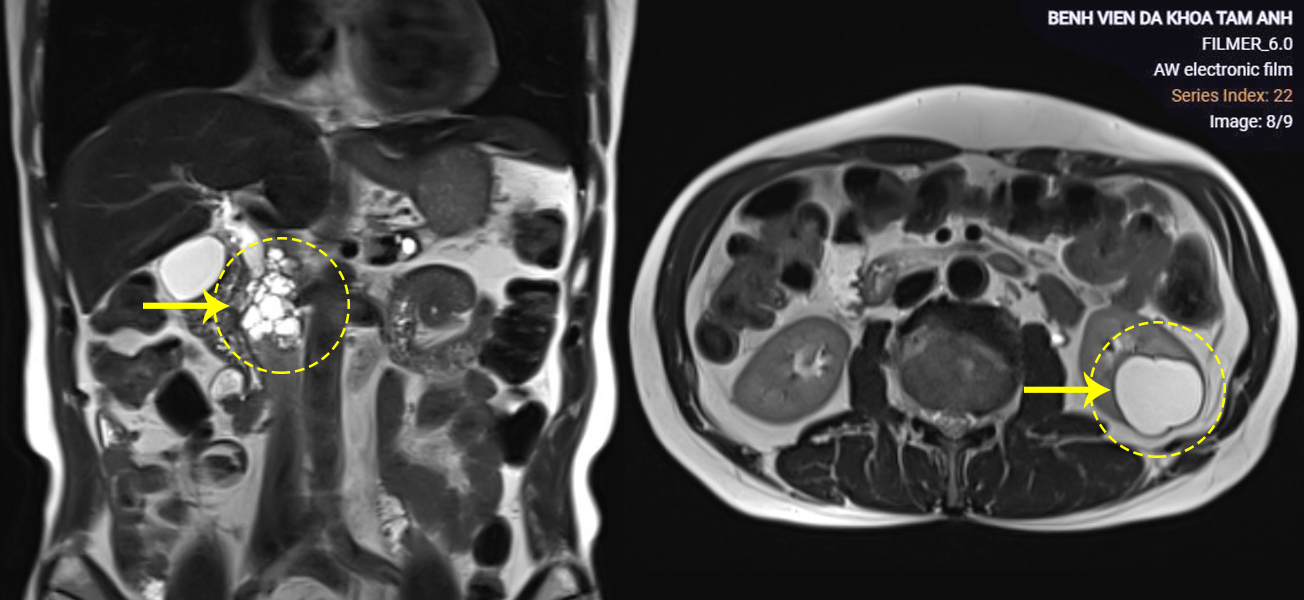 |
Cyst in the pancreatic head (left) and pseudoaneurysm in the pancreatic tail (right) of Mr. Quang. Photo: Tam Anh General Hospital
Associate Professor, Doctor Trieu Trieu Duong, Director of Surgery, explained that the cyst in the pancreatic tail was a pseudoaneurysm caused by chronic pancreatitis. This condition leads to fibrosis of the blood vessel walls, causing blood to leak and accumulate within the cyst wall. While not cancerous, it carried a risk of rupture, leading to massive hemorrhage into the abdominal cavity, which could be life-threatening. The cyst in the patient's pancreatic head was complex and difficult to rule out cancer, having progressed rapidly compared to previous scans.
Associate Professor Duong decided on surgery to simultaneously address the pseudoaneurysm in the pancreatic tail, perform an immediate biopsy of the pancreatic head cyst, and examine any liver lesions for Mr. Quang, to plan appropriate next steps.
The patient underwent endotracheal anesthesia. The surgical team performed an open procedure, removing the large cyst in the pancreatic tail and resecting the pancreatic body and tail along with a splenectomy to ensure complete resolution and prevent recurrence. Immediate biopsies of the pancreatic head cyst and liver lesions found no cancerous cells.
Associate Professor Duong performed the Frey-Berger procedure, which involved longitudinally opening the entire dilated pancreatic duct, removing many large pancreatic stones, excising the fibrotic pancreatic head parenchyma and uncinate process, and then connecting the pancreas to the small intestine to restore digestive flow.
Post-surgery, the patient no longer experienced abdominal pain, could eat soft foods, and moved around easily. All six samples from the spleen, pancreatic tail, pancreatic head, and three mesenteric lymph nodes showed benign results upon immunohistochemistry, confirming no cancer.
One month after his follow-up appointment, Mr. Quang had gained 5 kg, his surgical wound had healed, he was eating well, sleeping soundly, and no longer showed signs of anxiety disorder.
 |
Medical staff congratulate Mr. Quang on his special birthday in the hospital. Photo: Tam Anh General Hospital
Associate Professor Duong stated that pancreatitis is an inflammation of the pancreas, caused by digestive fluids or enzymes attacking the gland. The condition often occurs due to: gallstones obstructing pancreatic fluid flow, alcohol consumption causing pancreatic duct narrowing, high blood lipids impeding circulation, or activating pancreatic enzymes within the pancreas.
Acute pancreatitis causes upper abdominal pain, fever, vomiting, ascites, and diarrhea lasting several days. If not detected and treated promptly, it can lead to complications such as: hemorrhagic complications, respiratory failure, multiple organ failure, and infection, potentially resulting in death.
Many patients experience recurrent acute pancreatitis, which can easily lead to chronic pancreatitis. This causes pancreatic parenchymal fibrosis, loss of ability to digest and absorb fats (exocrine pancreatic insufficiency), impaired insulin hormone production (endocrine pancreatic insufficiency), diabetes, and an increased risk of pancreatic tumor formation and cancer.
Doctors recommend maintaining a healthy lifestyle, limiting alcohol consumption, having a balanced diet and regular exercise, and maintaining a stable weight to reduce the risk of pancreatitis. Patients need to adhere to treatment, attend regular follow-up appointments, not arbitrarily stop or reduce medication dosage, and avoid alcohol and tobacco to control the disease and prevent dangerous complications.
Thanh Long
| Readers can send questions about digestive diseases here for doctors to answer |