Eng English
China 中国人

Eng English
China 中国人
  • News
  • World
  • Business
  • Entertainment
  • Sports
  • Law
  • Education
  • Health
  • Lifestyle
  • Travel
  • Science
  • Digital
  • Automobiles
  • Trở lại Thể thao
  • Health
Friday, 28/11/2025 | 17:02 GMT+7

Two syndromes increase colorectal cancer risk

Lynch syndrome and familial adenomatous polyposis are genetic syndromes caused by gene mutations, raising the risk of colorectal cancer.

Colorectal cancer develops when epithelial cells in the colon and rectum lining grow abnormally and uncontrollably, forming malignant tumors. Doctor Kim Thi Be Diep, from the Oncology Department, Oncology Center, Tam Anh Hospital TP HCM, states that most colorectal cancers originate from adenomatous polyps, which are precancerous lesions. The progression from an adenomatous polyp to invasive cancer often occurs silently, potentially taking about 10-15 years.

Several genetic syndromes increase the risk of colorectal cancer; the most common are hereditary non-polyposis colorectal cancer (HNPCC), also known as Lynch syndrome, and familial adenomatous polyposis (FAP).

Lynch syndrome

Lynch syndrome results from mutations in several gene, including MLH1, MSH2, MSH6, PMS2, and EPCAM. This condition involves a defect in the DNA mismatch repair (MMR) system due to germline mutations in MMR gene.
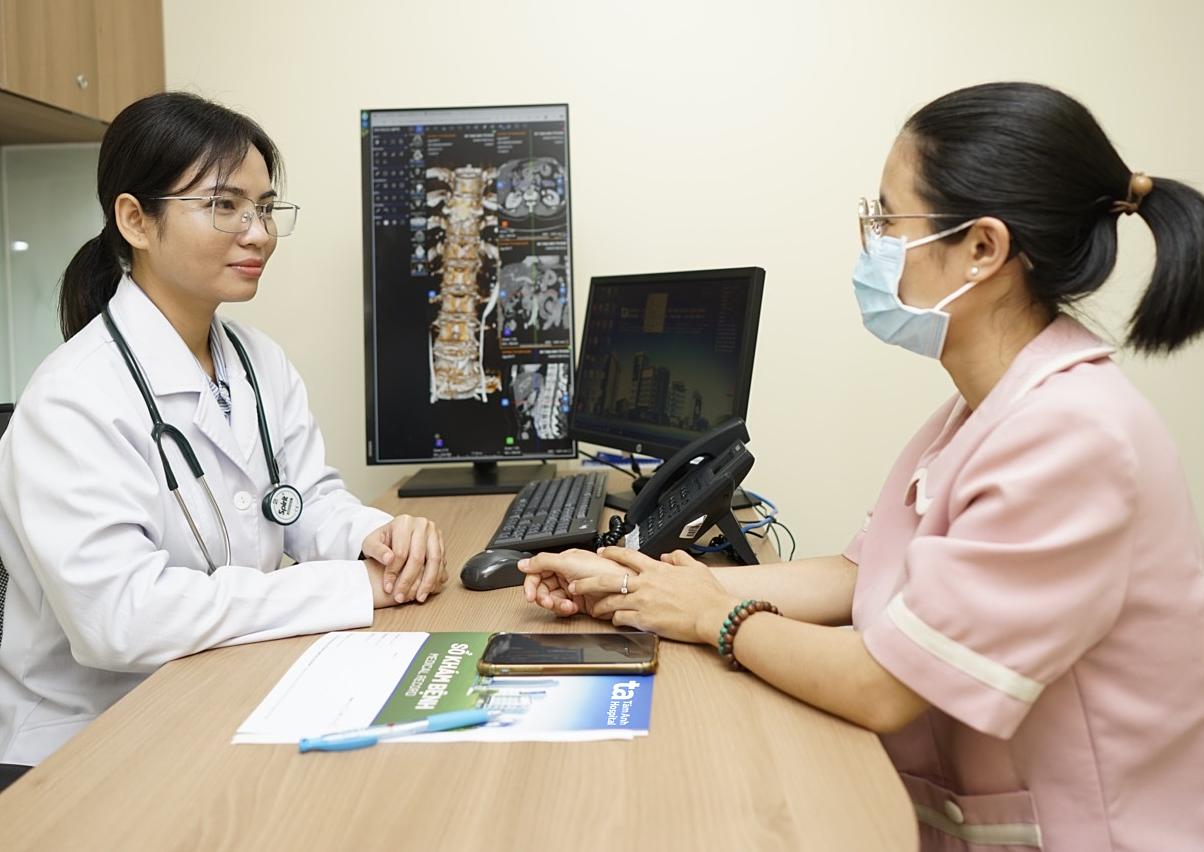
Doctor Diep consults a patient. Illustration: Tam Anh General Hospital

Patients with hereditary colorectal cancer due to Lynch syndrome are often diagnosed at a young age. The risk of developing colorectal cancer for individuals with Lynch syndrome ranges from 10% to 80%, according to Doctor Diep. The incidence rate gradually increases depending on the gene mutation causing the syndrome. Lynch syndrome is also a risk factor for several other cancers, such as endometrial, ovarian, small intestine, pancreatic, gastric, kidney, prostate, and breast cancers.

If a family member carries a gene mutation associated with Lynch syndrome, Doctor Diep advises relatives to undergo genetic testing or screening via colonoscopy. Screening is typically recommended every one to two years starting at age 20, or two to five years before the youngest age of cancer diagnosis in an affected relative.

Familial adenomatous polyposis

Familial adenomatous polyposis results from an APC gene mutation inherited from parents, accounting for approximately 1% of colorectal cancer cases. Individuals with FAP have an elevated risk of developing gastric, small intestine, pancreatic cancer, and some other cancers.

Those with this syndrome develop numerous polyps in the colon and rectum, often starting between ages 10 and 12. Cancer typically develops from one of these polyps, potentially as early as age 20. Individuals with genetic test results showing FAP-related gene changes should begin colonoscopy screening between ages 10 and 15. Additionally, close relatives (siblings and children) should undergo genetic testing.

Some less common genetic syndromes associated with colorectal cancer include Peutz-Jeghers syndrome, MUTYH-associated polyposis, and cystic fibrosis, caused by CFTR gene mutations.

Colorectal cancer screening helps detect precancerous lesions or early-stage malignant lesions, allowing for timely treatment and contributing to improved survival rates. Everyone should maintain a healthy lifestyle by not smoking, limiting alcohol consumption, and avoiding excessive processed, fatty foods to reduce disease risk.

Bao Tram

Readers can submit questions about digestive diseases here for a doctor's response.
By VnExpress: https://vnexpress.net/hai-hoi-chung-lam-tang-nguy-co-ung-thu-dai-truc-trang-4987213.html
Tags: adenomatous polyps colorectal cancer

News in the same category

Which HPV strains pose a cancer risk?

Which HPV strains pose a cancer risk?

HPV strains 6 and 11 commonly cause genital warts, while HPV 16 and 18 carry a risk of progressing to cervical and anal cancer.

How wearing contact lenses overnight harms your eyes

How wearing contact lenses overnight harms your eyes

Failing to remove contact lenses before sleeping can lead to dry eyes, reduced oxygen and tear production, fostering bacterial growth and increasing the risk of infection.

Using unmanned aerial vehicles to transport medicine and samples to hospitals

Using unmanned aerial vehicles to transport medicine and samples to hospitals

Duc Giang General Hospital is piloting unmanned aerial vehicles (UAVs) to transport medical samples, medicines, and supplies to and from other medical facilities, aiming to save time in crowded urban areas.

6 common herbs for better sleep

6 common herbs for better sleep

Lotus plumule, passionflower, chamomile tea, licorice, and artichoke contain liensinin and nelumbin, which have sedative effects, relax the nervous system, and support sleep.

Lost 21 kg before wedding

Lost 21 kg before wedding

Anh Tung, 32, gained weight rapidly, reaching 95 kg, and decided to treat his obesity, losing 21 kg before his wedding.

Botox injections relieve post-herpetic neuralgia pain

Botox injections relieve post-herpetic neuralgia pain

Mrs. Minh, 68, suffered from burning, aching pain due to post-herpetic neuralgia, leading to insomnia and weight loss, and received botox injections to alleviate her symptoms.

Late marriage, arduous journey to first child at 44

Late marriage, arduous journey to first child at 44

Ms. Le married at 40, faced diminished ovarian reserve, two miscarriages, and four years of infertility before successfully conceiving through in vitro fertilization.

Doctors from four hospitals collaborate to save man with degloved thigh

Doctors from four hospitals collaborate to save man with degloved thigh

A team of senior doctors from Ho Chi Minh City, currently on rotation in Con Dao, successfully performed surgery, helping a 45-year-old man with a crushed thigh save his leg.

Lens replacement for a myopic patient

Lens replacement for a myopic patient

Mr. Sam, 68, who had laser eye surgery 15 years ago, has returned to Vietnam from the US for cataract surgery.

Does white mold cause respiratory illnesses?

Does white mold cause respiratory illnesses?

Northern Vietnam is entering its humid season. High humidity creates conditions for white mold to grow indoors. Does it cause respiratory illnesses, and how can they be prevented? (Nguyen Quyen, 40, Hanoi)

Eng English
China 中国人
  • News
  • World
  • Business
  • Entertainment
  • Sports
  • Law
  • Education
  • Health
  • Lifestyle
  • Travel
  • Science
  • Digital
  • Automobiles
FPT Tower, 10 Pham Van Bach Street, Dich Vong Ward,
Cau Giay District, Hanoi, Vietnam
Email: contacts@vnportal.net
Tel: 028 7300 9999 - Ext 8556
Advertise with us: 090 293 9644
Register
© Copyright 2025 vnnow.net. All rights reserved.
Terms of use Privacy policy Cookies