Ms. Hoang, 58, had a history of bilateral kidney stones and a right ureteral stone. She experienced only dull pain, leading her to delay treatment for years. Recently, she suffered severe renal colic. An examination at Tam Anh General Hospital, TP HCM, revealed grade 3 (severe) right hydronephrosis and significant kidney function decline.
Doctor Pham Thanh Truc, a specialist from the Department of Urology, Center for Urology - Nephrology - Andrology, stated that the patient's right ureteral stone, approximately 22 mm in size, had been present for a long time. This caused severe urinary obstruction, leading to serious hydronephrosis. In this case, the ureteral stone needed to be addressed first to relieve the obstruction and reduce pressure on the kidney.
 |
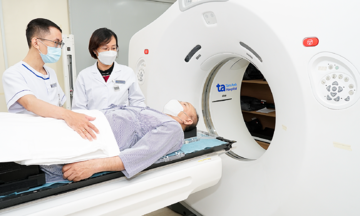
A CT scan shows Ms. Hoang had bilateral kidney stones and a right ureteral stone. *Photo: Tam Anh General Hospital* |
The patient's ureter was dilated, tortuous, abnormally kinked, and narrowed, making natural retrograde lithotripsy methods unsuitable. Doctor Truc and the team decided to perform retroperitoneal laparoscopic surgery to remove the stone. The doctor incised the ureter at the stone's location, removed the stone, and then sutured the ureter for recovery.
One month later, with stable kidney function, Ms. Hoang underwent flexible ureteroscopy to remove the kidney stones. Doctors used a laser to break the stones into tiny fragments, which were then removed, clearing stones from both kidneys in one session.
All stones were sent for composition analysis. Based on the results, doctors developed a suitable monitoring, care, and prevention regimen to avoid recurrence. According to Doctor Truc, about 50% of patients are at risk of stone recurrence within 5 years if risk factors are not well-controlled.
 |
Doctor Truc (right) and Doctor Doan Ngoc Thien performing laparoscopic stone removal surgery on Ms. Hoang. *Photo: Tam Anh General Hospital* |
Urinary stones form when concentrations of minerals like calcium, oxalate, and uric acid in urine increase and accumulate, crystallizing into stones. Stones typically originate in the kidneys and then descend into the ureters. Small stones may be asymptomatic and pass naturally. However, large stones are difficult to pass on their own and often cause urinary obstruction. Patients risk dangerous complications such as urinary tract infections, hydronephrosis, kidney function damage, and even acute or chronic renal failure.
Patients may experience symptoms such as dull or colicky pain in the lower back, painful urination, frequent urination, pink, red, or dark brown urine, cloudy urine with pus (if infected), accompanied by fever, chills, nausea, and vomiting. When these signs appear, patients should seek timely examination and treatment.
To prevent urinary stones, doctors recommend drinking enough water daily to dilute urine and limit stone formation. A healthy diet, reduced salt, limited animal protein and high-oxalate foods, and increased intake of green vegetables and fruits are advised. Avoid prolonged urine retention, as this concentrates urine, creating conditions for stone development. Regular physical activity, weight control, and effective treatment of underlying conditions like metabolic disorders, parathyroid disease, or urinary tract abnormalities are also important. Individuals with a history of urinary stones should have regular health check-ups to detect early recurrence and intervene promptly.
Ha Thanh
*Patient's name has been changed
| Readers can send questions about urological diseases here for doctors to answer. |