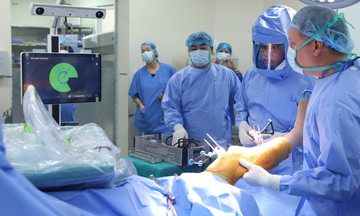
Medical training activities are currently managed by the Ministry of Health due to the unique nature of the profession. However, a revised draft of the Education Law, currently awaiting approval by the National Assembly, proposes separating "health specialty training" from the Ministry of Health and placing it under the Ministry of Education and Training. If the draft law is passed in early december, all health universities – except those affiliated with the military or police – would transfer to the Ministry of Education and Training for management, with the Minister of Education also approving health education programs.
"Specialty training has its own unique characteristics, closely linking lecture halls and practical experience in hospitals. If separated from the Ministry of Health, the quality of future doctors will certainly be affected," Deputy Minister of Health Nguyen Tri Thuc told VnExpress on 22/11.
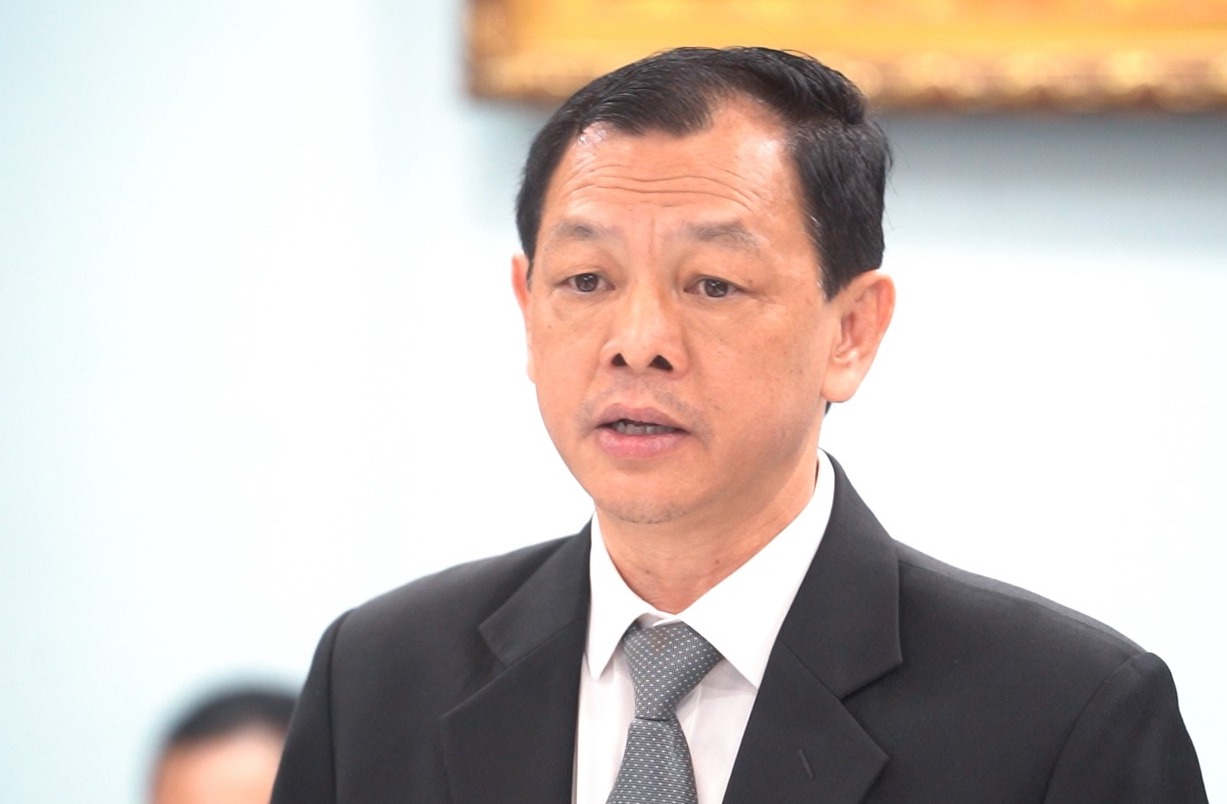 |
Associate Professor, Doctor, Nguyen Tri Thuc, Deputy Minister of Health. Photo: Hanh Nguyen |
Deputy Minister Thuc stated that downplaying the unique training model and equating resident doctors with ordinary vocational certificates, as suggested in the draft law, is a "fundamental misunderstanding of the medical profession." The relationship between medical universities and hospitals in Vietnam is currently likened to "lips and teeth," operating on a two-way personnel osmosis mechanism. University lecturers directly examine and treat patients in hospitals, while heads and deputy heads of hospital departments simultaneously serve as instructors. At Benh vien Cho Ray (a practical training facility for Dai hoc Y Duoc TP HCM) or Benh vien Bach Mai (a practical training facility for Dai hoc Y Ha Noi), administrative boundaries are almost blurred to serve the singular goal of treatment and training quality.
After graduating from university, doctors pursue one of two paths: a teaching path focused on master's and doctoral degrees, or a practical path with specialty one, specialty two, and residency. "Medical students must be involved with hospitals from their second year; the patient is the greatest teacher, not textbooks," he said, adding that specialty training globally is also linked to hospitals.
"Cutting the Ministry of Health's management role over specific content such as enrollment quotas, competency standards, and practical training facilities will disrupt this organic structure, pushing training into a state of 'dry learning,' far removed from clinical reality," the Deputy Minister of Health emphasized.
Citing international examples, he noted that advanced medical management models consistently adhere to a rigorous three-tiered structure to ensure patient safety. The first tier is the national policymaking body (Ministry of Health); the second is an independent accreditation organization (such as the Accreditation Council for Graduate Medical Education (ACGME) in the US, or the General Medical Council (GMC) in the UK); the third is the training institution integrated with a practical hospital. Data from the ACGME indicates that a resident doctor requires an average of three to seven years of continuous clinical practice under the supervision of the healthcare system before being able to practice independently. In the US, although universities grant degrees, residency training is influenced by the funding and standards of Medicare – the government health insurance program – to ensure that graduates meet national needs.
Based on this reality, the leadership of the Ministry of Health proposed that the revised draft Education Law add a provision designating the Ministry of Health as the lead agency responsible to the Government for managing specialty training. Specifically, the Ministry of Health would manage specialized aspects such as conditions for opening new programs, enrollment quotas, competency standards, and practical training facilities; while universities would still adhere to the general regulations of the Ministry of Education and Training.
Many medical education experts share similar views. Professor, Doctor, Nguyen Huu Tu, Rector of Dai hoc Y Ha Noi, believes that medical training is highly specialized and cannot be separated from the practical hospital system. Medical training can only function effectively when the lecture hall and the hospital are considered a unified entity in terms of content, training philosophy, and responsibility. He also cited Resolution 72 of the Politburo, which defines medical specialty training degrees as in-depth, specialized degrees falling under the management of the Ministry of Health. Therefore, "legalizing this to clarify responsibilities and authorities is essential," Professor Tu said.
According to Professor Tu, the specialty doctor one program shares 80% similarity with applied master's programs in terms of duration (around 67 credits) and the theory-practice structure. The main difference lies in the scientific research component; master's programs include additional research credits and a graduation thesis, while specialty one focuses more on clinical practice. Therefore, he believes that the specialty doctor one degree should continue to be managed by the Ministry of Health to ensure its specialized nature. If students later supplement with research modules and complete a thesis according to the master's standards of the Ministry of Education and Training, they would be recognized as equivalent to a Master's degree.
"This approach both preserves the unique nature of postgraduate medical specialty training and avoids conflict with the national qualifications framework," Professor Tu said, proposing that the two ministries should agree to issue regulations that benefit students, enable more suitable system management, and ensure the quality of the specialized medical workforce for the healthcare sector.
Another significant "bottleneck," identified by Professor, Doctor, Le Quang Cuong, Chairman of the Vietnam Association for Medical Education, is the lack of recognition for specialty degrees within the national qualifications framework. Although specialty doctors and residents are the "backbone" of the examination and treatment system, accumulating tens of thousands of practice hours, their degrees are not adequately recognized academically. This situation leads to a waste of intellectual capital, as many skilled clinical doctors pursue master's and doctoral degrees – which are research-oriented – merely to meet the requirements for civil servant promotion. Granting the Government the authority to specify and nationally recognize medical degrees is an urgent solution to standardize this elite workforce, laying the groundwork for international integration.
"The law should grant this authority to the Government, so that medical degrees have national standing," Mr. Cuong said, adding that this spirit was previously acknowledged in the revised Education Law of 2019.
Additionally, many experts express concern about the quality of health sector training at several private institutions. Currently, the Ministry of Education and Training decides on licensing private universities to open health-related programs and codes, while the system of private medical colleges, once under the authority of the Ministry of Labor, Invalids and Social Affairs, now lacks a clear responsible agency. Deputy Minister Thuc believes that if the licensing of health sector training is not handled by specialized medical agencies, it could lead to a "neglected" training system, inconsistent quality, and significant risks for the future workforce.
Previously, during a group discussion on 20/11 at the National Assembly session, Minister of Education and Training Nguyen Kim Son stated that health specialty training would be managed by the Ministry of Health, with the Ministry of Education not "taking on" this task. However, the draft law contains no provisions reflecting this.
Minister Son explained to the National Assembly that "the Ministry of Education only performs state management, while professional matters are managed by the Ministry of Health." Many delegates found this argument inconsistent, as state management of health is inherently a function of the Ministry of Health; transferring management to the Ministry of Education – an agency without medical expertise – while the Ministry of Health still retains professional oversight, is illogical and could create ambiguity in policy.
Le Phuong