Joint hypermobility describes joints with a greater range of motion than typical for a person's age, gender, and body characteristics. Individuals with this condition might perform actions like bending a thumb to touch the inner forearm or placing both palms on the floor when bending over without needing to flex their knees. However, performing a few such movements is not enough to confirm a diagnosis of generalized joint hypermobility.
Joint range of motion is influenced by factors such as connective tissue properties, bone structure, ligament and joint capsule tension, muscle tone, age, gender, and physical training. In people with joint hypermobility, ligaments and joint capsules may stretch more than usual, leading to increased joint mobility. Some individuals also experience reduced proprioception (the ability to sense joint position) or impaired motor control, which can make joints less stable under load. This instability can increase the risk of sprains, subluxations, dislocations, or soft tissue injuries, especially with incorrect or repetitive movements.
Flexibility is the ability to perform movements beyond normal limits. However, flexibility achieved through training primarily involves the adaptation of muscles, tendons, and the nervous system to specific movements. When performed with correct technique, gradually increasing intensity, and combined with strength training, this process can improve movement capability while maintaining joint stability. It is possible for an individual to have joint hypermobility and simultaneously improve their flexibility through exercise.
 |
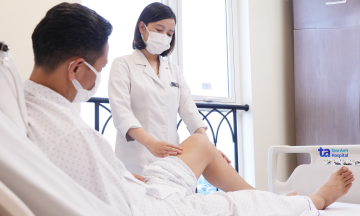
Doctor Thu assesses a patient's joint function. Photo: Tam Anh General Hospital |
Many people with joint hypermobility are completely healthy and experience no issues in daily life. Conversely, some cases involve persistent joint pain, recurrent dislocations, or impaired mobility. You should seek early medical evaluation if you notice warning signs, including:
Fatigue and dull pain when standing or walking for extended periods, as the body must recruit more muscle groups to stabilize loose joints.
Loud clicking sounds and a sensation of the joint almost dislocating during certain forceful or awkward movements, due to joint instability and poor balance.
Stiffness and pain in the knees, ankles, hips, shoulders, or spine after high-intensity physical activities. This pain can persist for several hours.
Dislocations can occur even with minor impacts or falls, often affecting highly mobile joints such as the shoulder, kneecap, fingers, and ankles. When this happens repeatedly, ligaments stretch further, and joints become more unstable, potentially leading to dislocations even when reaching for objects or turning suddenly.
Systemic issues such as autonomic nervous system dysfunction, dizziness, bloating, constipation, rapid heart rate, excessive sweating, thin skin, swollen and discolored hands and feet can also occur in people with joint hypermobility due to collagen's influence.
Simple joint hypermobility is not inherently dangerous. However, if accompanied by instability or recurrent injuries, individuals may experience chronic pain, reduced muscle strength, limited mobility, and damage to periarticular structures. In unstable or frequently injured joints, the risk of cartilage damage and secondary osteoarthritis can increase.
Treatment primarily targets symptomatic individuals. Physical therapy and individualized exercise programs help strengthen muscles around the joints, improve proprioception, balance, and motor control. Patients also need to learn to modify activities, avoid frequently "locking" joints at the end of their range of motion, and gradually increase exercise intensity. Attempting to further stretch already overly flexible joints can increase instability.
Braces or supportive devices are used only in specific cases and under the guidance of medical professionals. Surgery is rarely necessary, usually considered only for severe instability, recurrent dislocations, or structural damage unresponsive to conservative treatment.
Doctor Pham Thi Xuan Thu
Musculoskeletal and Rheumatology Department
Tam Anh General Hospital, Ho Chi Minh City
| Readers can submit questions about musculoskeletal conditions here for doctors to answer. |